The Hague School's Quiet Authority
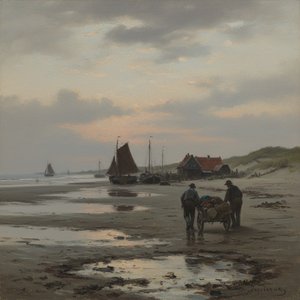
To look at the work of Julius Jacobus van de Sande Bakhuyzen is to see the precise moment Dutch landscape painting shifted its gaze from rigid tradition toward something more atmospheric and honest. He did not rely on grand, theatrical gestures. Instead, he mastered a loose, expressive style that captured the actual weight of the air in the Netherlands. His presence in the Hague School was defined by this ability to balance technical precision with a sense of spirit. He moved away from the meticulous, almost clinical approach of his predecessors to embrace a more tonalist sensibility.
His development was rooted in a specific lineage. Born in The Hague, he was trained by his father, Hendrikus van de Sande Bakhuyzen, a man whose style mirrored the 17th-century Dutch masters. This early education provided a foundation of rigorous draughtsmanship and observation. However, Julius sought more than just technical accuracy. He looked toward the emerging French influences of artists like Théodore Rousseau and Charles-François Daubigny. These painters worked directly from nature, using oils to capture immediate impressions. Bakhuysebyn adopted this outward focus, bringing a new, breathable quality to his landscapes.
Nature as a Technical Study
The geography of his work is as specific as his brushwork. While he spent significant time in Oosterbeek between 1840 and 1870, it was the landscape of Drenthe in north Holland that provided his most profound subject matter. In these works, the terrain is not merely a backdrop but a character. He utilized simple yet descriptive brushwork to render cattle, ponds, and the specific textures of the Dutch countryside. His technique allowed for a sense of tranquility that felt earned through careful observation rather than forced sentiment.
His studio life was equally grounded in the physical reality of art production. Sharing a workshop in his family home with his sister, Gerardina Jacoba van de Sande Bakhuyzen, he worked in an environment cluttered with the tools of the trade: sketches, engravings, and various studies. This proximity to constant creation shaped his output. His ability to interpret a view from both a technical and poetic standpoint allowed him to contribute significantly to the evolution of Dutch landscape painting during the late 19th century.
A Lasting Presence in the Canon
The merit of Bakhuyzen's work is confirmed by its placement in the most serious institutions. His paintings are not mere curiosities; they are permanent fixtures in collections that demand historical rigor, including:
He earned recognition through tangible achievements, such as receiving a gold medal following an 1866 exhibition in The Hague and the Royal Medal for his work 'Punctual in the Hague Forest'. He remained a steady, professional force in the national art scene until his death in 1925. His legacy is found in the way he bridged the gap between the old masters and the modern, tonalist approach to the natural world.
Spørgsmål og svar
I hvilken historisk periode arbejdede Julius van de Sande Bakhuyzen?
Julius van de Sande Bakhuyzen var aktiv i 19th Century-perioden. Denne periode placerer kunstnerens virke i en historisk kontekst.
Hvor mange kunstværker af Julius van de Sande Bakhuyzen er tilgængelige at gennemse?
Du kan gennemse 11 kunstværker værker af Julius van de Sande Bakhuyzen på siden Alle kunstværker.
Hvor kan jeg se alle værker af Julius van de Sande Bakhuyzen?
Se alle værker af Julius van de Sande Bakhuyzen på denne hjemmeside på kunstnerens Alle kunstværker-side.
Hvor kommer Julius van de Sande Bakhuyzen fra?
Julius van de Sande Bakhuyzen blev født i Netherlands.