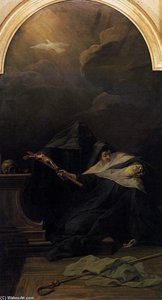
Portræt af Jean Ii Restout

De 31 mest berømte Jean Ii Restout-malerier, hver og en unik

Opdateret november 2026 · rangeret efter vores popularitetsscore (søgninger, besøg og ordrer for hvert værk) · 31 værker af Jean Ii Restout i vores katalog

Kort sagt

Pinsedag (1732) er det maleri af Jean Ii Restout, der vækker mest opsigt; originalen findes på Louvre, Paris. Derefter falder blikket på Ananias Laying Hands on Saint Paul (1719) og Venus Presenting Arms to Aeneas (1717). Blandt de 31 værker af Jean Ii Restout i vores katalog er disse 31 de mest berømte, hver især et unikt originalværk præsenteret med sit årstal, sit museum og årsagen til dets tidløse betydning.

1692 – 1768, Rouen Flest værker: Louvre

Top 10 malerier af Jean Ii Restout, set gennem galleriets øjne

1
Pinsedag (1732) af Jean Ii Restout

Pinsedag

1732 · Olie på lærred · Louvre, Paris

I den franske kunsthistories storslåede gobelin er der få værker, der indfanger krydsfeltet mellem guddommelig glød og teatralsk storhed så dybtgående som Jean II Restouts Pinsedag. Dette monumentale olie på lærred, færdiggjort i 1732, er langt mere end blot en illustration af bibelsk skrift; det er en omhyggeligt orkestreret spirituel oplevelse. Maleriet transporterer beskueren ind i hjertet af et helligt øjeblik, hvor Helligåndens nedstigning forvandler en forsamling af disciple til…

2
Ananias Laying Hands on Saint Paul (1719) af Jean Ii Restout

Ananias Laying Hands on Saint Paul

1719 · Oil On Canvas

Ananias Laying Hands on Saint Paul is a religious painting by Jean Restout created in 1719. The work depicts a specific moment from the New Testament regarding the Conversion of Saint Paul. The subject matter focuses on the restoration of sight to Paul the Apostle through divine intervention.

3
Venus Presenting Arms to Aeneas (1717) af Jean Ii Restout

Venus Presenting Arms to Aeneas

The scene unfolds in 1717, a moment where Venus Presenting Arms to Aeneas captures a pivotal exchange of strength and destiny. Jean Restout, the hand behind this composition, breathes life into the mythological encounter through a lens of late Baroque classicism. The figures exist in a state of heightened drama, caught in the very instant of preparation and purpose. Every line and shadow works to sustain the tension of this…

5
The Nymph Arethusa Pursued by Alpheus (1720) af Jean Ii Restout

The Nymph Arethusa Pursued by Alpheus

1720 · Oil · Musée Des Beaux, Tours

In Jean Restout's "The Nymph Arethusa Pursued by Alpheus," a sense of urgent, diagonal movement pulls the eye through a celestial struggle. The composition relies on an asymmetrical arrangement that heightens the tension of the chase. High above the viewer, two female figures cling to one another atop soft, billowing clouds. One nymph recoils in distress, her body twisting away from the pursuit, while the other reaches upward. Below them,…

6
Diana and Endymion (1724) af Jean Ii Restout

Diana and Endymion

1724 · Oil

The night is a heavy, velvet weight. In this oval window into the dark, a celestial glow breaks through the midnight blues and deep browns. Diana descends, a luminous presence carved from white drapery and pale skin. She leans toward the earth, toward the quiet stillness of a mortal man. Endymion lies in a deep, undisturbed slumber, his body a soft contour against the shadows. The air between them feels…

7
Christ Healing the Paralytic, also called The Pool of Bethesda (1725) af Jean Ii Restout

Christ Healing the Paralytic, also called The Pool of Bethesda

1725 · Oil

The air in the scene feels heavy with the scent of damp stone and expectation. At the center of this dramatic composition, a figure of light moves through the shadows. Christ stands as the axis of the work, his blue mantle cutting through a palette of ochre and deep sienna. Above, an angelic presence descends, casting an ethereal glow that pierces the atmospheric gloom. Below, the human condition is laid…

8
Le Baptème du Christ (1733) af Jean Ii Restout

Le Baptème du Christ

1733 · Oil · Musée Fabre, Montpellier

Le Baptème du Christ is an oil painting by the French artist Jean Restout. Created about 1733, this large-scale work depicts the biblical scene of the Baptism of Christ. The composition captures a specific moment of religious significance through a wide horizontal arrangement of figures set within a rugged landscape.

9
Alexander Gives His Mistress Campaspe to Apelles, or Painting (1737) af Jean Ii Restout

Alexander Gives His Mistress Campaspe to Apelles, or Painting

1737 · Oil On Canvas · Staatliche Kunsthalle Karlsruhe, Karlsruhe

We are looking at Alexander Gives His Mistress Campaspe to Apelles, or Painting, a work executed by Jean Restout. This piece dates to about 1737, a period when the artist was establishing his presence within the French academic tradition. The composition captures a specific moment of classical narrative, rendered with a sense of theatricality that defines much of Restout's output.

10
Alexander with Apelles, who gives him his mistress Campaspe (Painting) (1739) af Jean Ii Restout

Alexander with Apelles, who gives him his mistress Campaspe (Painting)

1739 · Oil On Canvas

Alexander with Apelles, who gives him his mistress Campaspe (Painting) by Jean Restout is organized around a central group of figures. A sense of movement flows from the left toward the right side of the canvas. The figures are layered across the foreground and the middle ground, which creates a sense of depth within the scene. This arrangement depicts Alexander the Great receiving Campaspe from the painter Apelles. Various onlookers,…

Jean Ii Restouts berømte malerier, nummer 11 til 31

Jean Ii Restouts berømte malerier, periode for periode

Motiverne, der fangede Jean Ii Restouts blik

De fire motiver, der optræder hyppigst i disse originaler, hver med sit fineste eksempel.

De museer, der udstiller Jean Ii Restouts originalværker

De 8 museer, der rummer flest af malerierne på denne side.

Museum By Værker af Jean Ii Restout Malerier fra denne liste
Louvre, ParisLouvre Paris 2 Pinsedag, Ananias Restoring the Sight of St Paul
Musée Des Beaux, ToursMusée Des Beaux Tours 2 The Nymph Arethusa Pursued by Alpheus, The Death of St Scholastica
Musée Fabre, MontpellierMusée Fabre Montpellier 2 Le Baptème du Christ, Baptism of Christ
National Gallery of Canada, OttawaNational Gallery of Canada Ottawa 1 Venus Presenting Arms to Aeneas
Los Angeles County Museum of Art, Los AngelesLos Angeles County Museum of Art Los Angeles 1 Venus Ordering Arms from Vulcan for Aeneas
Staatliche Kunsthalle Karlsruhe, KarlsruheStaatliche Kunsthalle Karlsruhe Karlsruhe 1 Alexander Gives His Mistress Campaspe to Apelles, or Painting
Palais des Beaux-Arts de Lille, LillePalais des Beaux-Arts de Lille Lille 1 The Pilgrims at Emmaus
Musée des Beaux-Arts de Caen, CaenMusée des Beaux-Arts de Caen Caen 1 Jesus Christ Washing the Feet of the Apostles

Jean Ii Restout gennem årtierne: ét unikt originalværk til hver

Værker per årti

Vælg et årti for at se det originale værk, der definerer det.

Jean Ii Restouts malerier: spørgsmål til galleriet

Hvad er det mest berømte værk af Jean Ii Restout?Vis svaret

Pinsedag (1732), Louvre, Paris. Derefter følger Ananias Laying Hands on Saint Paul (1719) og Venus Presenting Arms to Aeneas (1717).

Hvilken alder havde Jean Ii Restout, da Pinsedag blev skabt?Vis svaret

40 år gammel: Pinsedag er fra 1732, og Jean Ii Restout blev født i 1692.

Hvilke ti malerier af Jean Ii Restout er de mest berømte?Vis svaret

Pinsedag, Ananias Laying Hands on Saint Paul, Venus Presenting Arms to Aeneas, Venus Ordering Arms from Vulcan for Aeneas, The Nymph Arethusa Pursued by Alpheus, Diana and Endymion, Christ Healing the Paralytic, also called The Pool of Bethesda, Le Baptème du Christ, Alexander Gives His Mistress Campaspe to Apelles, or Painting og Alexander with Apelles, who gives him his mistress Campaspe (Painting). Ranglisten ovenfor viser det enkelte værks årstal og museum.

Hvor mange værker af Jean Ii Restout er kendt?Vis svaret

Vores katalog indeholder 31 værker af Jean Ii Restout, dateret fra 1717 til 1768.

Hvor kan de mest berømte originaler af Jean Ii Restout ses?Vis svaret

Primært i Louvre (Paris), Musée Des Beaux (Tours) og Musée Fabre (Montpellier). Museumslisten ovenfor viser dem alle.

I hvilken periode skabte Jean Ii Restout sine mest kendte malerier?Vis svaret

I 1730s: 8 af de 31 værker på denne side blev skabt dengang, herunder Pinsedag.

Hvilket berømt maleri af Jean Ii Restout er det tidligste, og hvilket er det seneste?Vis svaret

På denne side er det tidligste Venus Presenting Arms to Aeneas (1717) og det seneste Portrait of Abbé Tournus (1672-1733) (1768).

Hvilke motiver foretrak Jean Ii Restout?Vis svaret

Man (13), Drapery (13) og People (10), fordelt på de 31 værker på denne side.

Hvilke materialer brugte Jean Ii Restout mest til sine malerier?Vis svaret

Oil, for 13 af de 31 værker på denne side.

Hvilke originalværker af Jean Ii Restout kan jeg se på Louvre?Vis svaret

Pinsedag og Ananias Restoring the Sight of St Paul: Louvre, Paris har 2 af værkerne på denne side.

Jean Ii Restout: et portræt af kunstneren

Jean II Restout: Life and Legacy

Jean II Restout (1692 – 1768) was a French painter who distinguished himself through his late Baroque classicism, particularly in the realm of religious altarpieces. He stood as a notable figure resisting the prevailing Rococo style of his era.

Early Life and Family Background

Born in Rouen, France, in 1692, Jean II Restout came from an artistic family. His father was Jean I Restout, also a painter. Importantly, his mother, Marie M. Jouvenet, was the sister and pupil of the well-known painter Jean Jouvenet, who would become a significant influence on young Restout’s development.

Artistic Training and Early Career

In 1717, Restout achieved an early milestone by being elected to the Académie Royale de Peinture et de Sculpture based on his work for the prestigious Prix de Rome. However, unlike many recipients, he chose to remain in Paris rather than proceeding to Italy for further study. This decision allowed him to consistently exhibit at the Salons and steadily climb the ranks within the academic hierarchy.

Artistic Style and Major Works

Restout’s artistic style is characterized by a deliberate return to classical principles, even as Rococo flourished around him. His works are marked by their solemnity, dramatic composition, and meticulous detail. He excelled in large-scale altar pieces, ceilings, and designs for the Gobelin tapestries.

Influences and Artistic Development

Jean Jouvenet, his maternal uncle, was a crucial early influence on Restout’s artistic development. Jouvenet's emphasis on classical form and dramatic lighting profoundly shaped Restout’s approach to painting. Restout also studied the works of earlier masters, absorbing their techniques and principles.

Later Life and Legacy

Restout held various positions within the Académie throughout his career, demonstrating his standing in the artistic community. His son, Jean-Bernard Restout (1732–1797), also became a painter and won the Prix de Rome in 1758, though he later faced difficulties with the Academy due to disagreements over its rules.

Historical Significance

Jean II Restout occupies a unique position in French art history. While his work doesn’t possess the widespread fame of some of his contemporaries, his steadfast commitment to classical principles during the height of Rococo makes him a significant figure. He represents a resistance to fleeting trends and a dedication to enduring artistic values. His altarpieces remain important examples of late Baroque classicism in France.