A Life Anchored in the High Tatras
Jaroslav Votruba entered the world on 10th April 1889 in Praha-Uhříněves, beginning a life that would eventually find its permanent center among the peaks of the mountains. His early training took place at the School of Applied Arts in Prague between 1908 and 1912, where he studied under professors Schikaneder and Priesler. This formal education provided the foundation for a career that moved through various roles, from a teacher of drawing in Olomouc, Brno, and Prostějov to a resident of Bratislava. His travels were purposeful, including time spent in Bavaria in 1912 and brief stays in Leipzig and Vienna in 1914.
A work-related accident later changed the course of his daily existence, leaving him disabled and prompting a shift toward full-time painting and local organization. He moved between Bratislava and Starý Smokovec, finding a deep connection to the landscape. By 1936, he was spending much of his year in the High Tatras. He did not merely observe these mountains; he sought to document them with a specific, exhaustive focus, often working in series to capture the essence of a single theme.
The Painter of Mountain Beauties
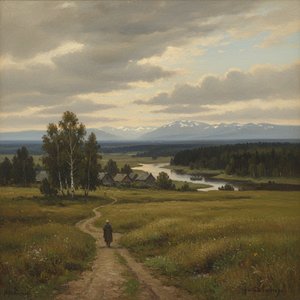
Votruba’s approach was shaped by an impressionist influence, utilizing techniques such as oil painting and tempera to translate the atmosphere of the Slovakian landscape. He was known for his dedication to the High Tatras, earning a reputation as a painter of their specific beauties. His work often focused on the following elements:
- The serene waters of locations like Šrbské pleso and Popradské pleso.
- The rugged terrain of peaks such as Lomnický štít and Kriváň.
- The seasonal shifts captured in works like Jeseň pod Vysokou or Vysoká na jar.
- Varied media including color woodcuts, charcoal on paper, and lithography.
His output was not limited to the canvas. He was a man of letters as well, publishing works such as Tatry Ocami Maliara in 1944 and Spring in the High Tatras in 1947, where his visual observations were paired with his own writing. This dual role allowed him to share his intimate knowledge of the terrain with a wider audience.
Cultural Ambitions and Final Years
Beyond the studio, Votruba possessed a drive to develop the cultural infrastructure of the region he loved. He worked toward the establishment of a gallery, a museum of traditional folk culture, and even a zoological and botanical garden within the Tatras. His efforts were directed at making the mountains a place of both natural study and cultural preservation.
He passed away on 21st July 1971 in Kežmarok. His final resting place is in Tatranská Javorina, situated among the very landscapes that defined his life's work. He left behind a body of work that remains tied to the geography of the High Tatras, ranging from small oil panels to large-scale tempera works on paper.
Spørgsmål og svar
Findes der en tidslinje over Jaroslav Votrubas værker?
Se kunstnerens Tidslinje for kunstværker for en kronologisk gennemgang af Jaroslav Votrubas værker, år for år.
Hvilke stemninger udtrykker Jaroslav Votrubas kunstværker?
Jaroslav Votrubas værker kan udforskes efter stemning på kunstnerens Stemningsfulde rum-side, hvor kunstværkerne er sorteret efter deres registrerede stemninger.
Hvor kommer Jaroslav Votruba fra?
Jaroslav Votruba blev født i Czech Republic.
Hvor kan man finde Jaroslav Votrubas værker grupperet efter kunstretning?
De kunstretninger, som Jaroslav Votruba arbejdede inden for, kan findes på kunstnerens Alle kunstretninger-side, hvor værkerne er grupperet efter kunstretning.