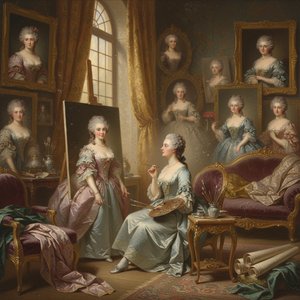
A Renaissance Soul in the Age of Louis XIV
In the vibrant, intellectual tapestry of seventeenth-century France, few figures shone with as much multifaceted brilliance as Élisabeth Sophie Chéron. Born in Paris on October 3, 1648, Chéron was far more than a mere painter; she was a true polymath, a woman whose intellect and creative spirit refused to be confined by the traditional boundaries of her era. Raised in an environment steeped in artistic discipline, she began her journey under the watchful eye of her father, an artist who introduced her to the delicate intricacies of enamelling and miniature painting during her childhood. This early training instilled in her a precision and a mastery of detail that would later define her celebrated portraiture.
Her life was a fascinating study in cultural and spiritual synthesis. While her father, a rigid Calvinist, sought to guide her toward his own faith, the influence of her fervent Roman Catholic mother led her through a transformative year in a convent. This period of religious devotion not only shaped her personal convictions but also infused her later literary and artistic works with a profound spiritual depth. As she matured, Chéron emerged as a formidable force in the Parisian art scene, navigating the complex social and intellectual circles of the Grand Siècle with grace and unparalleled erudition.
Mastery of the Brush and the Pen
Chéron’s ascent within the prestigious Académie Royale de Peinture et de Sculpture remains one of the most remarkable achievements of her career. In 1670, at the young age of twenty-two, she was admitted to the Academy as a portrait painter, bolstered by the influential sponsorship of the legendary Charles Le Brun. She was only the fourth woman to achieve such an honor, standing alongside pioneers like Catherine Girardon. Her reception piece, a striking 1672 self-portrait, served as a definitive statement of her technical prowess and her command over the medium, capturing both her physical likeness and her formidable intellectual presence.
However, to speak only of her canvases would be to overlook the vast breadth of her genius. Chéron was a woman of letters as much as a woman of color. Her literary talents were recognized across Europe; she was fluent in Hebrew, Greek, and Latin, and her poetic voice resonated through her published works, such as her 1694 book of Psalm paraphrases. This linguistic mastery even earned her a place in the Accademia dei Ricovrati in Padua, where she was celebrated under the classical pseudonym Erato. Whether she was translating complex texts, composing music, or painting the likenesses of the French elite, Chéron approached every medium with a singular, rigorous devotion to excellence.
Legacy of an Intellectual Icon
The historical significance of Élisabeth Sophie Chéron lies in her ability to transcend the limitations imposed upon women of her time. In an age where female artists were often relegated to minor genres, she commanded the Salon and participated in the highest levels of academic discourse. Her life was a testament to the power of interdisciplinary mastery, proving that the boundaries between painting, poetry, and music are fluid and interconnected.
Even her personal life reflected a certain unconventional strength. Though she moved within circles of brilliant men and faced numerous marriage proposals from the era's most distinguished intellectuals, she remained largely indifferent to such domesticties for much of her life, focusing instead on her scholarly and artistic pursuits. It was not until 1708, at the age of sixty, that she married Jacques Le Hay, a union that surprised many of her contemporaries. When she passed away on September 3, 1711, she left behind a legacy that continues to inspire admiration—a legacy of a woman who did not merely exist within the history of French art, but actively helped to shape its very soul.
Spørgsmål og svar
Hvordan er Élisabeth Sophie Chérons karriere opdelt i perioder?
Élisabeth Sophie Chérons karriere udfolder sig periode for periode på kunstnerens Kronologi-side: en horisontal tidslinje over værkerne, opdelt i kapitler efter karriereperioder.
Kan jeg udforske Élisabeth Sophie Chérons værker efter farvespektrum?
Farveindeks for Élisabeth Sophie Chéron er en side, der organiserer kunstnerens værker efter farve.
Hvor kan man finde Élisabeth Sophie Chérons værker opdelt efter emne?
Siden Emneoversigt kortlægger Élisabeth Sophie Chérons kunstværker efter motiv.
Hvor kan jeg se Élisabeth Sophie Chérons værker i kronologisk rækkefølge?
Se en tidslinje over Élisabeth Sophie Chérons værker på siden Tidslinje for kunstværker, hvor kunstværkerne er sorteret efter dato.