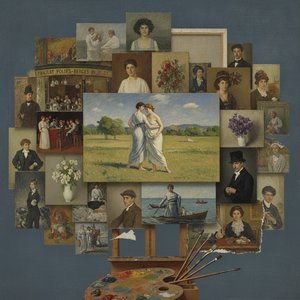
The Formative Years in Beharovce
The story begins in Beharovce, Liptov, where Elena Lazinovská enters the world on December 31, 1902. Her early years are spent away from the familiar landscapes of her birth, moving to Budapest to live with grandparents. It is here, amidst the quiet rhythms of a childhood in a different city, that her first inclinations toward visual expression emerge. She attends a folk school, a foundational step before her path leads toward formal academic training.
The trajectory shifts toward the technical and the disciplined. She moves into the sphere of professional study, first at the Academy of Fine Arts in Dresden and later at the Slovak University of Technology in Bratislava. In the studios of Bratislava, she works under the guidance of teachers such as Mallý, Milly, Sokol, and Mudroch. This period of rigorous instruction shapes her ability to navigate various mediums, from the delicate precision of watercolor to the heavy texture of oil on hardboard.
A Diverse Visual Language
Her output is characterized by a refusal to be confined to a single mode of expression. She moves between the intimate and the expansive, her hand finding its way through several distinct disciplines:
- Portraiture: Capturing the human presence, including works like Partizánka Jana, which functions as a contemporary self-portrait.
- Landscapes: Translating the topography of the region into color and form, seen in works like Landscape from Arles and Krajina.
- Graphic Arts: Utilizing linocut to create structured, rhythmic compositions such as Malá Fatra a Oravská úžina.
- Watercolor and Pastel: Exploring lighter, more ephemeral textures in works like Rozhovor and Žltá kytica.
The weight of her work often reflects the tension of her era. In 1976, her recognition reaches an international peak when she wins the Grand Prix at the 4th Grand Prix International d'Art Contemporain in Lyon. This achievement highlights a technical maturity that allows her to command attention on a European stage.
The Later Landscape
As her career progresses into the late 1970s, her connection to the Slovak landscape remains a constant. She documents the world through a lens that is both observational and deeply personal. Whether she is painting the ruggedness of Špania dolina or the light of a Journey to Podbanské, the environment is never merely a backdrop; it is the subject itself. Her work is held in significant collections, including the Liptov Gallery of Peter Michal Bohúň and the Tatra Gallery in Poprad.
She remains active in her craft well into her later years, continuing to produce work that maintains its visual integrity. Elena Lazinovská passes away on September 25, 2000, in Pressburg, leaving behind a body of work that spans the complexities of the 20th century through the varied textures of paint, ink, and paper.
Spørgsmål og svar
Kan jeg gennemse Elena Lazinovskás værker efter farvepalette?
Se Elena Lazinovskás værker sorteret efter farvepalette på kunstnerens Efter farvepalet side.
Hvilke kunstværker af Elena Lazinovská har flest visninger?
Siden Statistik for Elena Lazinovská præsenterer statistikker beregnet ud fra kunstnerens værker, som er listet på denne hjemmeside.
Kan jeg gennemse Elena Lazinovskás værker efter stemning?
Stemningsfulde rum for Elena Lazinovská er en side, hvor kunstnerens værker er organiseret efter stemning.
Hvordan er Elena Lazinovskás karriere opdelt i perioder?
Elena Lazinovskás karriere udfolder sig periode for periode på kunstnerens Kronologi-side: en horisontal tidslinje over værkerne, opdelt i kapitler efter karriereperioder.