The Ancestry of Assemblage: From Classical Mosaics to the Modern Pixel
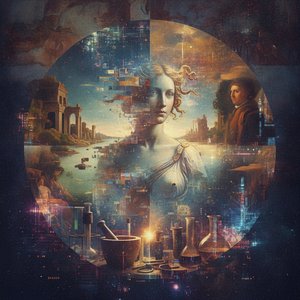 The Alchemy of Layers: How Digital Collage Reimagines the Soul of Artistic Tradition
The Ancestry of Assemblage: From Matisse’s Cut-Outs to the Digital Canvas To understand the profound magic of the digital collage, one must first wander through the sun-drenched studios of the past, where the very concept of assemblage began to breat...
To understand the profound magic of the digital collage, one must first wander through the sun-drenched studios and sacred halls of the past, where the very concept of assemblage began to breathe. The impulse to create a new whole from disparate fragments is not a modern whim but an ancient human instinct. Long before the advent of the pixel, the foundations of layering were laid in the 10th-century Japanese calligraphic traditions, where poets applied glued paper to surfaces to weave text and image into a singular poetic experience. As we move through history, we witness the evolution of this tactile hunger: from the shimmering gold leaf panels of Gothic cathedrals that sought to capture divine light, to the 18th-century botanical "flower Mosaicks" of Mary Delany, whose meticulous paper compositions prefigured the complexity of modern layering.
The early 20th century marked a dramatic renaissance for this technique. The term Papier collé, famously coined by Georges Braque and Pablo Picasso, signaled a departure from the singular perspective of the Renaissance toward a fragmented, multi-layered reality. This era introduced the idea that art could be an assembly of found forms—magazine clippings, newspapers, and ribbons—recontextualized to challenge the viewer's perception. Even in the auditory realm, the concept of musique concrète mirrored this visual revolution, as composers began "gluing" together sound objects to create entirely new sonic landscapes. Today, we recognize that the modern digital pixel is but a distant, luminous descendant of those torn pieces of paper and vibrant fabrics used by the masters.
The Digital Layer: Reimagably Depth, Texture, and Composition through Technology
 Mastering Digital Collage: An Expert Guide to Layering Art, Texture, and Imagination
The Foundations of Digital Layering: Understanding Composition and Depth To embark on the journey of digital collage is to step into a realm where the boundaries between reality and imagination dissolve through the strategic application of depth. For...
In the contemporary digital workspace, the boundaries between reality and imagination dissolve through the strategic application of depth. For the discerning eye, digital layering serves as an architectural blueprint, allowing an artist to orchestrate a visual hierarchy that guides the viewer through a curated, multidimensional experience. Unlike the physical limitations of traditional collage, where the thickness of paper might dictate the composition, the digital medium allows for infinite levels of opacity and scale. An artist can now juxtapose a microscopic, hyper-detailed texture against the vastness of a celestial nebula, creating an atmospheric perspective that feels both physically grounded and impossibly ethereal.
The true mastery of this medium lies in the subtle manipulation of light and shadow across these digital planes. By carefully managing the interplay between overlapping layers, a creator can evoke profound psychological complexity, much like the experimental works of the mid-20th century that used fragmented imagery to explore the human condition. This structural depth mimics the physical world yet transcends it, offering a window into a universe where every edge and shadow tells a story of connection or isolation. It is through this meticulous curation of visual assets—from found historical imagery to custom-rendered digital elements—that the artist builds a cohesive tonal range, ensuring that the final masterpiece possesses a soul that resonates far beyond the screen.
Glitch and Grace: How Contemporary Artists Remix History into New Narratives
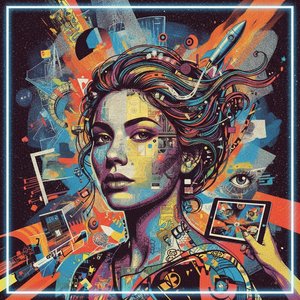 Digital Collage Unleashed: How to Remix Reality into High-Impact Pop Art
The Glitch Pop Revolution: Why Digital Collage is the New Streetwear for Your Walls Ethereal Fractures of a Dissolving Horizon in Crimson and Digital Light A Vision of Digital Chaos and Organic Grace Experience the breathtaking intensity of Ethereal ...
We are currently living in an era defined by a high-octane, digital pulse, where the visual landscape is often characterized by a "glitch" aesthetic—the beautiful, intentional error that disrupts the status quo. This movement, often referred to as Glitch Pop, captures the frantic energy of our hyper-connected lives, where the boundary between the physical and the virtual has effectively dissolved. In this realm, artists do not merely place images on a canvas; they remix reality itself. They take the static, silent halls of traditional galleries and infuse them with a kinetic motion that feels as immediate and impactful as a viral moment.
This aesthetic rebellion allows for a fascinating dialogue between the old and the new. Consider the work of contemporary visionaries who utilize digital tools to fragment classical motifs, creating a sense of "ethereal fractures" within a composition. By introducing digital chaos—distorted perspectives, chromatic aberrations, and fragmented figures—artists like Cai Ruibary can transport viewers to dreamlike, surreal landscapes that feel simultaneously familiar and utterly alien. This process of deconstructing the past to build a contemporary identity allows for a profound reimagining of history, where the "glitch" becomes a tool for grace, turning information overload into a structured, high-impact masterpiece.
The Alchemy of Hybridity: Merging Traditional Aesthetics with Algorithmic Precision
 jakub jernajczyk
A Digital Visionary: The Emergence of Jakub Jernajczyk Jakub Jernajczyk, a contemporary artist hailing from Poland, represents a fascinating intersection of traditional artistic principles and the boundless possibilities of digital media. While biogr...
To step into the world of modern mixed media is to embrace the beautiful, often unpredictable, dialogue between disparate materials and methods. The essence of hybridity lies in the intentional collision of the organic and the algorithmic. We see this in the emergence of artists like Jakub Jernajczyk, whose work represents a fascinating intersection of traditional artistic principles and the boundless possibilities of code. In pieces such as Integer Squares, technology is not merely a tool but the very substance of the art, harnessed to explore mathematical harmony and complex themes with a precision that only digital means can achieve.
This alchemy extends to the way artists blend the tactile weight of traditional painting with the limitless scale of digital design. The contemporary landscape thrives on this tension—the ability to use digital tools to simulate the heavy, impasto brushstrokes of Van Gogh or the light-drenched atmosphere of Monet. This hybridity allows for an expansion of the visual vocabulary, where the ruggedness of a digital texture can carry as much emotional weight as a delicate wash of watercolor. It is a celebration of the "afterlife" of art, where historical archetypes are reborn through new media, creating works that possess both the gravity of tradition and the innovation of the future.
Preserving the Infinite Canvas: The Future of Art History in a Digital Age
As we move further into a digital-first existence, the role of art history becomes even more vital. We are no longer just observers of a static past; we are active participants in its continuous reconstruction. The digital collage serves as a bridge, ensuring that the legacies of the Old Masters are not lost to time but are instead integrated into the very fabric of our modern visual culture. This evolution allows for a democratization of art, where the most iconic works—from the Mona Lisa to The Last Supper—can be reimagined, studied, and brought into the contemporary home in ways previously unimaginable.
At OriginalUniqueArt.com, we stand at this very intersection of history and technology. Our mission is to preserve human creativity by making the world's most significant masterpieces accessible to all. Whether through our professional digital mockup services that allow you to see a historical "remix" on your own wall, or our exquisite handmade oil reproductions that capture the true tactile depth of the original masters, we celebrate the enduring power of art. From transforming personal milestones into classical portraits to providing large-scale murals that recreate the grandeur of the Sistine Chapel, we invite you to join us in this ongoing journey of artistic preservation and innovation.