
 Se i rummet
 Del som kort
 Del
Del
 Detaljer
 Guide
Guide

 Download
 Lignende værker
 Røntgenundersøgelse
 Diasshow
 Spørgsmål og svar
 Statistikker
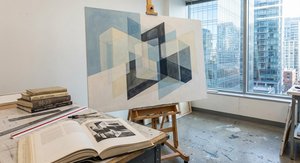
Black and White Structure

- 158.0 x 222.0 cm


 Vis mere
Kunstværket vist på denne side er beskyttet af ophavsretsloven, hvilket betyder, at vi ikke lovligt kan skabe eller sælge en identisk reproduktion. Denne beskyttelse håndhæves i henhold til internationale aftaler som f.eks. den Bernerkonventionen og af nationale love, herunder de bestemmelser, der er fastlagt i Amerikansk ophavsretslov - Titel 17.
Denne metode overholder fuldt ud ophavsretsreglerne, da den ikke indebærer kopiering eller duplikering af det beskyttede kunstværk. I stedet er der tale om en kreativ nytolkning – et nyt maleri, som er inspireret af det oprindelige, men ikke identisk med det.
Giclée / Kunsttryk
Giclée- eller lærredstryk i museumskvalitet med hurtig produktion og fleksible muligheder for finish. ( Køb håndmalet maleri Skift til digitalt billede)




































Vælg mellem vores forudindstillede størrelser, der matcher kunstværkets originale proportioner.

Indtast den bredde og højde, du har brug for, så det passer til din ramme eller din væg. Et print kan kun beskæres, aldrig gøres større end selve billedet, så en størrelse med et andet format vil medføre, at dele af motivet går tabt. Vi sender dig en digital mockup til godkendelse, før vi printer noget. Billedet vist på denne side viser ikke den faktiske beskæring — det er kun mockuppen, der gør.
Verdensomspændende levering () på 2 uger i stedet for de sædvanlige 4/5 uger. (8 november)

Gratis ekspresforsendelse til hele verden

Lærred af linned i høj kvalitet

Fuld transportforsikring

Garanti for refusion af told og importafgifter

Garanti for præcis farvegengivelse

100 dages returret ved fabrikationsfejl

100% fuld returret

Mængderabat ved flere køb
 Glasmulighed er kun tilgængelig i størrelser under 110 cm

Black and White Structure
Giclée / Kunsttryk
Størrelse på reproduktion
-


Samlet pris
Dkr 540
Spørgsmål og svar
I hvilket år og inden for hvilken stilart blev "Black and White Structure" skabt?
"Black and White Structure" blev skabt i 1965 som en del af Geometric Abstraction-bevægelsen.
Hvilken kunstretning tilhører "Black and White Structure" af Zdeněk Sýkora?
Kunstretningen forbundet med "Black and White Structure" af Zdeněk Sýkora er Geometric Abstraction. Denne klassificering placerer værket blandt relaterede kunstnere og kunstværker.
I hvilket år blev "Black and White Structure" af Zdeněk Sýkora skabt?
"Black and White Structure" af Zdeněk Sýkora blev skabt i 1965.
Kunstnerbiografi
The Architect of Lines: The Life and Legacy of Zdeněk Sýkora
In the vast landscape of twentieth-century modernism, few figures command as much intellectual curiosity as Zdeněk Sýkora. Born in 1920 in Louny, Czechoslovakia, Sýkora’s journey was one of profound transformation, moving from the tangible beauty of the natural world to the mathematical precision of the digital frontier. His early years were marked by a traditional approach to the canvas, where his late 1940s works captured the essence of landscapes through a more representational lens. However, as the political and cultural tides of Central Europe shifted, so too did Sýkora’s vision. He began to shed the weight of the physical world, gravitating instead toward the rigorous, cerebral beauty of geometric abstraction.
The evolution of his style was not merely a personal choice but a response to the burgeoning technological era. Influenced by the structural complexities of Cubism and the dreamlike logic of Surrealism, Sýkora sought a way to bridge the gap between human intuition and algorithmic precision. By the 1960s, he emerged as a true pioneer, becoming one of the first artists to integrate computer technology into the creative process. This was a revolutionary leap; through the use of computers, he could manipulate geometric structures with a level of complexity that surpassed the capabilities of the human hand alone. His work began to pulse with a new kind of energy, where mathematical logic met artistic spontaneity.
A Symphony of Geometry and Chance
As his career progressed, Sýkora’s aesthetic underwent another mesmerizing metamorphosis. The rigid, strict systems of his early geometric structures gradually gave way to a more fluid, rhythmic language. He developed a signature style characterized by intricate line paintings, where vibrant streaks of color traversed expansive canvases in seemingly random yet deeply calculated directions. This period of his work felt less like a mathematical proof and more like a visual symphony, capturing the tension between order and chaos. His membership in the Křižovatka (Crossroad) group further solidified his place within the vanguard of Czech modernism, as he explored the intersections of different artistic movements.
This creative spirit was often a collaborative one. In 1985, Sýkora began a profound artistic partnership with his wife, Lenka Sýkora. Together, they expanded the boundaries of abstraction, applying their shared vision to large-scale architectural projects. Their work moved beyond the confines of the gallery wall and into the very fabric of the built environment, such as the striking flight operation building in Jeneč near Prague. This integration of fine art and architecture allowed Sýlam’s geometric explorations to inhabit three-dimensional space, influencing how viewers interact with modern structures.
Recognition and Eternal Influence
Despite the challenges posed by the Soviet occupation and the resulting limitations on international exhibition opportunities, Sýkora’s brilliance could not be contained. His resilience led to a global recognition that honored his immense contributions to the evolution of abstract art. The prestige of his career is reflected in the numerous accolades he received, including:
- The Vladimír Boudnik Award (2008)
- L'Ordre des Arts et des Lettres from France
- The Herbert-Boeckl-Preis from Austria
Today, the legacy of Zdeněk Sýkora lives on in the permanent collections of the world’s most esteemed institutions. From the Centre Georges Pompidou in Paris to the MUMOK in Vienna, his works serve as a testament to the power of innovation. He remains a monumental figure for anyone studying the intersection of technology and fine art, reminding us that even within the strictest mathematical lines, there is room for the infinite soul of creativity.

Zdeněk Sýkora
1920 - 2011 , Czech Republic
Kort om kunstneren
- Full Name: Zdeněk Sýkora
- Nationality: Czech
- Date Of Birth: 1920
- Date Of Death: 2011
- Place Of Birth: Louny, Czech Republic
- Notable Artworks:
- Black & White Structure
- Lines No 24
- Artistic Movement Or Style: Geometric abstraction
- Artists Who Influenced This Artist:
- Cubism
- Surrealism
- Artists Or Movements Influenced By This Artist:
- Op Art
- Křižovatka group
Relaterede artikler
Beyond Form & Color: Geometric Abstraction's Enduring Legacy in Art History
Explore the captivating world of geometric abstraction! Discover its origins, key artists like Malevich & Mondrian, and why this movement remains highly valued by art collectors today. Expert insights at OriginalUniqueArt.

Beyond Form & Color: Geometric Abstraction's Evolution in 20th/21st Century Art
Explore the evolution of geometric abstraction from Cubism to contemporary art. Discover key artists like Malevich & Mondrian, investment insights, and expert collecting advice at OriginalUniqueArt.

Kandinskys 25 Mesterværker: En Rejse Ind i Abstrakt Kunst | OriginalUniqueArt.com
Oplev Kandinskys 25 mest ikoniske værker! Dyk ned i abstrakt kunst, ekspressionisme og farvernes sprog. Find luksus reproduktioner af berømte malerier som 'Komposition VIII' på OriginalUniqueArt.com – inspiration til din vægkunst & indretning.

Geometrisk Abstraktion: Top 10 Kunstværker der Definerede Bevægelsen | OriginalUniqueArt.dk
Oplev de 10 mest ikoniske værker inden for geometrisk abstraktion! Fra Kandinsky til Mondrian – lær historierne bag disse banebrydende kunstnere og deres farverige malerier. Find museumskvalitets reproduktioner & inspiration til din indretning på OriginalUniqueArt.dk.

Neo-Abstract Art: The High-Impact Evolution of Modern Visual Energy and Geometric Sophistication
Discover the power of Neo-Abstract art. Explore how bold geometric forms and high-impact visual energy are redefining modern design. Learn to curate sophisticated, high-energy spaces with the latest trends in contemporary abstraction and structural color.