Skift til printsalg
 Vis mere







































 For kunstværker eller reproduktioner, der er større end 105 cm (ca. 41 tommer) på en hvilken som helst side, vil rammen blive leveret som et adskilt sæt. Denne metode sikrer sikker levering og forhindrer skader under transport.


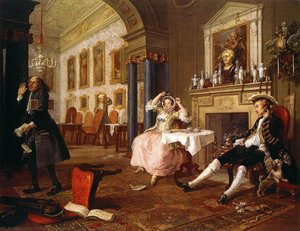
The Countess's Morning Levee: A Satirical Snapshot of Georgian Society
William Hogarth’s “The Countess’s Morning Levee,” completed around 1745, stands as a cornerstone of Rococo art and a masterful distillation of Enlightenment observation. More than just a depiction of an aristocratic gathering, it's a meticulously crafted commentary on social mores and anxieties prevalent in Georgian England—a subject that continues to fascinate historians and artists alike.
- Subject Matter: The painting portrays a lavish bedroom scene featuring a countess surrounded by twelve individuals representing various professions and social strata. Notably, a dog occupies a prominent position near the bottom right corner, adding an element of domesticity to this otherwise formal setting.
- Style & Technique: Hogarth’s approach aligns perfectly with Rococo aesthetics—characterized by delicate ornamentation and pastel hues—yet he employs a distinctly unflinching realism. The artist utilizes oil paint on canvas, applying brushstrokes with precision to capture subtle nuances of expression and gesture. This technique ensures that every detail contributes to the overall narrative and moralizing intent.
- Historical Context: Created during a period marked by burgeoning social ambition and anxieties surrounding propriety, “The Countess’s Morning Levee” reflects Hogarth's broader engagement with societal critique. The painting satirizes the obsession with appearances and the hypocrisy inherent in upholding social conventions—a theme that resonates powerfully even today.
- Symbolism & Narrative: Beyond its visual beauty, the artwork is laden with symbolic significance. The arrangement of figures—the dog, the servants, the musicians—represents various facets of aristocratic life. Furthermore, Hogarth subtly mocks the prevailing custom of “toilette,” highlighting the perceived vulgarity of displaying one’s wealth and status in such an intimate space.
- Emotional Impact: Viewing "The Countess's Morning Levee" evokes a sense of unease mingled with amusement. Hogarth compels us to confront uncomfortable truths about human behavior and social expectations, prompting contemplation on the complexities of morality and decorum. Its enduring appeal lies in its ability to capture both the grandeur and the folly of aristocratic society—a timeless reminder of art’s capacity for social commentary.
Currently housed at The Fitzwilliam Museum in Cambridge, United Kingdom, this masterpiece exemplifies Hogarth's dedication to documenting his era with unflinching honesty and artistic brilliance.
Spørgsmål og svar
Hvilken reproduktionsstørrelse anbefales til "The Countess's Morning Levee" af William Hogarth?
Den anbefalede trykstørrelse til "The Countess's Morning Levee" af William Hogarth er Stor format.
Hvor kan jeg finde kunstværker, der ligner "The Countess's Morning Levee" af William Hogarth?
Siden Lignende værker for "The Countess's Morning Levee" af William Hogarth præsenterer relaterede kunstværker.
Er "The Countess's Morning Levee" et berømt værk inden for Classicism?
Inden for Classicism-bevægelsen har "The Countess's Morning Levee" et Ikonisk popularitetsniveau.
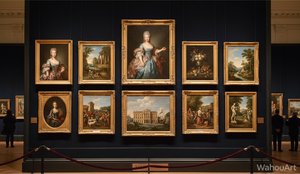
 Se i rummet
 Del som kort
 Del
Del
 Detaljer
 Guide
Guide

 Download
 Lignende værker
 Røntgenundersøgelse
 Diasshow
 Q&A
Q&A Statistikker