Abstract Expressionism · 1939
Seated Man (Willem De Kooning, 1939)
Willem De Kooning (1904–1997) har skabt Seated Man. Det er fra 1939. Det tilhører Abstract Expressionism-bevægelsen. Den er udført i Oil On Canvas. Målene er 97 × 87 cm.
- 1939
- Oil On Canvas
- 97 × 87 cm

 Se i rummet

 Håndmalet oliemalerie
 Del som kort
 Del
 Faktablad


 Download
 Lignende værker
 Røntgenundersøgelse
 Diasshow
 Spørgsmål og svar

 Statistikker
Seated Man kort fortalt
- Titel
- Seated Man
- Kunstner
- Willem De Kooning (1904–1997)
- Kunstner født i
- Rotterdam, Holland
- Dato
- 1939
- Materiale
- Oil On Canvas
- Dimensioner
- 97 × 87 cm
- Bevægelse
- Abstract Expressionism
- Periode
- Early Medieval
- Motiv
- seated man, figure, chair, dining, baldness, yellow shirt
Hvad forestiller Seated Man?
A Moment Frozen in Time: Willem de Kooning’s ‘Seated Man’
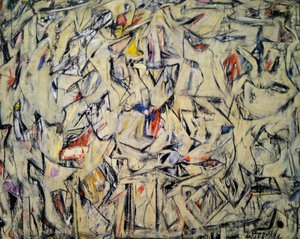
Willem de Kooning's “Seated Man,” painted in 1939, isn’t merely a depiction of a man at rest; it’s a potent distillation of the artist’s evolving approach to capturing human emotion and experience. This oil on canvas, measuring a modest yet significant 97 x 87 cm, currently resides within the Hirshhorn Museum and Sculpture Garden in Washington D.C., offering viewers an intimate glimpse into the mind of a pivotal figure in the New York School of art. De Kooning’s work during this period represents a fascinating crossroads – a deliberate exploration of realism interwoven with the burgeoning abstraction that would define his legacy, creating a dynamic tension within each piece.
The painting immediately draws the eye to its central subject: a man seated in a chair, his posture relaxed yet imbued with an underlying sense of contemplation. His arms are crossed, suggesting both vulnerability and self-possession. The deliberate use of color – primarily yellows and browns – contributes significantly to the work’s mood. The bright yellow shirt contrasts sharply with the darker tones of the figure's clothing and the chair, creating a visual rhythm that guides the viewer’s gaze across the canvas. Notably, de Kooning eschews a completely smooth finish; visible brushstrokes are prominent, adding texture and immediacy to the scene – a characteristic hallmark of his style.
Composition and the Dialogue Between Form and Space
The composition itself is carefully constructed to establish a clear dialogue between form and space. The man occupies the left side of the frame, anchoring the viewer’s attention while simultaneously allowing the right half of the canvas to be dominated by a dining table. This arrangement isn't arbitrary; it subtly suggests a domestic scene, a moment of quiet contemplation or perhaps even a shared meal. Two bowls are placed on the table, one closer to the center and the other slightly further away – a detail that invites speculation about their contents and the context of the gathering. A bottle is positioned in the upper left corner, adding another layer of visual interest and subtly directing the eye upwards.
The placement of these objects isn’t simply decorative; it contributes to the painting's overall sense of ambiguity. Is this a portrait of an individual lost in thought? Or does it represent a broader commentary on human interaction and the rituals of daily life? De Kooning deliberately avoids providing easy answers, leaving the interpretation open to the viewer’s own sensibility.
De Kooning’s Early Abstraction and the Human Condition
“Seated Man” is deeply rooted in de Kooning's early experimentation with abstract expressionism. While retaining elements of realism – particularly in the depiction of the man’s face and posture – the painting demonstrates a willingness to distort and fragment forms, anticipating the more radical gestures that would characterize his later work. This exploration of the human figure, often rendered with a sense of unease or even violence, reflects de Kooning's broader engagement with themes of identity, alienation, and the complexities of modern life. His work during this period was profoundly influenced by artists like Jackson Pollock and Franz Kline, whose techniques he absorbed and adapted to his own unique vision.
A Legacy in Modern Art
“Seated Man” stands as a significant testament to de Kooning’s contribution to the development of abstract expressionism. It exemplifies his ability to balance realism with abstraction, capturing not only the outward appearance of a subject but also its underlying emotional state. The painting's blend of observation and invention makes it a compelling study for art enthusiasts and scholars alike, offering insights into the artist’s creative process and his place within the broader context of 20th-century art. Reproductions of this powerful work offer a tangible connection to a pivotal moment in artistic history, allowing viewers to experience de Kooning's vision firsthand.
Højopløselige billeder af Seated Man

Beskyttet af ophavsret: disse filer er til personlig reference og udgør ikke en licens til genudgivelse.
Willem De Kooning, Seated Man (1939).
Spørgsmål om Seated Man besvaret
I hvilket år blev "Seated Man" af Willem De Kooning skabt?
"Seated Man" af Willem De Kooning er dateret til 1939.
Hvilket medie er "Seated Man" af Willem De Kooning udført i?
"Seated Man" af Willem De Kooning er udført i Oil On Canvas. Reproduktionerne har til formål at gengive denne tekniks visuelle udtryk.
Hvad er målene på det originale "Seated Man" af Willem De Kooning?
De registrerede mål for "Seated Man" af Willem De Kooning er 97 x 87 cm. Reproduktioner kan bestilles i andre størrelser, mens de samme proportioner bevares.
Hvad forestiller "Seated Man" af Willem De Kooning?
Motiverne i "Seated Man" er seated man, figure, chair, dining, baldness, yellow shirt, abstraction, casual.
Er "Seated Man" fri for ophavsret?
Ophavsretsstatus for "Seated Man" af Willem De Kooning: værket er stadig beskyttet af ophavsret. Dette afgør, om der frit må foretages reproduktioner af billedet.
Hvilken kunstner tilskrives "Seated Man"?
"Seated Man" tilskrives Willem De Kooning.
Hvilken kunstretning tilhører "Seated Man" af Willem De Kooning?
Kunstretningen forbundet med "Seated Man" af Willem De Kooning er Abstract Expressionism. Denne klassificering placerer værket blandt relaterede kunstnere og kunstværker.
Hvilken fase af Willem De Koonings kunstneriske udvikling repræsenterer "Seated Man"?
Inden for Willem De Koonings karriere tilhører "Seated Man" perioden Early Abstract, hvilket gør det muligt at sammenligne værket med kunstnerens øvrige værker.
Hvor gammel var Willem De Kooning, da vedkommende skabte "Seated Man"?
Da "Seated Man" blev skabt i 1939, var Willem De Kooning – født i 1904 – 35 år gammel.
Om kunstneren, Willem De Kooning

1904–1997, Holland
Willem De Kooning
Willem De Koonings liv Rotterdam, 1904. Luften i Nederlandene bærer på tyngden af en familie i opbrud. Willem De Kooning træder ind i verden den 24. april, født af Leendert de Kooning og Cornelia Nobel.
Om Willem De Kooning Bemærkelsesværdige værker af Willem De Kooning
Også af Willem De Kooning
 Willem de Kooning1952
 Parc rosenberg,1957, privat
 Udgravning1950
 Døren til Floden1960
Essays om Seated Man
 Willem de Kooning: Abstraction, Gesture & the Evolution of Post-War American PaintingExplore the evolution of Willem de Kooning's iconic Abstract Expressionist paintings. Discover his signature style, key themes & investment…
 Hollandsk Barok: Top 10 Mesterværker der Definerede en Æra – Kunst til Dit HjemOplev Hollandsk Barok's 10 mest ikoniske værker! Rembrandt, Vermeer & co. – dyk ned i historien bag mesterværkerne og find inspiration til …
 Art for Every Course: Designing Dining Spaces with Visual Rhythm and Masterpiece CurationElevate your restaurant's narrative with expert art curation. Discover how to use visual rhythm, masterwork reproductions, and immersive sc…