Contemporary Realism · 1935
Miners (Walker Evans, 1935)
Walker Evans (1903–1975) har skabt Miners. Det er fra 1935. Det tilhører Contemporary Realism-bevægelsen. Den er udført i Gelatin Silver Print. Det opbevares på J. Paul Getty Museum i Los Angeles, USA. Målene er 7 × 17 cm.
- 1935
- Gelatin Silver Print
- 7 × 17 cm
- J. Paul Getty Museum, Los Angeles

 Håndmalet oliemalerie
 Del som kort
 Del
 Faktablad


 Download
 Lignende værker
 Diasshow
 Spørgsmål og svar

 Statistikker
Miners kort fortalt
- Titel
- Miners
- Kunstner
- Walker Evans (1903–1975)
- Kunstner født i
- St. Louis, USA
- Dato
- 1935
- Medium
- Gelatin Silver Print
- Dimensioner
- 7 × 17 cm
- Hvor det kan ses
- J. Paul Getty Museum, Los Angeles, USA
- Bevægelse
- Contemporary Realism
- Motiv
- rural america, depression era, photography, houses, clothing line, poverty
Hvad forestiller Miners?
Miners' Houses, Vicinity Birmingham, Alabama – A Snapshot of Resilience
Walker Evans’s photograph “Miners’ Houses, Vicinity Birmingham, Alabama,” created in 1935 during his tenure documenting rural poverty for the Farm Security Administration (FSA), stands as a poignant testament to the human spirit amidst the hardships of the Great Depression. Captured with meticulous detail and bathed in muted grayscale tones, it transcends mere documentation; instead, it embodies an understated beauty rooted in the quiet dignity of everyday life—a stark contrast to the grand narratives often dominating historical portrayals. Evans’s lens focuses on a modest dwelling nestled amongst surrounding houses, revealing a scene that speaks volumes about the resilience of ordinary Americans facing immense economic challenges. The photograph isn't merely visually arresting; it’s imbued with symbolic significance, representing not just physical hardship but also the enduring spirit of community and perseverance.- Subject Matter: The image depicts a cluster of houses in Birmingham, Alabama—primarily occupied by coal miners—providing insight into the living conditions experienced during this period.
- Style: Evans’s approach aligns with his signature style – Photorealism – prioritizing accuracy and capturing the essence of the subject matter without embellishment. He eschewed artistic interpretation for a truthful representation of reality.
- Technique: Executed as a gelatin silver print, Evans utilized a technique known for its tonal range and ability to convey subtle nuances in light and shadow. This meticulous process ensured that every detail was faithfully reproduced, contributing to the photograph’s profound impact.
- Birmingham’s Industry: Before the 20th century, Birmingham was primarily known for its iron ore smelting and textile production—industries that provided employment opportunities but also subjected workers to hazardous conditions.
- The FSA Mission: The Farm Security Administration's goal was to combat poverty through photography – documenting rural America’s hardships while simultaneously promoting social reform. Evans’s work exemplifies this commitment, presenting a truthful portrayal of daily life during the Depression.
- Minimalist Aesthetic: Evans’s approach paved the way for Minimalist art—characterized by simplicity, geometric forms, and an absence of ornamentation—reflecting a broader cultural shift toward austerity and intellectual contemplation.
- Photorealism's Roots: His commitment to capturing reality with unflinching honesty solidified Photorealism as a dominant artistic movement in the mid-20th century—a style that sought to reproduce images with astonishing precision, mirroring the visual world around us.
Hvilket museum udstiller Miners?
J. Paul Getty Museum
Los Angeles, USA
Oprindelse og museets historie J. Paul Getty Museum er et amerikansk kunstmuseum beliggende i Los Angeles, Californien. Dets fundament er rodfæstet i overbevisningen om, at verdens kunstneriske kulturarv bør være frit tilgængelig for alle.


Højopløselige billeder af Miners

Protected by copyright: these files are for personal reference, not a licence to republish.
Walker Evans, Miners (1935), J. Paul Getty Museum.
Spørgsmål om Miners besvaret
Hvor kan jeg se det originale værk "Miners" af Walker Evans?
Du kan se det originale værk "Miners" på J. Paul Getty Museum, Los Angeles, USA.
Hvornår er "Miners" af Walker Evans skabt?
"Miners" af Walker Evans er dateret til 1935.
Hvilken teknik er brugt til "Miners" af Walker Evans?
"Miners" er udført i Gelatin Silver Print.
Hvad er målene på det originale værk "Miners"?
Det originale værk "Miners" af Walker Evans måler 7 x 17 cm.
Hvad forestiller "Miners"?
Temaerne i "Miners" af Walker Evans omfatter rural america, depression era, photography, houses, clothing line, poverty, alabama, som tilsammen udgør værkets motivverden.
Er "Miners" fri for ophavsret?
Ophavsretsstatus for "Miners" af Walker Evans: værket er stadig beskyttet af ophavsret. Dette afgør, om der frit må foretages reproduktioner af billedet.
Hvem er kunstneren bag "Miners"?
Kunstneren bag "Miners" er Walker Evans. Værket er katalogiseret under Walker Evanss navn.
Hvilken kunstretning tilhører "Miners" af Walker Evans?
Kunstretningen forbundet med "Miners" af Walker Evans er Contemporary Realism. Denne klassificering placerer værket blandt relaterede kunstnere og kunstværker.
Hvilken fase af Walker Evanss kunstneriske udvikling repræsenterer "Miners"?
"Miners" tilhører Great Depression i Walker Evanss karriere. Denne klassificering knytter værket til kunstnerens udvikling.
Om kunstneren, Walker Evans

1903–1975, USA
Walker Evans
Walker Evans: En Amerikansk Fotografs Stille Stemme Walker Evans, født i St. Louis i 1903, blev en afgørende figur i amerikansk fotografi – hans navn er uadskilleligt forbundet med det visuelle billede af Depressionstiden. Men at definere ham udelukkende ud fra denne periode ville være at overse bredden af hans kunstneriske vision og hans varige indflydelse. Hans liv var en konstant udforskning, der udviklede sig fra litterære ambitioner til en unikt observerende fotografisk stil, der ikke blot gengav *hvad* Amerika var, men også *hvordan* det føltes – dets rolige værdighed, dets barske realiteter og dets ofte oversete skønhed.
Også af Walker Evans
 Roadside Stand, vicinity Birmingham, Alabama1971
 Let Us Now Praise Famous Men1936
 Havana Citizen / Citizen in Downtown Havana1933
 Silverware1936
Essays om Miners
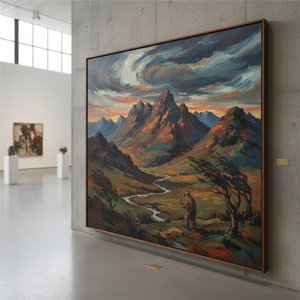 Evan Walters: A Study in Contemporary Landscape Painting & Emotional ResonanceExplore the captivating world of Evan Walters, a Welsh artist renowned for his evocative landscapes & social commentary. Discover his Impre…
 Dokumentarfotografiets Mestre: Top 10 Værker der Ændrede Kunsten – OriginalUniqueArt.dkOplev de 10 mest indflydelsesrige værker inden for dokumentarfotografiet. Lær historierne bag ikoniske billeder og kendte fotografer. Find …
 Romantic Realism's Finest: 10 Masterpieces for Your Home | OriginalUniqueArtExplore 10 defining masterpieces of Romantic Realism! Discover Courbet, Millet & Daumier's powerful paintings—capturing emotion and social …