

 Se i fuld skala
 Del
Del Del
Del
 Detaljer

 Download
 Lignende værker
 Røntgenundersøgelse
 Diasshow
Lamentation
 86.0 x 71.0 cm
 Museum Mayer van den Bergh
 Se mere
Køb et højopløst, forbedret digitalt billede, der er langt bedre end online-forhåndsvisningen.
Hver fil er omhyggeligt forberedt af vores interne specialister ved hjælp af avancerede værktøjer og ekspertmæssig manuel retuschering. Vi sikrer, at hvert billede har enestående klarhed, præcis farvegengivelse og fine detaljer.
Den endelige fil leveres via e-mail inden for 72 timer og er optimeret til øjeblikkelig brug i professionelle, redaktionelle og trykte miljøer. Det er den samme kvalitet, som førende designstudier, forlag og gallerier har tillid til.
Digitalt billede
Download en højopløselig fil til personlig fremvisning, print og kreative projekter. ( Køb print Køb håndlavet maleri)
Inkluderet i alle ordrer på digitale billeder
Ekspert digital levering, garanteret
Når du vælger OriginalUniqueArt.com, får du ikke blot et billede – du modtager et professionelt optimeret digitalt kunstværk, skabt med præcision og sikret med en tilfredshedsgaranti. Her er alt, hvad din ordre automatisk indeholder:

Hurtig levering via e-mail
Din højkvalitets digitale billedfil vil blive sendt til din e-mail inden for 72 timer efter bestilling – klar til øjeblikkelig brug.

AI-optimeret digital fil
Dit kunstværk optimeres professionelt ved hjælp af avancerede AI-værktøjer og manuel redigering, hvilket sikrer maksimal detaljegrad, klarhed og farvenøjagtighed.

Gratis livslang genlevering
Har du ved en fejl slettet eller mistet din fil? Ingen bekymring – vi sender den igen til enhver tid, helt gratis.

Ingen importgebyrer – nogensinde
Nyd dit kunstværk med det samme uden told, afgifter eller leveringsgebyrer – digitale downloads er altid skattefrie.

Garanteret farvenøjagtighed
Vi sikrer, at dit digitale billede gengiver de originale farver så præcist som muligt ved hjælp af professionelle værktøjer og farvestyring.

60 dages tilfredshedsgaranti
Hvis du ikke er tilfreds med dit digitale billede, vil vi revidere det eller refundere 100% inden for 60 dage – uden spørgsmål.

100% Pengene tilbage-garanti
Ik tilfreds? Få fuld refusion inden for 60 dage efter modtagelse af din digitale fil – uden spørgsmål.

Mængderabat
Køb 3 billeder, spar 10% - Køb 5, spar 15% - Køb 10+, spar 20%. Ideelt til kreative projekter, gallerier og bureauer.
Kunstnerens biografi
The Gentle Heir of Netherlandish Grandeur
In the golden, luminous era of Early Netherlandish painting, few names resonate with as much quiet dignity as Vrancke van der Stockt. While history often casts a brilliant, sometimes blinding light upon his mentor, the legendary Rogier van der Weyden, Van der Stockt emerged not merely as a shadow, but as a vital successor who carried the torch of Flemish emotional depth into a new generation. Born in Leuven before 1420, his life was woven into the very fabric of the Burgundian Netherlands, a period defined by unparalleled technical mastery and a profound spiritual intensity that sought to bridge the gap between the earthly and the divine.
Van der Stockt’s artistic journey began within the disciplined walls of his father’s workshop. Under the tutelage of Jan van der Stockt, he mastered the meticulous craftsmanship required by the era's high standards, learning to manipulate oil pigments to capture the subtle textures of velvet, the cold glint of metal, and the soft glow of skin. This foundational training provided him with the technical vocabulary that would later allow him to serve as a direct heir and popularizer of the Weyden style. His association with Rogier van der Weyden was perhaps the most defining chapter of his career; as an assistant and collaborator, he absorbed the master's ability to sculpt human grief and spiritual ecstasy onto wooden panels, yet he began to infuse these lessons with a uniquely restrained elegance.
A Legacy of Devotion and Civic Grace
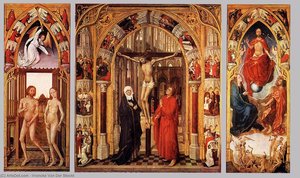
As his career matured, Van der Stockt’s work became characterized by a certain gentle sensitivity. Where Weyden might employ dramatic, sweeping gestures to convey agony, Van der Stockt often favored a more poised and graceful aesthetic. This is nowhere more evident than in his celebrated Triptych of the Redemption. In this monumental work, one finds a breathtaking narrative journey that guides the viewer through the sacred cycle of Christ's sacrifice. He possessed a miraculous ability to ground cosmic theological events in the recognizable human experience, populating his divine landscapes with tiny, meticulously rendered figures engaged in quiet, everyday activities—a technique that makes the sacred feel tangibly present and intimately reachable.
Beyond the confines of his studio, Van der Stockt was a man of significant civic importance. His life was marked by a profound engagement with the community of Leuven and Brussels, reflecting the high social standing of successful master painters in the 15th century. His achievements extended far beyond the easel:
- Mastery of the Guild: In 1445, he achieved the prestigious status of master within the Brussels Guild of St. Luke, a testament to his technical skill and professional standing.
- Civic Leadership: He served with distinction on the Leuven Town Council during several terms, including 1465, 1472, and 1475, demonstrating his influence in the political life of the city.
- Religious Stewardship: His leadership as the head of the Confraternity of St. Eloy between 1471 and 1473 highlighted his deep integration into the religious and social structures of his time.
- Official Recognition: Following the death of Rogier van der Weyden in 1464, Van der Stockt ascended to the position of the official painter of Leuven, a role that solidified his reputation as a premier artist of the region.
The Enduring Echo of a Master
Though the passage of centuries has left certain gaps in our biographical knowledge—a frustrating lacuna for modern art historians—the stylistic fingerprints of Vrancke van der Stockt remain indelible. His ability to balance the monumental with the minute, and the dramatic with the serene, ensures his place in the pantheon of the Northern Renaissance. He did not seek to eclipse the giants upon whose shoulders he stood; instead, he sought to refine their vision, offering a more tempered, graceful window into the soul of the late medieval world. Today, when we gaze upon his Lamentation or the intricate panels of his triptychs, we do not merely see a follower of Weyden, but a master in his own right, whose gentle hand helped define the very heartbeat of Netherlandish art.
vrancke van der stockt
1420 - 1495
Kort om kunstneren
- Artistic Movement Or Style: Early Netherlandish Painting
- Artists Or Movements Influenced By This Artist: ['Rogier van der Weyden']
- Artists Who Influenced This Artist: ['Rogier van der Weyden']
- Date Of Death: 14 June 1495
- Full Name: Vrancke van der Stockt
- Nationality: Dutch
- Notable Artworks:
- Triptych of the Redemption
- Lamentation
- Pietà
- Place Of Birth: Brussels, Belgium

