Skift til printsalg
 Vis mere







































 For kunstværker eller reproduktioner, der er større end 105 cm (ca. 41 tommer) på en hvilken som helst side, vil rammen blive leveret som et adskilt sæt. Denne metode sikrer sikker levering og forhindrer skader under transport.


Victor Vasarely: A Pioneer of Geometric Abstraction
Victor Vasarely (1906-1997) stands as one of the most influential figures in Op Art—a movement that revolutionized visual perception during the mid-20th century. Born Károly Vaszary in Pécs, Croatia, his artistic journey began unexpectedly with aspirations for a medical career at Eötvös Loránd University in Budapest. However, fate intervened when he discovered an irresistible passion for painting, enrolling at Sándor Bortnyik’s Műhely academy in 1927—a school deeply rooted in the Bauhaus principles of functional design and geometric abstraction. This formative experience irrevocably shaped his artistic vision, propelling him away from representational art toward a radical exploration of form and color relationships.- Early Influences: Vasarely’s initial explorations mirrored those of fellow artists like Piet Mondrian and Kazimir Malevich—masters who championed pure abstraction as a path to spiritual enlightenment. Yet, he refused to simply emulate their stylistic choices; instead, he sought to transcend established conventions and forge his own distinctive aesthetic.
- The Bauhaus Connection: Műhely’s influence was profound, instilling in Vasarely the importance of systematic methodology and mathematical precision. These principles would become central to his approach—a deliberate rejection of intuition in favor of logical reasoning.
- Birth of Op Art: By the late 1920s, Vasarely began experimenting with techniques that would define Op Art—manipulating shapes and colors to generate illusions of movement and depth. This groundbreaking endeavor challenged viewers’ sensory experience and questioned their understanding of reality itself.
Koska-Rev: A Symphony of Geometric Forms
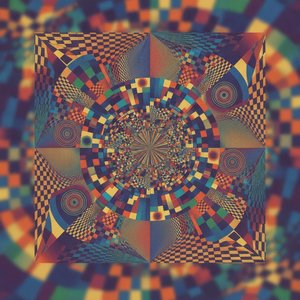
“Koska-Rev,” created in 1972, exemplifies Vasarely's signature Op Art style—a mesmerizing interplay of red squares punctuated by yellow dots arranged in a cruciform pattern. The artwork’s composition consists of four interconnected squares, each imbued with distinct hues that contribute to the overall visual effect. This deliberate use of color is not merely decorative; it serves as a conduit for conveying complex ideas about perception and spatial illusion.- Technique: Vasarely employed heliogravure—a printing process known for its exceptional tonal accuracy and ability to reproduce subtle nuances of color—to faithfully capture the essence of his vision.
- Mathematical Precision: The grid system underpinning Koska-Rev underscores Vasarely’s commitment to mathematical principles as a tool for artistic exploration. Each element is carefully positioned according to precise calculations, ensuring that the resulting image achieves its intended optical impact.
- Symbolism & Illusion: While seemingly simple in appearance, Koska-Rev embodies profound symbolic significance—representing the harmonious balance between opposing forces and inviting viewers to contemplate the elusive nature of visual experience.
Legacy and Influence
Victor Vasarely’s contribution to modern art extends far beyond his individual masterpieces. He championed reproducibility as a means of democratizing artistic appreciation, believing that “originals don't count for more than their reproductions.” His unwavering conviction in this principle solidified Op Art’s place at the forefront of visual culture—inspiring generations of artists and designers alike. Today, Vasarely’s geometric abstractions continue to captivate audiences worldwide, demonstrating the enduring power of pure form and color to provoke thought and stimulate imagination. Explore a high-quality reproduction of Koska-Rev on OriginalUniqueArt.com!Spørgsmål og svar
Findes der et faktablad om "KOSKA-STRI" af Victor Vasarely til studerende?
Der er en Elevguide-side tilgængelig for "KOSKA-STRI" af Victor Vasarely: et printbart faktablad om kunstværket, designet til elever og undervisningsbrug.
Hvad er den overordnede stemning i "KOSKA-STRI" af Victor Vasarely?
"KOSKA-STRI" har en Minimalist atmosfære.
Hvad forestiller "KOSKA-STRI" af Victor Vasarely?
Temaerne i "KOSKA-STRI" af Victor Vasarely omfatter geometric abstraction, optical illusion, color vibration, mathematical patterns, visual perception, kinetic art, retro futurism, som tilsammen udgør værkets motivverden.
 Se i rummet
 Del som kort
 Del
Del
 Detaljer
 Guide
Guide

 Download
 Lignende værker
 Røntgenundersøgelse
 Diasshow
 Spørgsmål og svar
 Statistikker