Skift til printsalg
 Vis mere







































 For kunstværker eller reproduktioner, der er større end 105 cm (ca. 41 tommer) på en hvilken som helst side, vil rammen blive leveret som et adskilt sæt. Denne metode sikrer sikker levering og forhindrer skader under transport.


Thomas Gainsborough: A Pioneer of British Landscape Painting
The Suffolk countryside holds a profound significance in the artistic legacy of Thomas Gainsborough (1727 – 1788), arguably Britain’s most celebrated painter of the Georgian era. Born into a family involved in wool trading, young Gainsborough defied convention by prioritizing artistic pursuits over the family business, recognizing and nurturing an extraordinary talent that would propel him to international acclaim.
His formative years were spent absorbing the beauty of Suffolk's rolling hills and meadows – landscapes that would become central to his oeuvre. Unlike many artists of his time who favored idealized depictions, Gainsborough approached nature with a remarkable honesty and immediacy, capturing fleeting moments of light and atmosphere with effortless grace.
Style and Technique: Lightness and Impressionistic Foreshadowing
Gainsborough’s distinctive style is characterized by a luminous palette dominated by pastel hues – greens, blues, yellows – that evoke the serenity and vibrancy of the English countryside. He employed loose brushstrokes and subtle gradations of color to create an illusion of depth and movement, anticipating the Impressionistic techniques that would emerge decades later.
His meticulous attention to detail is balanced by a willingness to forgo precise rendering in favor of capturing the essence of his subjects. This approach resulted in paintings imbued with a palpable sense of spontaneity and emotion – qualities that resonate powerfully with viewers even today.
Elizabeth Wrottesly: Symbolism Within Pastoral Beauty
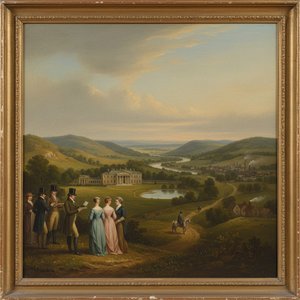
Considered Gainsborough’s masterpiece, “Elizabeth Wrottesly” exemplifies his masterful blend of landscape and portraiture. The painting depicts Elizabeth Wrottesly, a young woman known for her beauty and grace, posed amidst a meticulously rendered pastoral scene. The verdant foliage and dappled sunlight serve as a backdrop to Wrottesly's figure, symbolizing fertility and renewal.
The inclusion of a feather – delicately positioned in Wrottesly’s hand – adds another layer of symbolic meaning. Feathers have long been associated with aspiration and nobility, reflecting Wrottesly’s elevated social standing and embodying the artist’s desire to elevate his subject beyond mere physical appearance.
Historical Context: Establishing the Landscape School
Gainsborough's work emerged during a period of significant artistic innovation in Britain. He spearheaded the establishment of the Royal Academy in 1769, marking a pivotal moment in British art history and fostering a collaborative environment for artists to experiment with new ideas.
His influence extended far beyond his own lifetime, inspiring generations of painters who embraced his pioneering approach to landscape painting. Gainsborough’s legacy continues to endure as a testament to the transformative power of observation and artistic vision – qualities that remain eternally relevant in our contemporary world.
Spørgsmål og svar
Hvordan kan jeg se en forhåndsvisning af en reproduktion af "Elizabeth Wrottesly" af Thomas Gainsborough?
Siden Forhåndsvisning for "Elizabeth Wrottesly" giver dig mulighed for at se en forhåndsvisning af kunstværket, før du bestiller.
Er farverne i "Elizabeth Wrottesly" af Thomas Gainsborough mættede eller dæmpede?
Farverne i "Elizabeth Wrottesly" af Thomas Gainsborough har en Balanced Soft mætning. Mætning beskriver, hvor livlige eller dæmpede farverne er.
Hvad er den dominerende farve i "Elizabeth Wrottesly" af Thomas Gainsborough?
Den farve, der træder tydeligst frem i "Elizabeth Wrottesly", er Phthalo Green (#201c07). Den dominerende farve er nyttig, når man skal matche et kunstværk med en indretning.
 Se i rummet
 Del som kort
 Del
Del
 Detaljer
 Guide
Guide

 Download
 Lignende værker
 Røntgenundersøgelse
 Diasshow
 Q&A
Q&A Statistikker