American Realism · 1898
Salutat (Thomas Eakins, 1898)
Thomas Eakins (1844–1916) har skabt Salutat. Det er fra 1898. Det tilhører American Realism-bevægelsen. Den er udført i Oil On Canvas. Det opbevares på Addison Gallery of American Art i Massachusetts, USA.
- 1898
- Oil On Canvas
- Addison Gallery of American Art, Massachusetts

 Se i rummet

 Håndmalet oliemalerie
 Del som kort
 Del
 Faktablad


 Download
 Lignende værker
 Røntgenundersøgelse
 Diasshow
 Spørgsmål og svar

 Statistikker
Salutat kort fortalt
- Titel
- Salutat
- Kunstner
- Thomas Eakins (1844–1916)
- Kunstner født i
- Philadelphia, USA
- Dato
- 1898
- Medium
- Oil On Canvas
- Hvor det kan ses
- Addison Gallery of American Art, Massachusetts, USA
- Bevægelse
- American Realism
- Motiv
- human figure, performance art, monochromatic palette, psychological depth, american painting, realism technique
Hvad forestiller Salutat?
A Portrait of Vulnerability: Exploring Thomas Eakins’ Salutat
- Subject Matter The painting “Salutat,” created in 1898 by American artist Thomas Eakins, depicts a solitary man standing amidst a crowd. Strikingly nude from the waist up, he presents his back to the audience, embodying an arresting stillness that contrasts sharply with the bustling activity surrounding him.
- Style and Technique Eakins’ masterful use of oil on canvas exemplifies realism—a hallmark of his oeuvre. The monochromatic palette—primarily shades of gray—intensifies the emotional impact, focusing attention squarely on the central figure's posture and expression. Precise brushstrokes contribute to a textured surface that conveys both physicality and psychological depth.
- Historical Context Produced during the late Victorian era, “Salutat” reflects the artistic currents of its time, prioritizing observation and anatomical accuracy over idealized representations. Eakins’ fascination with scientific illustration—evident in his meticulous rendering of musculature—mirrors a broader trend toward documenting the human form with unprecedented detail.
- Symbolism The man's posture – turned away from scrutiny – speaks to themes of introspection and vulnerability. The bucket held aloft symbolizes perhaps an act of defiance or performance, adding layers of narrative complexity to the composition. It invites contemplation on notions of exposure and self-presentation within a social context.
- Emotional Impact “Salutat” transcends mere visual depiction; it evokes feelings of quiet contemplation and subtle unease. The painting’s stark simplicity underscores the profound psychological portraiture characteristic of Eakins's work, prompting viewers to consider questions of identity and perception.
The Artist: Thomas Eakins – A Pioneer of Realism
Thomas Cowperthwait Eakins (1844-1916), born in Philadelphia, stands as a cornerstone of American art history. Unlike many artists of his era preoccupied with grand narratives or romantic ideals, Eakins relentlessly pursued the depiction of everyday life—the world of doctors, rowers, and hunters—with an unwavering commitment to anatomical precision and psychological insight.
His formative years instilled in him a profound appreciation for observation and scientific inquiry. This dedication would propel him to become one of the most influential realist painters of the late nineteenth century, challenging conventions and establishing a new standard for artistic representation. Eakins’s Philadelphia was not a city of picturesque vistas; it was a crucible of intellectual ferment—a place where he honed his skills and developed his distinctive vision.
Exploring Eakins's Method: Anatomical Precision and Monochromatic Palette
Eakins’ artistic approach stemmed from a deep understanding of human anatomy. He meticulously studied musculature, striving to capture the subtle nuances of posture and movement—a practice that would inform his paintings with remarkable accuracy. This scientific rigor extended beyond mere anatomical representation; it served as a springboard for exploring psychological states.
Furthermore, Eakins favored a monochromatic palette—primarily shades of gray—to heighten emotional resonance. By eliminating color, he focused the viewer’s gaze on form and texture, emphasizing the expressive qualities of light and shadow. This technique underscores his belief that visual art could convey profound truths about human experience.
Beyond Representation: The Psychological Depth of Salutat
"Salutat" isn't simply a portrait; it’s an invitation to delve into the complexities of human consciousness. Eakins skillfully captures the vulnerability inherent in solitude—the man’s averted gaze conveying a sense of introspection and confronting unspoken anxieties.
The painting’s deliberate simplicity amplifies its impact, prompting viewers to consider questions of identity and perception. Like Elizabeth at the Piano and Portrait of Professor Henry A. Rowland – also available on OriginalUniqueArt.com – “Salutat” exemplifies Eakins's unwavering dedication to portraying the human condition with unflinching honesty.
Hvilket museum udstiller Salutat?
Addison Gallery of American Art
Massachusetts, USA
Et fyrtårn for amerikansk vision: En udforskning af Addison Gallery Gemt væk på den historiske campus ved Phillips Academy i Andover, Massachusetts, står Addison Gallery of American Art som meget mere end blot et depot for malerier og skulpturer; det er et levende vidnesbyrd om den udviklende ånd og den vedvarende kraft i den kunstneriske udfoldelse i USA. Siden grundlæggelsen i 1931 med en vision om at dyrke kritisk tænkning og æstetisk sans, er Addison er blomstret op til et dynamisk centrum for læring, dialog og inspiration – et rum, der er frit tilgængeligt for alle, som søger forbindelse til Amerikas rige kreative arv. Dets historie er fortællingen om bevidste anskaffelser, gennemtænkt ekspansion og en urokkelig forpligtelse til at fremvise bredden og dybden i amerikansk kunst, fra dens koloniale rødder til de nutidige bevægelses pulserende energi.


Højopløselige billeder af Salutat

Public domain: kunstneren døde i 1916.
Andre størrelser, beskæringer og kildehenvisning →Thomas Eakins, Salutat (1898), Addison Gallery of American Art. Public domain
Spørgsmål om Salutat besvaret
Hvor kan jeg se det originale værk "Salutat" af Thomas Eakins?
Originalen af "Salutat" af Thomas Eakins opbevares på Addison Gallery of American Art, Massachusetts, USA. En reproduktion gør det muligt at udstille værket i hjemmet.
Hvornår blev "Salutat" skabt?
"Salutat" af Thomas Eakins blev skabt i 1898.
Hvilken teknik er "Salutat" udført med?
Thomas Eakins brugte Oil On Canvas-teknikken til "Salutat". Teknikken definerer det originale værks materielle karakter.
Hvad forestiller "Salutat" af Thomas Eakins?
Motiverne i "Salutat" er human figure, performance art, monochromatic palette, psychological depth, american painting, realism technique, bucket gesture.
Er "Salutat" fri for ophavsret?
Ophavsretsstatus for "Salutat" af Thomas Eakins: værket er i det offentlige domæne – ophavsretten er udløbet. Dette afgør, om der frit må foretages reproduktioner af billedet.
Hvilken kunstner tilskrives "Salutat"?
"Salutat" blev skabt af Thomas Eakins. Informationen på denne side beskriver Thomas Eakinss originale værk.
Hvilken stilart tilhører "Salutat"?
"Salutat" af Thomas Eakins tilhører American Realism-bevægelsen. Denne bevægelse giver den stilistiske kontekst for værket.
Hvilken fase af Thomas Eakinss kunstneriske udvikling repræsenterer "Salutat"?
"Salutat" repræsenterer Thomas Eakinss Mature Period.
Hvor gammel var Thomas Eakins, da "Salutat" blev skabt?
Thomas Eakins skabte "Salutat" i en alder af 54. Kunstneren blev født i 1844, og værket er dateret 1898.
Om kunstneren, Thomas Eakins

1844–1916, USA
Thomas Eakins
Thomas Eakins' liv Født i Philadelphia, Pennsylvania, den 25. juli 1844, levede Thomas Eakins et liv, der var dybt forankret i sin fødeby. Han var en mand med mange discipliner, der arbejdede som maler, fotograf, billedhugger og underviser i de skønne kunster. Selvom hans interesser ofte førte ham til udlandet for at studere, forblev hans eksistens geografisk centreret i Philadelphia.
Også af Thomas Eakins
 Gross Klinikken1875
 Svømning1885
 Max Schmitt i en enkelt roddbåt1871
 Portrait of Samuel Murray1889

Essays om Salutat
 American contemporary realist paintersMasterpieces by Chuck Close and Amy Sherald define American contemporary realism. Explore the full collection online at OriginalUniqueArt.c…
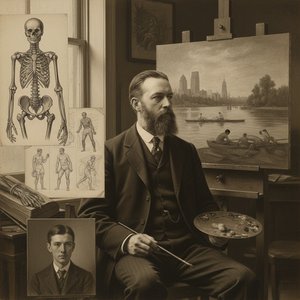 Thomas Eakins: Realism, Anatomy & the American Spirit – A Comprehensive Exploration of Life and LegacyExplore the life & legacy of Thomas Eakins, a pivotal American Realist painter. Discover his groundbreaking techniques, anatomical precisio…
 James Abbott McNeill Whistler: Top 25 Kunstværker – Skønhed, Harmoni & Historie | OriginalUniqueArtOplev James Abbott McNeill Whistlers 25 mest ikoniske kunstværker. Fordyb dig i æstetismens verden, tonale malerier & harmoniske kompositio…