Hudson River School
Moonlight - Piazza Vecchia (Thomas Cole)
Thomas Cole (1801–1848) har skabt Moonlight - Piazza Vecchia. Det tilhører Hudson River School-bevægelsen. Den er udført i Oil On Canvas.
- Oil On Canvas

 Se i rummet

 Håndmalet oliemalerie
 Del som kort
 Del
 Faktablad


 Download
 Lignende værker
 Røntgenundersøgelse
 Diasshow
 Spørgsmål og svar

 Statistikker
Moonlight - Piazza Vecchia kort fortalt
- Titel
- Moonlight - Piazza Vecchia
- Kunstner
- Thomas Cole (1801–1848)
- Kunstner født i
- Bolton, Storbritannien
- Medium
- Oil On Canvas
- Bevægelse
- Hudson River School
- Periode
- 19th Century
- Motiv
- moonlight, bridge, buildings, clock, river, person
Hvad forestiller Moonlight - Piazza Vecchia?
Identification of Moonlight - Piazza Vecchia
Moonlight - Piazza Vecchia is an oil painting by Thomas Cole. The artist, born in 1801 in Bolton, United Kingdom, moved to the United States in 1818. He eventually settled in Catskill, New York, where he remained until his death on February 11, 1848.
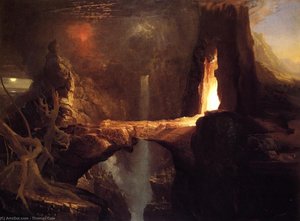
The scene captures a cityscape under a moonlit atmosphere. A bridge overlooks a body of water, appearing as either a river or an ocean. In the foreground, two buildings flank the composition, with a clock hanging from a wall near the center. A solitary figure stands near the bridge, observing the nocturnal view. The moonlight casts a soft glow across the architecture and the water, establishing a serene mood.
The Composition and Visual Elements
The nocturnal cityscape is organized around a central bridge that spans a body of water, appearing as either a river or an ocean. In the foreground, the composition is framed by two buildings positioned on the left and right sides. Near the center of the image, a clock hangs from a wall, providing a focal point amidst the architectural details. A solitary figure stands near the bridge, appearing to observe the view or move through the urban space.
Atmospheric light defines the scene. Moonlight casts a soft glow across the environment, creating a serene and peaceful mood. This illumination interacts with the shadows of the buildings and the surface of the water to establish depth within the nocturnal setting. The interplay of light and shadow emphasizes the quietude of the city at night.
The Artistic Style of Thomas Cole
Working primarily with oil on canvas, Cole developed a technique characterized by a sophisticated use of light and shadow. He utilized this interplay to establish atmospheric depth and a sense of volume within his compositions. His approach frequently involved the placement of solitary structures or small figures against expansive, moody landscapes, a method that emphasizes the scale of the environment relative to human presence.
His brushwork demonstrates a keen ability to render the specific textures of the natural world. This attention to detail allows for a tactile quality in his depictions of wilderness and terrain. Through careful layering of pigments, he achieved a tonal richness that defines the visual weight of his subjects.
Related Works by Thomas Cole
Cole’s exploration of landscape and the passage of time is evident in several significant compositions. His 1836 work, The Oxbow, also known as The Connecticut River near Northampton, examines the tension between untamed nature and cultivated land. This same year saw the completion of The Course of Empire, a five-part series tracing the cyclical rise and fall of civilizations.
Other notable works include River in the Catskills, painted in 1843. These pieces reflect the artist's ongoing engagement with the American wilderness and the shifting relationship between the natural world and human presence.
Højopløselige billeder af Moonlight - Piazza Vecchia
Public domain: kunstneren døde i 1848.
Thomas Cole, Moonlight - Piazza Vecchia. Public domain
Spørgsmål om Moonlight - Piazza Vecchia besvaret
Hvilken teknik er brugt til "Moonlight - Piazza Vecchia" af Thomas Cole?
"Moonlight - Piazza Vecchia" er udført i Oil On Canvas.
Hvad forestiller "Moonlight - Piazza Vecchia"?
"Moonlight - Piazza Vecchia" af Thomas Cole forestiller: moonlight, bridge, buildings, clock, river, person, cityscape, night.
Er "Moonlight - Piazza Vecchia" af Thomas Cole i det offentlige domæne?
"Moonlight - Piazza Vecchia" af Thomas Cole er i det offentlige domæne – ophavsretten er udløbet. Denne status bestemmer, hvordan billedet af værket må reproduceres.
Hvem er kunstneren bag "Moonlight - Piazza Vecchia"?
Kunstneren bag "Moonlight - Piazza Vecchia" er Thomas Cole. Værket er katalogiseret under Thomas Coles navn.
Hvilken stilart tilhører "Moonlight - Piazza Vecchia"?
Kunstretningen forbundet med "Moonlight - Piazza Vecchia" af Thomas Cole er Hudson River School. Denne klassificering placerer værket blandt relaterede kunstnere og kunstværker.
Er "Moonlight - Piazza Vecchia" af Thomas Cole i det offentlige domæne, og hvorfor?
Ophavsretsstatus for "Moonlight - Piazza Vecchia" – i det offentlige domæne – ophavsretten er udløbet – følger af kunstnerens død i 1848.
Hvad deler "Moonlight - Piazza Vecchia" med resten af Thomas Coles produktion?
"Moonlight - Piazza Vecchia" er et værk fra Thomas Coles Hudson River School-periode, hvis gennemgående temaer inkluderer european old masters, hudson river school, romantic landscape, spiritual resonance, nature vs. civilization.
Hvordan relaterer motivet i "Moonlight - Piazza Vecchia" sig til Thomas Coles sædvanlige temaer?
"Moonlight - Piazza Vecchia" skildrer moonlight, bridge, buildings, clock, river, person, cityscape, night, mens Thomas Coles registrerede temaer er european old masters, hudson river school, romantic landscape, spiritual resonance, nature vs. civilization. En sammenligning af de to viser, hvordan værket relaterer sig til kunstnerens sædvanlige motiver.
Om kunstneren, Thomas Cole

1801–1848, Storbritannien
Thomas Cole
Livet og kunsten hos Thomas Cole Født den 1. februar 1801 i Bolton le Moors, Lancashire, England, begyndte Thomas Cole sit liv langt fra de landskaber, der i sidste ende skulle definere hans navn. Hans familie emigrerede til USA i 1818 i søgen efter en ny begyndelse i et land af enorme, uudforskede territorier. I disse tidlige år var han en mand med mange færdigheder; han arbejdede som graver og fandt senere fast arbejde som portrætmaler fra 1822.
Også af Thomas Cole
 Oxbøyen
 Arkitektens drøm1840
 Udtrykket. Månens lys og glød1828
 Ud af Firenze fra San Miniato1837
Essays om Moonlight - Piazza Vecchia
 British artworks of the 1840s1840s British masterpieces by J. M. W. Turner and John Everett Millais. Shop museum-quality reproductions on OriginalUniqueArt.com.
 Barbizon School vs. Hudson River School: Two Visions of the Natural WorldDiscover the key differences between Barbizon and Hudson River School landscapes. Master art history with our expert comparison guide.
 British artworks of the 1820sBritish Romanticism in the 1820s features the iconic works of J.M.W. Turner, John Constable, and William Blake. View the full collection at…