Pop Art
Visa (Stuart Davis)
Stuart Davis (1892–1964) har skabt Visa. Det tilhører Pop Art-bevægelsen.

 Se i rummet

 Håndmalet oliemalerie
 Del som kort
 Del
 Faktablad


 Download
 Lignende værker
 Røntgenundersøgelse
 Diasshow
 Spørgsmål og svar

 Statistikker
Visa kort fortalt
- Titel
- Visa
- Kunstner
- Stuart Davis (1892–1964)
- Kunstner født i
- Philadelphia, USA
- Bevægelse
- Pop Art
- Motiv
- bold typography, geometric shapes, dynamic composition, color collage, modernist design, abstract expression
Hvad forestiller Visa?
A Dynamic Synthesis: Exploring Stuart Davis’ “Visa”
Stuart Davis's "Visa" is a captivating example of American Modernism at its most vibrant and energetic. This collage-style painting isn’t merely an aesthetic statement; it’s a visual articulation of the dynamism of early 20th-century America, infused with the rhythms of jazz and the burgeoning spirit of Pop Art decades before its formal emergence. The artwork immediately commands attention through its bold typography – the phrase “CHAMPION ELSE” emblazoned across a complex field of geometric abstraction. This isn’t a tranquil scene; it's a burst of controlled chaos, reflecting the accelerating pace and multifaceted nature of modern life.Style & Technique: Cubism Meets Jazz Age Energy
Davis masterfully blends influences in “Visa.” While the fragmented forms and overlapping planes clearly nod to Cubism, particularly the Synthetic Cubist approach, the work transcends simple imitation. The bright, contrasting colors and graphic treatment anticipate the boldness of Pop Art, demonstrating Davis’s forward-thinking vision. His technique appears to be a sophisticated combination of hand-painted elements layered with potentially printed components – creating texture and depth. This mixed-media approach allows for a unique visual density and a slightly rough surface quality that adds to its tactile appeal. The flattened perspective further emphasizes the artwork's graphic nature, prioritizing impact over illusionistic space. It’s a testament to Davis’s skill in translating musicality—specifically, the improvisational spirit of jazz—into visual form.Historical Context & Symbolic Resonance
Created during a period of significant artistic upheaval and experimentation, “Visa” reflects Davis's early engagement with avant-garde movements. His inclusion in the groundbreaking Armory Show of 1913, alongside European Modernists, was pivotal in shaping his artistic trajectory. The title itself, while seemingly simple, hints at a deeper meaning. "Visa" can be interpreted as a metaphorical stamp of approval – a validation of striving and competition, aligning with the phrase “CHAMPION ELSE.” The repeated ‘C’ shapes within the composition could symbolize cycles, continuous effort, or even musical chords, reinforcing the jazz-inspired undercurrents. Davis wasn't simply depicting objects; he was exploring concepts—the energy of urban life, the pursuit of success, and the very essence of American identity in a rapidly changing world.Emotional Impact & Interior Design Considerations
“Visa” evokes a sense of exhilaration and restless energy. It’s a piece that demands attention and sparks conversation. Its bold color palette and dynamic composition make it a striking focal point for any space. In an interior design context, “Visa” would be particularly effective in modern or contemporary settings, adding a vibrant accent to minimalist décor. The artwork's graphic quality also lends itself well to larger spaces where its impact won’t be diminished. A high-quality reproduction of "Visa" offers an opportunity to bring a piece of American Modernist history into your home or office, injecting it with the spirit of innovation and artistic freedom that defines Stuart Davis’s legacy.Højopløselige billeder af Visa
Beskyttet af ophavsret: disse filer er til personlig reference og udgør ikke en licens til genudgivelse.
Stuart Davis, Visa.
Stuart Davis (1892–1964), Visa. Billede: OriginalUniqueArt.com.
Spørgsmål om Visa besvaret
Hvad forestiller "Visa" af Stuart Davis?
Motiverne i "Visa" er bold typography, geometric shapes, dynamic composition, color collage, modernist design, abstract expression, jazz influence.
Er billedet af "Visa" af Stuart Davis frit tilgængeligt i det offentlige domæne?
Ophavsretsstatus for "Visa" af Stuart Davis: værket er stadig beskyttet af ophavsret. Dette afgør, om der frit må foretages reproduktioner af billedet.
Hvem er kunstneren bag "Visa"?
Kunstneren bag "Visa" er Stuart Davis. Værket er katalogiseret under Stuart Daviss navn.
Hvilken stilart tilhører "Visa"?
Kunstretningen forbundet med "Visa" af Stuart Davis er Pop Art. Denne klassificering placerer værket blandt relaterede kunstnere og kunstværker.
Hvilken periode i Stuart Daviss karriere tilhører "Visa"?
"Visa" repræsenterer Stuart Daviss Mature Period.
Hvad er årsagen til ophavsretsstatus for "Visa" af Stuart Davis?
Ophavsretsstatus for "Visa" – stadig beskyttet af ophavsret – følger af kunstnerens død i 1964.
Hvordan passer "Visa" ind i Stuart Daviss temaer og stil?
"Visa" er et værk fra Stuart Daviss Pop Art-periode, hvis gennemgående temaer inkluderer early pop experiments, bold color exploration, proto-pop imagery, pop art & cubism, jazz aesthetics, geometric abstraction, competition & victory, american modernity.
Er "Visa" typisk for det, som Stuart Davis normalt skabte?
Stuart Daviss gennemgående temaer inkluderer early pop experiments, bold color exploration, proto-pop imagery, pop art & cubism, jazz aesthetics, geometric abstraction, competition & victory, american modernity; "Visa" fokuserer på bold typography, geometric shapes, dynamic composition, color collage, modernist design, abstract expression, jazz influence.
Om kunstneren, Stuart Davis
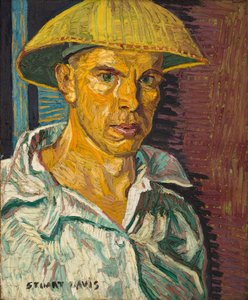
1892–1964, USA
Stuart Davis
Stuart Davis: En Pioner inden for Amerikansk Modernisme Stuart Davis blev født Edward Stuart Davis den 7. december 1892, i Philadelphia til Edward Wyatt Davis, kunstredaktør for *The Philadelphia Press*, og Helen Stuart Davis, skulptør. Denne familiære baggrund fremmede naturligt hans tidlige interesse for kunst. Han voksede op omgivet af kunstnere og kunstværker, hvilket var særligt tydeligt takket være sin mors arbejde som skulptør og farens rolle som kunstredaktør.
Også af Stuart Davis
 Odol
 Lucky Strike1924
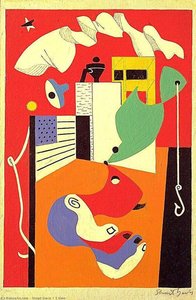 T View1951
 Sixth Avenue El1931
Essays om Visa
 American artworks of the 1950s1951's Saying Grace by Norman Rockwell and Jackson Pollock's 1949 Number 1 show the shift from Paris to New York through 10 key works.
 Geometry with Purpose: Distinguishing Suprematism from ConstructivismKazimir Malevich hung his Black Square in the corner of a room in Petrograd in 1915. Why did this single gesture change the purpose of art?
 Dreams on Canvas: Understanding Automatist and Veristic SurrealismIn 1924, André Breton launched a movement in Paris to liberate the mind. One path used spontaneous gestures, while the other used photograp…