Cubism
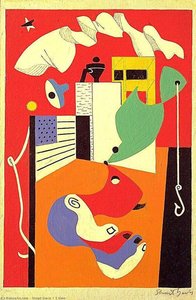
Interior (Stuart Davis)
Interior er et værk af Stuart Davis (1892–1964). Det tilhører Cubism-bevægelsen.

 Se i rummet

 Håndmalet oliemalerie
 Del som kort
 Del
 Guide


 Download
 Lignende værker
 Røntgenundersøgelse
 Diasshow
 Spørgsmål og svar

 Statistikker
Interior: det vigtigste
- Titel
- Interior
- Kunstner
- Stuart Davis (1892–1964)
- Kunstner født i
- Philadelphia, USA
- Bevægelse
- Cubism
- Motiv
- abstract, geometric, modernism, composition, lines, forms
Se på Interior
A Dynamic Vision of Modernity: Exploring Stuart Davis’s “Interior”
Stuart Davis's “Interior” is a captivating example of American Modernism, pulsating with energy and reflecting the artist’s unique response to the burgeoning urban landscape and the rhythms of jazz. Created sometime during his prolific career (1892-1964), this work embodies Davis’s commitment to developing a distinctly American visual language, moving beyond European influences towards a bold, independent style.
Deconstructing Space: Style & Technique
- The artwork is immediately striking for its geometric abstraction. Davis employs fragmented forms and flattened perspectives – hallmarks of both Cubism and Constructivism – but infuses them with a uniquely American sensibility.
- A vibrant palette dominates, anchored by the stark contrast between the white background, bold reds, blues, and greys, and punctuated by energetic black lines. The orange border further intensifies this visual impact.
- Davis’s technique is evident in the visible brushstrokes and layering of paint, creating a subtle texture that adds depth despite the overall flattened composition. This suggests an active process of building up form and color on the canvas, likely using oil paints as his primary medium.
- The arrangement isn't simply random; it’s carefully orchestrated into distinct zones – a tower-like structure in blue-grey, a dynamic red section with a vertical ‘sail’ or flag element, and a central area of interwoven geometric shapes. This zoning creates a sense of controlled chaos.
Echoes of Jazz & the Machine Age: Context & Symbolism
Davis was deeply influenced by jazz music, which he saw as embodying the spirit of modern America – improvisational, energetic, and uniquely its own. While “Interior” isn’t a direct representation of musical notes, the dynamic interplay of shapes and colors evokes the same sense of rhythm and syncopation found in jazz compositions.
- The architectural elements, particularly the stylized tower, could be interpreted as representing aspiration or the burgeoning skyscrapers of American cities. Davis frequently engaged with urban themes throughout his career.
- The ‘sail’ or flag-like form introduces a sense of movement and direction, perhaps symbolizing progress or the forward momentum of modern life.
- His early exposure to the Armory Show in 1913 was pivotal. While his initial works reflected the Ashcan School style, he quickly absorbed and transformed European avant-garde ideas into something distinctly American.
Emotional Resonance & Lasting Impact
“Interior” is not a tranquil scene; it’s charged with energy and tension. The fragmented forms and bold colors create a sense of dynamism, while the lack of traditional perspective can be slightly unsettling. This emotional complexity reflects the anxieties and excitements of a rapidly changing world.
- The artwork invites viewers to actively engage with its abstract language, prompting individual interpretations and fostering a personal connection.
- As a pioneering figure in American Modernism, Stuart Davis paved the way for subsequent generations of artists. His work continues to inspire those seeking to break free from convention and explore new forms of visual expression.
Interior i høj opløsning
Beskyttet af ophavsret: billedet er kun vist som reference.
Flere størrelser, beskæringer og kildehenvisning →Stuart Davis, Interior.
Spørgsmål om Interior
Hvilken farvepalette og hvilken dominerende farve definerer "Interior"?
"Interior" af Stuart Davis benytter en Metallics farvepalet, hvor Steel Blue (#5c7ba9) er den dominerende farve.
Kan jeg se "Interior" som et diasshow i fuld skærm?
Se diaporamabillederne af "Interior" på værkets side Billedserie.
Hvad er årsagen til ophavsretsstatus for "Interior" af Stuart Davis?
"Interior" af Stuart Davis er stadig beskyttet af ophavsret. Ophavsretten løber fra kunstnerens dødsår, som var 1964.
Hvilken farvepalette benytter "Interior"?
"Interior" af Stuart Davis benytter en Metallics farvepalette, der indfanger værkets overordnede farvekarakter.
Findes der værker, der ligner "Interior"?
Se lignende værker til "Interior" på siden Lignende værker.
Hvilken farve dominerer kompositionen i "Interior" af Stuart Davis?
Steel Blue (#5c7ba9) er den dominerende farve i "Interior" af Stuart Davis.
Hvem er kunstneren bag "Interior"?
"Interior" tilskrives Stuart Davis.
Hvilken kunstretning tilhører "Interior" af Stuart Davis?
Kunstretningen forbundet med "Interior" af Stuart Davis er Cubism. Denne klassificering placerer værket blandt relaterede kunstnere og kunstværker.
Hvordan er farvesammensætningen i "Interior" af Stuart Davis opbygget?
I "Interior" parres en Statement kontrast med en Strong Color Unity harmoni.
Om kunstneren, Stuart Davis

1892–1964, USA
Stuart Davis
Stuart Davis: En Pioner inden for Amerikansk Modernisme Stuart Davis blev født Edward Stuart Davis den 7. december 1892, i Philadelphia til Edward Wyatt Davis, kunstredaktør for *The Philadelphia Press*, og Helen Stuart Davis, skulptør. Denne familiære baggrund fremmede naturligt hans tidlige interesse for kunst. Han voksede op omgivet af kunstnere og kunstværker, hvilket var særligt tydeligt takket være sin mors arbejde som skulptør og farens rolle som kunstredaktør.
Også af Stuart Davis
 Odol
 Lucky Strike1924
 T View1951
 Blue Café1928
Essays around Interior
 Stuart Davis: Modernist Abstraction & the Vibrant Spirit of the Jazz AgeExplore the vibrant world of Stuart Davis, a pioneer of American Modernism. Discover his jazz-inspired paintings, signature style & investm…
 The Geometry of Elegance: Elevating Modern Villa Interiors with Cubist-Inspired ArtDiscover how Cubist-inspired art elevates modern villa interiors. Explore the intersection of geometric precision and luxury design through…
 Steel & Soul: The Rhythmic Geometry and Industrial Resonance of the Machine AgeExplore the rhythmic geometry of Fernand Leger and the Machine Age. Discover the power of industrial art today.