

 Se i rummet
 Send
Send Del
Del
 Detaljer
 Studieguide til kunstværker

 Download
 Lignende værker
 Røntgenundersøgelse
 Se diasshow
 Statistik
Untitled


 Læs mere
Kunstværket vist på denne side er beskyttet af ophavsretsloven, hvilket betyder, at vi ikke lovligt kan skabe eller sælge en identisk reproduktion. Denne beskyttelse håndhæves i henhold til internationale aftaler som f.eks. den Bernerkonventionen og af nationale love, herunder de bestemmelser, der er fastlagt i Amerikansk ophavsretslov - Titel 17.
Denne metode overholder fuldt ud ophavsretsreglerne, da den ikke indebærer kopiering eller duplikering af det beskyttede kunstværk. I stedet er der tale om en kreativ nytolkning – et nyt maleri, som er inspireret af det oprindelige, men ikke identisk med det.
Giclée / Kunsttryk
Giclée- eller lærredstryk i museumskvalitet med hurtig produktion og fleksible muligheder for finish. ( Bestil håndmalet reproduktion Skift til digitalt billede)




































Vælg mellem vores forudindstillede størrelser, der matcher kunstværkets originale proportioner.

Indtast den bredde og højde, du har brug for, så det passer til din ramme eller din væg. Et print kan kun beskæres, aldrig gøres større end billedet, så en størrelse med en anden form vil miste en del af motivet. Vi sender dig en digital mockup til godkendelse, før vi printer noget. Billedet vist på denne side viser ikke den faktiske beskæring — det er kun mockuppen, der gør.
Verdensomspændende levering () på 2 uger i stedet for de sædvanlige 4/5 uger. (26 oktober)

Gratis ekspresforsendelse til hele verden

Lærred af linned i høj kvalitet

Komplet transportforsikring

Garanti for refusion af told og importafgifter

Garanti for autentisk farvegengivelse

100 dages returret ved fabrikationsfejl

100% fuld returret

Mængderabat ved flere køb
 Glasmulighed er kun tilgængelig i størrelser under 110 cm

Untitled
Giclée / Kunsttryk
Reproduktionsstørrelse
-


Samlet pris
Dkr 531
Om kunstneren
The Witness of Bengal’s Turbulent Century
Somnath Hore (1921–2006) was far more than a mere creator of forms; he was a profound chronicler of the human condition, standing as an unflinching witness to the socio-imaginative upheavals of twentieth-century Bengal. His artistic journey was inextricably linked to the very marrow of social struggle, shaped by the devastating echoes of the 1943 Bengal famine and the defiant spirit of the Tebhaga peasant movement. Born in Chittagong, Hore’s early life was deeply colored by the political currents of his era. His affiliation with the Communist Party during his youth infused his work with a powerful socialist ideology, transforming his practice into a medium for documenting historical trauma and advocating for social justice. He did not merely observe history from the periphery; he translated the hunger, the resistance, and the resilience of the marginalized into a visual language that remains hauntingly relevant today.The Architecture of Suffering and Technique
The technical brilliance of Hore’s oeuvre lies in his ability to translate visceral, often agonizing experiences into delicate, rhythmic textures. As a master of printmaking, he achieved legendary status through his command of lithography and intaglio, using these mediums to explore the depths of human vulnerability. He is perhaps most celebrated for his development of the unique pulp-print technique, a method that allowed him to imbue his work with a raw, tactile quality. This was most notably realized in his critically acclaimed Wounds series, where the very texture of the paper seemed to mirror the physical and emotional scars of the people he depicted. Through meticulous hatching and cross-hatching, Hore sculpted light out of darkness, using fine, rhythmic lines to create a sense of depth that was both aesthetically masterful and emotionally heavy. Whether through the starkness of a charcoal drawing or the intricate layers of an etching, his work captures a profound intimacy—a moment where the artist’s hand becomes a vessel for collective memory.A Sculptural Legacy in Clay and Spirit
As his artistic vision matured, Hore expanded his dialogue with form, moving from the two-dimensional plane into the tactile, three-dimensional world of sculpture. Utilizing stoneware clay and bronze, he brought a contorted, expressive energy to his figures, echoing the tension and endurance found in his earlier prints. This transition allowed him to explore the weight and presence of the human body in space, imbuing his sculptures with a humanist sensibility that was both grounded in realism and elevated by poetic expression. His later years were deeply rooted in the academic and creative community of Santiniketan, where he headed the Graphics and Printmaking Department at Kala Bhavan. Working alongside luminaries such as K.G. Subramanyan and Ramkinkar Baij, Hore helped shape the trajectory of modern Indian art. His legacy remains a testament to the power of art to serve as both a mirror to society’s darkest moments and a celebration of the indomitable human spirit.
Somnath Hore
1921 - 2006 , India
Hurtige fakta
- Full Name: Somnath Hore
- Nationality: Indian
- Date Of Birth: 1921
- Date Of Death: 2006
- Place Of Birth: India
- Notable Artworks: ['Untitled']
- Artistic Movement Or Style: Social realism
Relaterede artikler
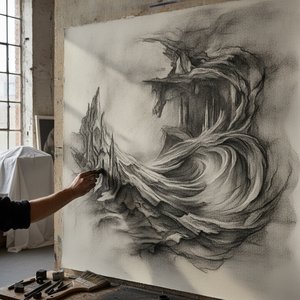
Mastering Charcoal: A Professional Guide to Texture and Depth for Large-Scale Interior Art Commissions
Discover professional techniques for mastering charcoal texture and depth. An expert guide for hotel designers and procurement managers looking to integrate high-impact monochrome art into large-scale hospitality projects with precision and scale.

Mastering Charcoal: The Definitive Expert Guide to Capturing Profound Depth, Texture, and Shadow
Elevate your artistry with this definitive expert guide to mastering charcoal. Designed for art students, learn professional techniques for capturing profound depth, intricate textures, and dramatic shadows through advanced blending and chiaroscuro methods.

Mastering the Line: A Comprehensive Expert Guide to Technical Precision and Expressive Depth in Drawing
Elevate your artistic practice with this expert guide to mastering the line. Discover advanced techniques in graphite, charcoal, and contour drawing designed for art students seeking technical precision and expressive depth in their fine art studies.

Mastering Charcoal: The History, Technique, and Chiaroscuro Power of Black and White Art
Explore the profound history and technical mastery of charcoal art. From prehistoric origins to Renaissance chiaroscuro, learn the essential additive and subtractive techniques used by masters to capture light, shadow, and raw emotional depth in monochrome fine art.

The Eloquent Form: A Historical & Aesthetic Exploration of the Nude in Art
Explore the captivating history of the nude in art! From ancient Greece to modern masters, discover its evolving symbolism, techniques & enduring beauty. Expert insights for collectors and enthusiasts.