Skift til printsalg
 Vis mere







































 For kunstværker eller reproduktioner, der er større end 105 cm (ca. 41 tommer) på en hvilken som helst side, vil rammen blive leveret som et adskilt sæt. Denne metode sikrer sikker levering og forhindrer skader under transport.


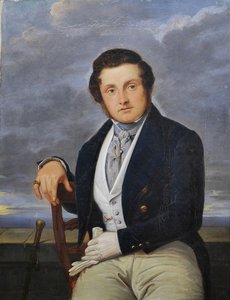
A Study in Dignity: The Timeless Presence of John Inglis
In the quiet, commanding presence of Sir John Watson Gordon’s 1854 portrait, John Inglis, one encounters more than just a likeness; one meets the very essence of mid-1ical British authority. This masterpiece of academic realism serves as a profound window into the mid-19th century, capturing a moment where social standing and personal character converge on canvas. The composition is masterfully centered, presenting Mr. Inglis in a three-quarter pose that suggests both accessibility and an impenetrable sense of decorum. As the viewer’s eye meets the subject, there is an immediate sense of being in the presence of a gentleman of substance, a man whose identity is inextricably linked to the professional and social stability of his era.
The technical brilliance of Gordon lies in his sophisticated use of light and shadow, a hallmark of his transition from Neoclassical precision toward a more atmospheric, tonal approach. A dramatic light source, positioned at the upper left, sweeps across the subject, carving his features out of the surrounding gloom. This chiaroscuro effect does more than provide depth; it breathes life into the textures of the era. One can almost feel the heavy, velvety weight of his dark coat and the subtle sheen of his footwear against the floor. The background, a textured tapestry of deep browns, blacks, and muted shadows, recedes into an enigmatic void, ensuring that every brushstroke dedicated to the subject's face and hands carries maximum emotional resonance.
For the discerning collector or interior designer, this portrait offers a profound sense of "quiet luxury." The color palette—dominated by somber, sophisticated tones of charcoal, ebony, and earth—provides a versatile anchor for grand, classical interiors or more contemporary, moody spaces. There is a rhythmic beauty in the way Gordon uses defined lines to trace the folds of fabric and the structural geometry of the surrounding furniture, contrasting these with the organic, soft modeling of human skin. It is a piece that does not shout for attention but rather commands it through its understated elegance.
Beyond the aesthetic allure, the painting carries a heavy symbolic weight. In an age of burgeoning industrial change, such portraits were vital assertions of permanence and legacy. To possess a reproduction of this work is to invite a sense of historical continuity and intellectual depth into a room. It evokes the atmosphere of a private library or a stately manor, offering an emotional anchor of stability and grace. Whether viewed as a triumph of oil technique or a soulful character study, John Inglis remains an enduring testament to the power of portraiture to immortalize the human spirit.
Spørgsmål og svar
Hvem har skabt "John Inglis", og hvornår?
Kunstneren bag "John Inglis" er Sir John Watson Gordon, og værket er fra 1854.
Hvilken lysstyrke har "John Inglis" af Sir John Watson Gordon?
Farverne i "John Inglis" har en Dark luminans.
Hvorfor er "John Inglis" af Sir John Watson Gordon en ideel gave?
Med sin Somber stemning anbefales "John Inglis" af Sir John Watson Gordon som en gave til Corporate Gift.
 Se i rummet
 Del som kort
 Del
Del
 Detaljer
 Guide
Guide

 Download
 Lignende værker
 Røntgenundersøgelse
 Diasshow
 Q&A
Q&A Statistikker