Skift til printsalg
 Vis mere







































 For kunstværker eller reproduktioner, der er større end 105 cm (ca. 41 tommer) på en hvilken som helst side, vil rammen blive leveret som et adskilt sæt. Denne metode sikrer sikker levering og forhindrer skader under transport.


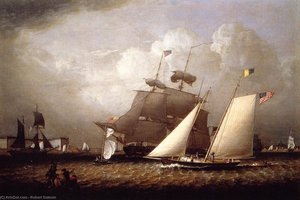
Robert W. Salmon’s “View of Palermo” – A Romantic Echo of Imperial Grandeur
Robert W. Salmon’s “View of Palermo,” painted in 1845, stands as a quintessential example of Romantic landscape painting infused with Neoclassical elegance and Luminism—a technique championed by artists like Turner that sought to capture the fleeting effects of light on nature. More than just a depiction of a coastal panorama, it embodies an ambitious vision of imperial power tempered by serene beauty, transporting viewers back to a pivotal moment in Sicilian history.
The artwork captures a sprawling promenade lined with figures – nobles and soldiers alike – enjoying the breezy Mediterranean air overlooking Cassaro Street. Salmon skillfully employs horizontal lines dominating the composition, emphasizing the vastness of the beach and sea, mirroring the grandeur of Roman imperial architecture. Dominating the right side is a dramatic rocky island rising from the water, serving as a powerful focal point that draws the eye upwards into the hazy distance.
- Composition & Perspective: Salmon’s linear perspective guides the viewer's gaze towards distant buildings and mountains, gradually diminishing in detail and atmospheric haze—a hallmark of Luminism. This masterful illusion of depth creates a palpable sense of space and contributes significantly to the painting’s immersive quality.
- Color Palette & Brushwork: The color palette is muted yet rich, primarily utilizing soft blues, greens, browns, and ochres. Loose brushstrokes—characteristic of Romantic style—add texture and dynamism to the canvas, conveying a feeling of movement and capturing the ephemeral qualities of twilight.
- Symbolism & Context: Painted during the reign of Queen Victoria, “View of Palermo” reflects the Victorian fascination with idealized landscapes and celebrates the splendor of nature as viewed through an aristocratic lens. The island’s rugged terrain symbolizes resilience and strength, juxtaposed against the tranquil sea—a visual metaphor for peace and stability.
- Technique: Salmon utilized oil paints on canvas, employing a glazing technique to achieve luminous colors and subtle tonal variations. This meticulous layering of paint allowed him to capture the atmospheric conditions of late afternoon or early evening with remarkable accuracy.
The foreground promenade invites contemplation, populated by figures dressed in formal attire—a testament to Palermo’s aristocratic heritage. Architectural details like grand buildings and columns along Cassaro Street reinforce the painting's Neoclassical influence, grounding its Romantic spirit within a framework of classical ideals. The sky is filled with billowing clouds, intensifying the dramatic mood and enhancing the overall visual impact.
Ultimately, “View of Palermo” succeeds in evoking a profound emotional response—a feeling of awe at the beauty of nature combined with an awareness of imperial authority. It’s a painting that lingers in the memory long after viewing, reminding us of a bygone era and its enduring artistic legacy.
Spørgsmål og svar
Hvilken kunstner og hvilken stil står bag "View of Palermo"?
Bag "View of Palermo" står Robert W. Salmon og Romanticism-bevægelsen.
Hvilken printstørrelse af "View of Palermo" af Robert W. Salmon passer til det anbefalede rum?
Den anbefalede kombination til "View of Palermo" af Robert W. Salmon: et tryk i størrelsen Medium til et Living Room.
Hvad foreslås der at bruge "View of Palermo" af Robert W. Salmon til?
Den foreslåede anvendelse af "View of Palermo" af Robert W. Salmon er Statement, men den kan også tjene andre formål.
 Se i rummet
 Del som kort
 Del
Del
 Detaljer
 Guide
Guide

 Download
 Lignende værker
 Røntgenundersøgelse
 Diasshow
 Q&A
Q&A Statistikker