Se i rummet
 Send
Send Del
Del
 Detaljer
 Studieguide til kunstværker

 Download
 Lignende værker
 Røntgenundersøgelse
 Se diasshow
 Statistik
View of Greenock, Scotland


 Læs mere
Giclée / Kunsttryk
Giclée- eller lærredstryk i museumskvalitet med hurtig produktion og fleksible muligheder for finish. ( Bestil håndmalet reproduktion Skift til digitalt billede)




P118B $10

P118H $10

P118W $10

P438Z $10

P508JH $12

P508YH $12

P805H $10

P805Z $10

P919BZ $10

P919G $10

P919XJ $10

P959ZH $10

P968JZ $12

W106C $8

W218G $10

W218JH $8

W218Y $10

W307PJ $10

W316G $10

W316PJ $8

W316Y $10

W398PJ $8

W4111J $10

W500HY $15

W500JH $15

W692G $12

W849H $8

W940BG $15

W953PJ $8




Vælg mellem vores forudindstillede størrelser, der matcher kunstværkets originale proportioner.

Du kan indtaste dine egne mål for at passe til en specifik ramme eller et bestemt område. Hvis den valgte størrelse ikke stemmer overens med det originale billedes proportioner, vil vi enten beskære kunstværket eller udvide billedet med en spejlet eller ensfarvet kant. En digital mockup vil blive sendt til din godkendelse, før produktionen påbegyndes.
Bemærk venligst, at forhåndsvisningen på skærmen ikke afspejler den faktiske beskæring eller udvidelse. Kun mockuppen vil nøjagtigt vise den endelige komposition.
Selvom specialmål er tilgængelige, anbefaler vi at vælge et mål fra den foruddefinerede liste for at bevare de originale proportioner.
Verdensomspændende levering () på 2 uger i stedet for de sædvanlige 4/5 uger. (25 september)

Gratis ekspresforsendelse til hele verden

Lærred af linned i høj kvalitet

Komplet transportforsikring

Garanti for refusion af told og importafgifter

Garanti for autentisk farvegengivelse

100 dages returret ved fabrikationsfejl

100% fuld returret

Mængderabat ved flere køb
 Glasmulighed er kun tilgængelig i størrelser under 110 cm

View of Greenock, Scotland
Giclée / Kunsttryk
Reproduktionsstørrelse
-


Samlet pris
$ 81
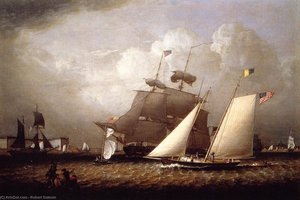
A Panoramic Vision of Industry and Nature – Robert W. Salmon’s ‘View of Greenock’
Robert W. Salmon's 1816 painting, “View of Greenock, Scotland,” isn’t merely a landscape; it’s a meticulously observed snapshot of a burgeoning port city on the cusp of transformation. More than two centuries after its creation, this oil-on-canvas masterpiece offers a rare glimpse into the heart of a Scottish industrial awakening, blending the romantic ideals of the late 18th and early 19th centuries with a remarkably detailed depiction of everyday life and burgeoning maritime activity. The painting captures Greenock – then a vital trading hub on the River Clyde – not as a pristine wilderness but as an integrated part of its environment, showcasing the complex relationship between human settlement and the natural world.
Salmon’s artistic lineage is immediately apparent. He was deeply influenced by the Dutch masters of the 17th century, particularly their skill in rendering atmospheric perspective and capturing the subtle nuances of light and shadow. Furthermore, he drew inspiration from Italian *vedute* – landscape views – exemplified by artists like Claude Lorrain, whose emphasis on idealized landscapes and dramatic lighting resonates strongly within Salmon’s composition. This fusion of styles results in a painting that is both technically proficient and emotionally evocative, transporting the viewer to a specific moment in time and place.
The Scene Unfolds: A City in Transition
The painting immediately establishes a sense of depth and perspective through a carefully orchestrated arrangement of elements. The foreground features a small group of figures – likely travelers or laborers – resting near a cart and scattered belongings, providing a human scale to the vast landscape. These individuals are positioned strategically to draw the eye into the scene, leading us towards the sprawling cityscape nestled along the River Clyde. The buildings themselves—a mix of warehouses, factories, and residential structures—are rendered with remarkable precision, reflecting Salmon’s keen observational skills and his understanding of urban planning. Notice the linear arrangement of streets, mirroring a nascent grid system that would soon define Greenock's development.
Dominating the midground is the River Clyde, teeming with sailing vessels – evidence of Greenock’s thriving trade in timber, coal, and other commodities. The masts and sails create a dynamic interplay of lines, adding movement and vitality to the composition. The distant hills provide a dramatic backdrop, anchoring the scene within its geographical context. Salmon masterfully employs atmospheric perspective—the subtle shift in color and detail as objects recede into the distance—to convey the immense scale of the landscape and the sense of depth that stretches towards the horizon.
Symbolism and Historical Context
“View of Greenock” is more than just a topographical record; it’s imbued with symbolic meaning. The painting reflects a pivotal moment in Scottish history – the aftermath of the Napoleonic Wars and the rapid expansion of industrialization. Greenock, strategically located at the “Tail of the Bank,” where the Clyde deepens into the Firth of Clyde, was rapidly becoming a major port for exporting Scotland’s agricultural produce and importing manufactured goods. The presence of numerous ships signifies Greenock's growing importance as a commercial center, while the figures in the foreground represent the human cost – and potential benefits – of this economic transformation.
The painting also offers insights into the social fabric of Greenock at the time. The washerwomen depicted in the foreground are a common motif in 19th-century art, symbolizing hard work and domesticity. Their presence reminds us that even amidst the bustle of industrial activity, everyday life continued much as it always had.
A Legacy Preserved: Reproduction and Artistic Impact
Today, “View of Greenock” is held in the collection of the Museo Thyssen-Bornemisza in Madrid. Its enduring appeal lies not only in its technical brilliance but also in its ability to transport us back in time, offering a vivid glimpse into a rapidly changing world. Reproductions of this remarkable painting capture the essence of Salmon’s vision, allowing viewers to appreciate the intricate details and emotional depth of this historical masterpiece. When selecting a reproduction, consider the quality of materials used – oil on canvas is essential for achieving the authentic look and feel of the original—and the level of detail captured in the print.
Salmon's work stands as a testament to his skill and vision, offering a valuable window into the history of Greenock and the broader story of industrialization in Scotland. It’s a painting that continues to resonate with viewers today, reminding us of the enduring power of art to capture both the beauty and complexity of human experience.
Om kunstneren
Tidligt liv og kunstnerisk uddannelse
- Oprindelse: Salmon blev født som Robert Salomon, søn af juveleren Francis Salomon. Whitehavens travle havn udgjorde en tidlig og væsentlig inspirationskilde for hans kunstneriske udvikling.
- Tidlige indflydelser: Selvom hans uddannelse ikke er omfattende dokumenteret, men det antages, at han studerede de hollandske marinemalere fra det 17. århundrede, italienske vedute-kunstnere og Claude Lorrain.
- Tidlige værker: Hans tidligste kendte værker, “Two Armed Merchantmen Leaving Whitehaven Harbor” (1800) og “The ‘Estridge’ off Dover,” demonstrerer hans tidlige evne til at indfange maritime scener.
- Debut på Royal Academy: Salmon udstillede første gang på Royal Academy i 1802, hvilket markerede et betydeligt skridt i hans karriere.
Karrieremæssig udvikling og stil
- Flytning til Liverpool (1806): Salmon bosatte sig i Liverpool og ændrede sit navn til Salmon. Denne periode bød på produktionen af talrige marinemalerier, som i dag er indlemmet i National Maritime Museum i London.
- Skibsportrætter: Hans skibsportrætter afslører en dyb fortrolighed med sejlskibe og deres mekanik, hvor han ofte afbildede det samme fartøj fra flere vinkler på et enkelt lærred.
- Popularitet og samlere: Salmons arbejde vandt popularitet blandt fremtrædende borgere i Boston, såsom Samuel Cabot, Robert Bennett Forbes og John Newmarch Cushing, hvilket vidner om hans voksende anerkendelse i Amerika.
- Luminismens pioner: Han betragtes som en nøglefigur i udviklingen af amerikansk luminisme og påvirkede kunstnere som William Bradford og Fitz Henry Lane. Hans fokus på lys og atmosfære skabte serene og fredfyldte scener.
Bemærkelsesværdige værker og kunstnerisk betydning
- Centrale malerier: Nogle af Salmons mest anerkendte værker inkluderer "The Brig 'Ariel'", "Sailing Ship 'Trelawney'" og “View of Liverpool from Cheshire.” Disse malerier eksemplificerer hans evne til at indfange sejlskibenes skønhed og kompleksitet.
- Boston Harbor-serien: Han producerede en betydelig række værker, der skildrer Boston Harbor, som viser det maritime liv og det historiske Boston. “Boston Harbor from Castle Island (Ship Charlotte)” er et bemærkelsesværdigt eksempel.
- Indflydelse på amerikansk kunst: Salmons stil havde en dybtgående indflydelse på efterfølgende generationer af amerikanske marinemalere og bidrog til udviklingen af luminismen som en vigtig kunstnerisk bevægelse.
Eftermæle og anerkendelse
- Museumssamlinger: Salmons værker opbevares i prestigefyldte institutioner, herunder U.S. Naval Academy, Museum of Fine Arts i Boston og National Maritime Museum i Greenwich.
- Varig indvirkning: Hans malerier fortsætter med at inspirere kunstnere i dag og står som et vidnesbyrd om hans dygtighed og kunstneriske talent.
- Faderen til amerikansk luminisme: Salmons eftermæle er solidt etableret som en pioner inden for amerikansk luminisme, hvilket har efterladt et uudsletteligt mærke på kunstverdenen.

Robert W. Salmon
1775 - 1845 , Storbritannien
Hurtige fakta
- Artistic Movement Or Style: Luminism
- Artists Or Movements Influenced By This Artist:
- William Bradford
- Fitz Henry Lane
- Artists Who Influenced This Artist:
- Nederlandske sømalere
- Italienske vedute kunstnere
- Claude Lorrain
- Date Of Birth: 1775
- Full Name: Robert W. Salmon
- Nationality: Britisk
- Notable Artworks:
- Sailing Ship 'Trelawney'
- Boston Harbor fra Castle Island
- A Frigate af Baltikum
- Place Of Birth: Whitehaven, United Kingdom
Relaterede artikler
Robert W. Salmon: Navigating the Currents of Maritime Painting & American Realism
Explore the captivating maritime paintings of Robert W. Salmon, a pioneer of American Luminism. Discover his Boston Harbor scenes, legacy, and collecting guide at OriginalUniqueArt.

Romantikkens Landskaber: Top 10 Malerier der Definerede En Æra | OriginalUniqueArt
Oplev romantikkens storhedstid! Dyk ned i top 10 landskabsmalerier af Caspar David Friedrich, Turner & Constable. Historiske fortællinger og museumskvalitets reproduktioner på OriginalUniqueArt.com – find din inspiration til væggen her!
Alexander Nasmyth: Picturing Scotland's Romantic Landscape – Innovation & Identity
Explore the life & art of Alexander Nasmyth, a pivotal figure in Scottish Romantic landscape painting. Discover his iconic works, including portraits of Robert Burns, and learn about his lasting influence on national identity. Fine art reproductions available.

Evocations of Place: A Historical Journey Through Landscape Art
Explore the rich history of landscape art with OriginalUniqueArt. Discover renowned artists, movements like Impressionism & Romanticism, and expert guidance for collecting timeless pieces. Find your perfect serene escape today!

David Roberts: A Scottish Pioneer of Topographical Art & Orientalist Vision
Explore the captivating world of David Roberts, a pioneering Scottish painter renowned for his detailed Orientalist scenes & stunning Egyptian landscapes. Discover his legacy and find museum-quality reproductions at OriginalUniqueArt.