Post-Impressionism · 1924
Mount Stephen, Devon (Robert Polhill Bevan, 1924)
Robert Polhill Bevan (1865–1925) har skabt Mount Stephen, Devon. Det er fra 1924. Det tilhører Post-Impressionism-bevægelsen. Den er udført i Oil On Canvas. Målene er 56 × 76 cm.
- 1924
- Oil On Canvas
- 56 × 76 cm

 Se i rummet

 Håndmalet oliemalerie
 Del som kort
 Del
 Faktablad


 Download
 Lignende værker
 Røntgenundersøgelse
 Diasshow
 Spørgsmål og svar

 Statistikker
Mount Stephen, Devon kort fortalt
- Titel
- Mount Stephen, Devon
- Kunstner
- Robert Polhill Bevan (1865–1925)
- Kunstner født i
- Hove, Storbritannien
- Dato
- 1924
- Materiale
- Oil On Canvas
- Dimensioner
- 56 × 76 cm
- Bevægelse
- Post-Impressionism
- Periode
- Modern
- Motiv
- devon village, rural england, coastal scene, british art, village life, impressionism
Hvad forestiller Mount Stephen, Devon?
Identification of Mount Stephen, Devon
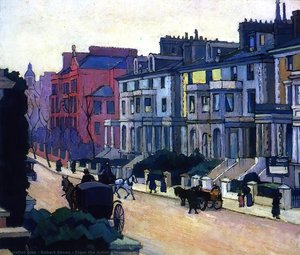
Mount Stephen, Devon is an oil on canvas painting by the artist Robert Bevan. This work was created in 1924. The piece measures 56 x 76 cm. It depicts a scene in Devon, England, featuring a red brick building in the foreground and two figures standing outside the structure.
The subject matter focuses on a small village setting. The composition includes residential architecture, specifically houses with thatched roofs, chimneys, and windows. Two people are positioned on the sidewalk, engaged in conversation. The perspective is slightly elevated, looking down a sloping street toward the sea. The sky is covered by clouds, which creates diffused lighting across the scene. This lighting casts soft shadows and highlights the various colors present in the village architecture and the surrounding landscape.
The Composition and Visual Elements
The composition presents a balanced arrangement of clustered buildings situated under a cloudy sky. The perspective is slightly elevated, looking down a sloping street that leads toward the sea. In the foreground, a red brick building anchors the scene. Two people stand outside this structure, positioned on the sidewalk near the architecture. The subject matter focuses on residential architecture, including houses characterized by thatched roofs, chimneys, and windows.
The arrangement of the village in Devon, England, relies on a series of rectangular shapes and organic lines. The rooflines of the houses create a structured pattern against the sky. Lines define the edges of the buildings, while the sloping street provides a sense of depth through atmospheric perspective. Distant elements appear paler and less distinct, establishing a clear recession into the background. The lighting is diffused by the overcast sky, casting soft shadows across the surfaces of the buildings and the street.
Technique and Artistic Style
The style of this work is reminiscent of the Post-Impressionist movement. It utilizes bold colors and geometric shapes to define the architecture and the landscape. The composition relies on rectangular forms for the buildings and organic shapes for the roofs. Visible brushstrokes are used throughout the piece, creating a sense of texture. On the walls and roofs, the paint appears thick and impasto-like, suggesting a deliberate layering of the medium.
The lighting in the scene is diffused, a result of the overcast sky. This soft light avoids harsh shadows and instead highlights the various colors across the village. Depth is achieved through the use of atmospheric perspective, where distant elements appear paler and less distinct than those in the foreground. This technique establishes a sense of space between the red brick building in the front and the elements further back in the composition.
Related Works by Robert Bevan
The artist's engagement with the Devon landscape is evident in other compositions from different periods. Landscape in the Blackdown Hills, Devon was painted in 1917. This work focuses on the rolling topography and the relationship between the land and the sky. Other depictions of the region include Devonshire Valley, No. 2, which was painted in 1913. This piece features a sweeping vista of a verdant valley where a small stone cottage with a pink-hued roof sits among dark trees.
Earlier works also demonstrate the artist's interest in atmospheric conditions and specific technical approaches. Haze over the Valley was created in 1913. In different studies, the artist utilized a divisionist technique, as seen in The Turn-Rice Plough. These varied approaches to color and form reflect a career spent exploring the structural elements of the English countryside and the application of light across different terrains.
Højopløselige billeder af Mount Stephen, Devon

Public domain: kunstneren døde i 1925.
Andre størrelser, beskæringer og kildeangivelse →Robert Polhill Bevan, Mount Stephen, Devon (1924).
Robert Polhill Bevan (1865–1925), Mount Stephen, Devon, 1924, oil on canvas. Frit tilgængelig Billede: OriginalUniqueArt.com.
Spørgsmål om Mount Stephen, Devon besvaret
Hvornår er "Mount Stephen, Devon" af Robert Polhill Bevan skabt?
"Mount Stephen, Devon" af Robert Polhill Bevan er dateret til 1924.
Hvilken teknik er brugt til "Mount Stephen, Devon" af Robert Polhill Bevan?
"Mount Stephen, Devon" af Robert Polhill Bevan er udført i Oil On Canvas. Reproduktionerne har til formål at gengive denne tekniks visuelle udtryk.
Hvad er de faktiske mål på "Mount Stephen, Devon" af Robert Polhill Bevan?
Det originale værk "Mount Stephen, Devon" af Robert Polhill Bevan måler 56 x 76 cm.
Hvad forestiller "Mount Stephen, Devon" af Robert Polhill Bevan?
Temaerne i "Mount Stephen, Devon" af Robert Polhill Bevan omfatter devon village, rural england, coastal scene, british art, village life, impressionism, colorful painting, som tilsammen udgør værkets motivverden.
Er billedet af "Mount Stephen, Devon" af Robert Polhill Bevan frit tilgængeligt i det offentlige domæne?
"Mount Stephen, Devon" af Robert Polhill Bevan er i det offentlige domæne – ophavsretten er udløbet. Denne status bestemmer, hvordan billedet af værket må reproduceres.
Hvem har skabt "Mount Stephen, Devon"?
Kunstneren bag "Mount Stephen, Devon" er Robert Polhill Bevan. Værket er katalogiseret under Robert Polhill Bevans navn.
Hvilken kunstretning tilhører "Mount Stephen, Devon" af Robert Polhill Bevan?
"Mount Stephen, Devon" er et værk fra Post-Impressionism. Denne stilart angiver den kunstneriske tradition, som værket indgår i.
Hvilken fase af Robert Polhill Bevans kunstneriske udvikling repræsenterer "Mount Stephen, Devon"?
"Mount Stephen, Devon" tilhører Mature Period i Robert Polhill Bevans karriere. Denne klassificering knytter værket til kunstnerens udvikling.
Hvor gammel var Robert Polhill Bevan, da "Mount Stephen, Devon" blev skabt i 1924?
Robert Polhill Bevan var 59 år gammel, da vedkommende skabte "Mount Stephen, Devon" i 1924. Alderen er beregnet ud fra kunstnerens fødselsår, 1865.
Om kunstneren, Robert Polhill Bevan

1865–1925, Storbritannien
Robert Polhill Bevan
Robert Polhill Bevan (1865–1925): British painter & Camden Town Group founder Robert Polhill Bevan, født i Hove i 1865, indtager en central og ofte nedtonet position inden for fortællingen om tidlig britisk kunst. Han rejste sig op fra en kvakker baggrund præget af finansielle forbindelser – hans forældre var Richard Alexander Bevan og Laura Maria Polhill – og modsatte sig konventionelle forventninger til at blive en dristig innovatør, en nøglefigur i overgangen fra impressionisme mod mere radikale udforskninger af farve og form. Hans rejse var én af konstant eksperimentering, hvor han absorberede indflydelser fra hele Europa samtidig med at forme sin egen kunstneriske vision, der ville dybtgående påvirke udviklingen af moderne kunst i England. Hans tidlige uddannelse ved Westminster School of Art under Frederick Brown gav et solidt fundament, men det var hans efterfølgende studier ved Académie Julian i Paris, hvor han virkelig fik gang i sin kreative gnist.
Om Robert Polhill Bevan Bemærkelsesværdige værker af Robert Polhill Bevan
Også af Robert Polhill Bevan
 From the Artist's Window1915
 Horse Dealers (Sale at Ward's Repository No.1)1918
 Devonshire Valley, No. 21913
 Landscape in the Blackdown Hills, Devon1917

Essays om Mount Stephen, Devon
 10 Stunning Paintings of Rolling Hills and Earthy LandscapesGeorgia O'Keeffe used the sweeping curves of New Mexico to map the soul. Was the desert landscape actually a hidden self-portrait?
 25 Essential Works by Pierre Puvis de Chavannes: A Visual GuidePierre Puvis de Chavannes used muted palettes in 25 works between 1856 and 1888, including The Poor Fisherman and The Beheading of Saint Jo…
 Masterpieces of Light: The Top 25 Bernardo Bellotto ArtworksBernardo Bellotto moved beyond the bright palettes of his uncle Canaletto to embrace a restrained, atmospheric realism. Compare twenty-five…