Expressionism · 1936
Max Beerbohm (Reginald Grenville Eves, 1936)
Reginald Grenville Eves (1876–1941) har skabt Max Beerbohm. Det er fra 1936. Det tilhører Expressionism-bevægelsen. Den er udført i Oil On Canvas.
- 1936
- Oil On Canvas

 Se i rummet

 Håndmalet oliemalerie
 Del som kort
 Del
 Faktablad


 Download
 Lignende værker
 Røntgenundersøgelse
 Diasshow
 Spørgsmål og svar

 Statistikker
Max Beerbohm kort fortalt
- Titel
- Max Beerbohm
- Kunstner
- Reginald Grenville Eves (1876–1941)
- Kunstner født i
- London, Storbritannien
- Dato
- 1936
- Medium
- Oil On Canvas
- Bevægelse
- Expressionism
- Periode
- Modern
- Motiv
- man, portrait, hat, book, black and white, face
Hvad forestiller Max Beerbohm?
Portrait of Max Beerbohm by Reginald Grenville Eves
The gaze of Sir Max Beerbohm meets the viewer from within this striking portrait, captured by the hand of Reginald Grenville Eves about 1936. The subject sits in a moment of quiet contemplation, his presence filling the frame with a sense of gravity. He holds a hat and a small book or notepad, objects that suggest a man caught in a pause between thoughts. There is a subtle melancholy in his expression, a hint of introspection that lingers in the shadows of his face. The atmosphere feels heavy with the weight of a life lived through intellect and observation.
Reginald Grenville Eves, born in London, United Kingdom, brings a focused intensity to this depiction. The artist, who passed away in 1941, focuses his attention entirely on the character of the sitter. The background recedes into deep, dark tones, pushing the figure of Beerbohm forward into the light. This dramatic contrast isolates the subject, making the study of his features the singular purpose of the work. Every line and shadow works to define the contours of his face and the texture of his clothing, creating a portrait that feels immediate and alive.
Composition and Visual Elements of the Portrait
The composition centers tightly on the subject, pulling the viewer into an intimate encounter with his face and upper body. He fills most of the frame, leaving little room for the world beyond his immediate presence. His gaze drifts slightly off-center, a subtle movement that suggests a mind occupied by thoughts elsewhere. This slight deviation from a direct stare creates a sense of quiet observation, as if we have caught him in a private moment of contemplation.
A stark, grayscale palette governs the entire scene, stripping away the distraction of color to focus purely on form and light. The visual field exists in a world of extreme tonal shifts, ranging from the deepest, impenetrable blacks to the brightest, piercing whites. This high contrast defines the contours of his features and the folds of his clothing, creating a dramatic interplay between light and shadow. The background recedes into a deep, heavy shadow, pushing the subject forward and ensuring that nothing interrupts the focus on his character.
Technique and Artistic Style of the Work
The oil paint clings to the surface in thick, expressive layers, creating a palpable texture that invites the eye to trace every ridge. These visible brushstrokes are loose and energetic, carving out the contours of the face, the unruly hair, and the heavy folds of the clothing. The surface feels rough and uneven, suggesting a spontaneous application where the artist's hand moves with immediate, unblinking intent. This impasto approach gives the portrait a physical presence, as if the paint itself is still settling into its final form.
Light and shadow engage in a dramatic struggle across the subject. A strong, unseen light source strikes the face, pulling features into sharp relief while casting the rest of the composition into deep, heavy darkness. This stark contrast creates a sense of gravity and weight, pulling the viewer into a quiet, contemplative moment. The style carries echoes of Impressionism through this emphasis on capturing a fleeting, atmospheric instant, yet the grayscale palette strips away the typical color to focus entirely on the interplay of light and form.
The Artistic Style of Reginald Grenville Eves
Reginald Grenville Eves moves through the history of 20th-century British art with a refined and steady hand. His training at the Slade School of Fine Art between 1891 and 1895 shapes a technique that prioritizes the essence of the individual. He possesses a remarkable ability to capture a quiet dignity in those he paints, avoiding the loud or the theatrical in favor of a restrained, observational grace. This subtle approach allows the inner character of a sitter to emerge through careful tonal variations and a mastery of light and shadow.
His technical precision earned him significant recognition on the international stage, including a silver medal at the Paris Salon in 1924 and a gold medal in 1926. These accolades reflect a skill for rendering volume and texture that feels both real and atmospheric. During the tensions of 1940, his role as an official war artist for the War Artists' Advisory Committee brought his observational eye to the realities of conflict, documenting the presence of military leaders during a tumultuous era.
The permanence of his contribution is felt in the halls of the Tate Gallery and the National Portrait Gallery, where his works remain held in prestigious collections. He approaches the canvas with a sense of purpose, seeking to reveal the human spirit through a sophisticated command of form. His legacy is one of elegance and psychological depth, captured in the steady, deliberate application of paint.
Højopløselige billeder af Max Beerbohm
Public domain: kunstneren døde i 1941.
Reginald Grenville Eves, Max Beerbohm (1936). Public domain
Spørgsmål om Max Beerbohm besvaret
Hvornår blev "Max Beerbohm" skabt?
"Max Beerbohm" stammer fra 1936. Datoen placerer værket i Reginald Grenville Eves's karriere og dets tidsalder.
Hvilket medie er "Max Beerbohm" af Reginald Grenville Eves udført i?
Reginald Grenville Eves brugte Oil On Canvas-teknikken til "Max Beerbohm". Teknikken definerer det originale værks materielle karakter.
Hvad forestiller "Max Beerbohm"?
Motiverne i "Max Beerbohm" er man, portrait, hat, book, black and white, face, clothing.
Er "Max Beerbohm" fri for ophavsret?
"Max Beerbohm" af Reginald Grenville Eves er i det offentlige domæne – ophavsretten er udløbet. Denne status bestemmer, hvordan billedet af værket må reproduceres.
Hvem er kunstneren bag "Max Beerbohm"?
"Max Beerbohm" tilskrives Reginald Grenville Eves.
Hvilken kunstretning tilhører "Max Beerbohm" af Reginald Grenville Eves?
Kunstretningen forbundet med "Max Beerbohm" af Reginald Grenville Eves er Expressionism. Denne klassificering placerer værket blandt relaterede kunstnere og kunstværker.
Hvilken periode i Reginald Grenville Evess karriere tilhører "Max Beerbohm"?
"Max Beerbohm" tilhører Mature Period i Reginald Grenville Evess karriere. Denne klassificering knytter værket til kunstnerens udvikling.
Hvor gammel var Reginald Grenville Eves, da "Max Beerbohm" blev skabt i 1936?
Reginald Grenville Eves skabte "Max Beerbohm" i en alder af 60. Kunstneren blev født i 1876, og værket er dateret 1936.
Er "Max Beerbohm" af Reginald Grenville Eves i det offentlige domæne, og hvorfor?
"Max Beerbohm" af Reginald Grenville Eves er i det offentlige domæne – ophavsretten er udløbet. Ophavsretten beregnes ud fra kunstnerens dødsår, og Reginald Grenville Eves døde i 1941.
Om kunstneren, Reginald Grenville Eves

1876–1941, Storbritannien
Reginald Grenville Eves
Reginald Grenville Eves: En portrætmaler af sin tid Reginald Grenville Eves (1876-1941) står som en betydningsfuld, omend ofte overset, skikkelse i det 20. århundredes britiske kunst. Han blev født i London i 1876 som søn af William Henry Eves, en fredsdommer, og hans kunstneriske rejse begyndte med en formel uddannelse ved University College School og senere ved den prestigefyldte Slade School of Fine Art mellem 1891 og 1895. Under vejledning af indflydelsesrige kunstnere som Alphonse Legros, Frederick Brown og Henry Tonks forfinede Eves sine færdigheder inden for tegning og maleri, hvilket lagde fundamentet for hans fremtidige karriere som portrætmaler.
Om Reginald Grenville Eves Bemærkelsesværdige værker af Reginald Grenville Eves
Også af Reginald Grenville Eves
 Self Portrait
 A Nymph Beside a Pool1910
 Sir Ernest Henry Shackleton (1874–1922)1921
 Thomas Hardy1923
Essays om Max Beerbohm
 British contemporary realist paintersContemporary Realism painters from the UK like Frederick William Elwell and Frank O. Salisbury. Find museum-quality art reproductions on Or…
 The Art of the Gaze: A Collector's Guide to Mastering Portrait Composition and Emotional DepthMaster the nuances of portrait composition with our expert guide for collectors. Discover how light, gaze, and texture create emotional dep…
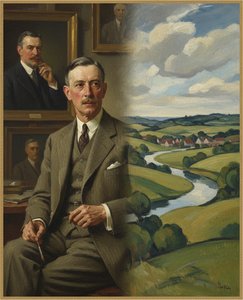 Reginald Grenville Eves: Bridging Portraiture & Modern British Landscape PaintingExplore the life & work of Reginald Grenville Eves, a leading British portraitist who transitioned to captivating landscape painting. Disco…