
 Se i rummet
 Del som kort
 Del
Del
 Detaljer
 Guide
Guide

 Download
 Lignende værker
 Røntgenundersøgelse
 Diasshow
 Q&A
Q&A Statistikker
The Visit

- 68.0 x 58.0 cm


 Vis mere
Giclée / Kunsttryk
Giclée- eller lærredstryk i museumskvalitet med hurtig produktion og fleksible muligheder for finish. ( Køb håndmalet maleri Skift til digitalt billede)




P118B Dkr10

P118H Dkr10

P118W Dkr10

P438Z Dkr10

P508JH Dkr12

P508YH Dkr12

P805H Dkr10

P805Z Dkr10

P919BZ Dkr10

P919G Dkr10

P919XJ Dkr10

P959ZH Dkr10

P968JZ Dkr12

W106C Dkr8

W218G Dkr10

W218JH Dkr8

W218Y Dkr10

W307PJ Dkr10

W316G Dkr10

W316PJ Dkr8

W316Y Dkr10

W398PJ Dkr8

W4111J Dkr10

W500HY Dkr15

W500JH Dkr15

W692G Dkr12

W849H Dkr8

W940BG Dkr15

W953PJ Dkr8




Vælg mellem vores forudindstillede størrelser, der matcher kunstværkets originale proportioner.

Indtast den bredde og højde, du har brug for, så det passer til din ramme eller din væg. Et print kan kun beskæres, aldrig gøres større end selve billedet, så en størrelse med et andet format vil medføre, at dele af motivet går tabt. Vi sender dig en digital mockup til godkendelse, før vi printer noget. Billedet vist på denne side viser ikke den faktiske beskæring — det er kun mockuppen, der gør.
Verdensomspændende levering () på 2 uger i stedet for de sædvanlige 4/5 uger. (1 november)

Gratis ekspresforsendelse til hele verden

Lærred af linned i høj kvalitet

Fuld transportforsikring

Garanti for refusion af told og importafgifter

Garanti for præcis farvegengivelse

100 dages returret ved fabrikationsfejl

100% fuld returret

Mængderabat ved flere køb
 Glasmulighed er kun tilgængelig i størrelser under 110 cm

The Visit
Giclée / Kunsttryk
Størrelse på reproduktion
-


Samlet pris
Dkr 538
A Moment Frozen in Delft Light
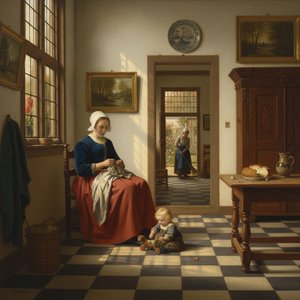
In the quiet, sun-drenched interiors of the seventeenth century, moments of profound connection were often found in the most mundane settings. Pieter de Hooch's "The Visit," painted in 1657, stands as a quintessential emblem of Dutch Baroque artistry—a deceptively simple tableau that speaks volumes about the social fabric and artistic sensibilities of its era. Captured in muted tones of ochre, ivory, and charcoal gray, this masterpiece transports us back to Delft during the zenith of the Dutch Golden Age, offering an intimate glimpse into the daily life of a bourgeois household. The painting’s enduring appeal lies not merely in its visual beauty but also in its masterful execution and subtle symbolic resonance, inviting viewers to step through a doorway into a world of domestic tranquility.
The scene unfolds with a palpable sense of realism, as de Hooch captures a group of individuals gathered around a dining table. There is a quiet drama in the way the figures are positioned; some stand while others sit, their presence suggesting a convivial conversation and shared enjoyment. The table itself is laden with details that ground the scene in reality—multiple wine glasses catch the light, hinting at a celebratory or social meal, while a book rests near one of the guests, perhaps a remnant of a shared intellectual pursuit before dinner began. Even the subtle inclusion of a clock on the wall serves as a poignant reminder of the passage of time, anchoring this fleeting social interaction within the eternal flow of history.
Mastery of Light and Texture
De Hooch's style embodies the Baroque preoccupation with illusionism and chiaroscuro—the dramatic interplay between light and shadow. Unlike the overtly theatrical compositions of his contemporaries, "The Visit" achieves grandeur through the meticulous observation of natural light filtering into a domestic interior. The artist skillfully renders textures with remarkable accuracy; one can almost feel the grain of the worn wooden bench and the crispness of the linen tablecloth. Through subtle gradations of tone, de Hooch sculpts form and conveys a profound sense of depth, drawing the viewer’s eye into the room's corners and through its architectural layers.
This technical precision makes the work an extraordinary subject for high-quality reproductions. For the art collector or interior designer, the painting offers a sophisticated palette that complements a variety of decor styles. Its monochrome-leaning tones of gray and earth colors provide a neutral yet emotionally resonant anchor for a room, bringing a sense of historical weight and calm sophistication to any space. The way de Hooich utilizes light creates an atmospheric quality that can transform a modern living area into a sanctuary of classical elegance.
A Reflection of Golden Age Prosperity
Beyond its aesthetic brilliance, "The Visit" reflects a pivotal moment in Dutch history—the burgeoning prosperity fueled by global trade and exploration. During this era, Delft was a thriving center for craftsmanship and commerce, attracting affluent families eager to establish their social standing through the cultivation of refined domestic environments. De Hooch’s depiction captures the aspirational ideal of bourgeois comfort: a world where peace, plenty, and companionship are the ultimate markers of success.
To possess a reproduction of this work is to invite the spirit of the Dutch Golden Age into one's home. It serves as more than just decoration; it is a window into a vanished era of stability and grace. Whether placed in a sunlit study or a formal dining room, "The Visit" continues to inspire awe through its ability to find the extraordinary within the ordinary, reminding us that true beauty often resides in the quietest moments of human connection.
Spørgsmål og svar
Hvad deler "The Visit" med resten af Pieter de Hoochs produktion?
I Pieter de Hoochs samlede værk placerer "The Visit" sig i Baroque-stilen, sammen med temaerne omkring baroque realism, domestic tranquility, dutch society, light’s subtle grace, artistic legacy.
Hvordan kan jeg købe en digital fil af "The Visit" af Pieter de Hooch?
Et digitalt billede af "The Visit" af Pieter de Hooch kan købes på siden for Digitalt billede: et højopløseligt digitalt billeddownload.
Hvem er kunstneren bag "The Visit"?
Kunstneren bag "The Visit" er Pieter de Hooch. Værket er katalogiseret under Pieter de Hoochs navn.
Kunstnerbiografi
tidligt liv og uddannelse
pieter de hooch, en fremtrædende skikkelse i den hollandske guldalder, blev født den 20. december 1629 i rotterdam, nederlandene. han var den ældste af fem børn født af hendrick hendricksz de hooch, en murer, og annetge pieters, en jordemoder. lidt er kendt om hans tidlige liv, men det antages, at han arbejdede i rotterdam, delft og amsterdam. de hoochs kunstneriske uddannelse fandt sted i haarlem under landskabsmaleren nicolaes berchem, sammen med jacob ochtervelt. denne periode lagde fundamentet for hans fremtidige succes som maler af stille, hjemlige scener med en åben døråbning.kunstnerisk stil og temaer
de hoochs værk er kendetegnet ved dets sans for detaljen, naturalisme og brug af lys. hans malerier skildrede ofte hverdagslivet og afspejlede værdierne og ambitionerne hos den fremvoksende middelklasse. et bemærkelsesværdigt eksempel på denne stil er "gården i et hus i delft" (1658), som fremviser hans evne til at indfange de jævne detaljer i dagligdagen. de hoochs arbejde deler også temaer og kompositioner med emanuel de witte, men hans fokus på mennesker og deres indbyrdes relationer adskiller ham fra andre. dette ses tydeligt i "kvinde der ammer" (1658) og "kvinde med en baby på skødet" (1658), som demonstrerer hans interesse for de intime, hjemlige scener.bemærkelsesværdige værker og eftermæle
nogle af de hoochs mest betydningsfulde værker inkluderer:- "den muntre drinker" (ca. 1650)
- "kortspillere i et solbeskinnet rum" (1658)
- "en kvinde der forbereder brød og smør til en dreng" (1661)
museer og samlinger
de hoochs værker kan findes på forskellige museer, herunder koninklijk museum voor schone kunsten i antwerpen, Belgien, som rummer en omfattende samling af europæisk kunst fra det 15. til det 20. århundrede. opdag mere om pieter de hooch og hans værker på OriginalUniqueArt: [https://OriginalUniqueArt.com/@/pieter-de-hooch](https://OriginalUniqueArt.com/@/pieter-de-hooch) /da/art/show/art-d3b4kt-da/ (opdag mesterværkerne fra koninklijk museum voor schone kunsten, Belgien) note: de angivne links er fra OriginalUniqueArt og er relevante for emnet. ingen eksterne links er tilføjet i overensstemmelse med instruktionerne.
Pieter de Hooch
1629 - 1694 , Nederland
Kort om kunstneren
- Artistic Movement Or Style: Barok
- Artists Or Movements Influenced By This Artist: ['Johannes Vermeer']
- Artists Who Influenced This Artist:
- Hendrik Sorgh
- Jacob Ochtervelt
- Date Of Birth: Rotterdam, 1629
- Date Of Death: Efter 1683
- Full Name: Pieter Hendricksz de Hooch
- Nationality: Nederlandsk
- Notable Artworks:
- Det lille køkken
- Servant og dreng i gården
- Dame ved skrivebordet
- Place Of Birth: Rotterdam, Nederland
Relaterede artikler

Golden Light & Dutch Skies: The Timeless Magic of Dutch Golden Age Landscapes
Discover the breathtaking beauty of Dutch Golden Age landscapes. Explore the mastery of light, chiaroscuro, and 17th-century realism through an expert art history lens, celebrating the enduring legacy of the Dutch Masters for discerning collectors and art lovers.

Willem van de Velde the Elder: Master of Maritime Painting & Chronicler of the Dutch Golden Age
Discover the captivating maritime paintings of Willem van de Velde the Elder, a master chronicler of the Dutch Golden Age. Explore his unparalleled realism and lasting influence on naval art history.

Mastering Light & Shadow: A Journey Through the Dutch Golden Age's Luminous Legacy
Embark on a cultural journey through the Dutch Golden Age. Explore the masterful interplay of light and shadow in 17th-century masterpieces, from Rembrandt to Vermeer, and discover how this era of profound realism continues to inspire fine art collectors today.
Pieter de Hooch: Illuminating Dutch Domestic Life & Golden Age Charm
Explore the captivating world of Pieter de Hooch, a master of Dutch Golden Age painting. Discover his innovative use of light, intimate domestic scenes, and lasting influence on art history. Learn more at OriginalUniqueArt.

Hollandske Mestre: Top 10 Værker fra Guldalderen – Kunst til Dit Hjem
Oplev de 10 mest ikoniske værker fra den hollandske guldalder! Rembrandt, Vermeer og andre mestre afsløres. Find inspiration til dit hjem & køb museumskvalitets kunsttryk på OriginalUniqueArt.com.


