

 Se i rummet
 Send
Send Del
Del
 Detaljer
 Studieguide til kunstværker

 Download
 Lignende værker
 Røntgenundersøgelse
 Se diasshow
 Statistik
Paying the Hostess
 Oil On Canvas
- WallArt
- Baroque
 1670
1670 95.0 x 111.0 cm
 Metropolitan Museum of Art
 Læs mere
Håndlavet oliereproduktion
Håndmalet olie på lærred i din valgte størrelse og ramme, udført efter bestilling af vores kunstnere. ( Skift til printversion Skift til digitalt billede)




P118B Dkr10

P118H Dkr10

P118W Dkr10

P438Z Dkr10

P508JH Dkr12

P508YH Dkr12

P805H Dkr10

P805Z Dkr10

P919BZ Dkr10

P919G Dkr10

P919XJ Dkr10

P959ZH Dkr10

P968JZ Dkr12

W106C Dkr8

W218G Dkr10

W218JH Dkr8

W218Y Dkr10

W307PJ Dkr10

W316G Dkr10

W316PJ Dkr8

W316Y Dkr10

W398PJ Dkr8

W4111J Dkr10

W500HY Dkr15

W500JH Dkr15

W692G Dkr12

W849H Dkr8

W940BG Dkr15

W953PJ Dkr8




Vælg mellem vores forudindstillede størrelser, der matcher kunstværkets originale proportioner.

Indtast den bredde og højde, du har brug for, så det passer til din ramme eller din væg. Da dette er håndmalet, kan kunstneren ved en anden form på størrelsen male lidt mere rundt om billedet eller skære lidt væk — det er op til dig. Vi sender dig et digitalt mockup til godkendelse, før maleriet påbegyndes. Billedet, der vises på denne side, viser ikke det endelige resultat — det er kun mockuppet, der gør.
Efter bestilling vil OriginalUniqueArt.com team sende en e-mail til kunden for at indhente instruktioner og fremsende et udkast til gennemgang.
Levering i hele verden () på 3-4 uger i stedet for de standard 5 uger. (23 oktober). Ingen kompromiser med kvaliteten.

Gratis ekspresforsendelse til hele verden

Lærred af linned i høj kvalitet

Komplet transportforsikring

Garanti for refusion af told og importafgifter

Garanti for autentisk farvegengivelse

100 dages returret ved fabrikationsfejl

100% fuld returret

Mængderabat ved flere køb
 Glasmulighed er kun tilgængelig i størrelser under 110 cm

Paying the Hostess
Reproduktionsmateriale
Reproduktionsstørrelse
-


Samlet pris
Dkr 2301
A Quiet Moment in Delft: Pieter de Hooch’s “Paying the Hostess”
Pieter de Hooch's "Paying the Hostess," painted around 1670, isn’t merely a depiction of a transaction; it’s a masterful distillation of Dutch Golden Age life—a fleeting glimpse into the subtle social dynamics and quiet elegance of a Delft inn. The painting immediately draws the eye with its luminous quality, achieved through de Hooch's signature use of light and shadow, creating an atmosphere both intimate and subtly charged. It’s a scene brimming with unspoken narratives, inviting viewers to become silent observers of this private moment within a bustling world. De Hooch was a pivotal figure in the Delft School of painting, known for his ability to capture the essence of domestic life—not grand portraits or heroic scenes, but rather the everyday rituals and interactions that shaped the lives of the burgeoning middle class. His work stands apart through its remarkable realism, capturing not just appearances but also the nuances of human behavior and the play of light on surfaces.The Composition: A Dance of Observation
The composition itself is a testament to de Hooch’s skill. The scene unfolds within what appears to be a modest inn yard—a space simultaneously public and private. A smartly dressed gentleman, likely a wealthy merchant or official, stands poised before a young woman, presumably the hostess, as she presents him with a bill. Their hands are subtly overlapping, creating an immediate visual tension – a delicate dance of negotiation and perhaps even flirtation. The background is deliberately blurred, populated by other patrons engaged in their own conversations and activities—a lively tableau that hints at the inn’s vibrant atmosphere without distracting from the central drama. Notice how de Hooch uses architectural details—the rough-hewn beams of the barn, the simple wooden furniture, the straw bales – to ground the scene in a tangible reality. The placement of figures within the space is carefully considered, creating depth and guiding the viewer’s eye through the composition.Technique and Style: Light, Shadow, and Texture
De Hooch's technique is characterized by its meticulous attention to detail and his masterful manipulation of light. He employed a technique known as *chiaroscuro*, using strong contrasts between light and shadow to create a sense of volume and drama. The light streams in from the open doorway on the left, illuminating the figures and casting long shadows across the yard, adding depth and atmosphere. The artist’s brushwork is remarkably subtle—a delicate layering of paint that creates a rich texture without sacrificing clarity. You can almost feel the roughness of the wooden surfaces, the warmth of the straw bales, and the softness of the fabrics. This textured approach adds to the painting's realism and invites close inspection. The use of muted colors – browns, grays, and ochres – further enhances the sense of atmosphere and contributes to the painting’s overall mood.Symbolism and Context: A Glimpse into Dutch Society
“Paying the Hostess” offers a fascinating window into 17th-century Dutch society. The scene is not simply about settling an account; it's laden with symbolic meaning. The overlapping hands of the couple suggest a complex interplay of power, attraction, and social expectations. In Dutch art of this period, such interactions often carried connotations of flirtation and even illicit desire – a subtle commentary on the constraints and freedoms of the time. The presence of other guests in the background underscores the importance of social interaction within the community. The inclusion of the delivery boy with sheaves of wheat hints at the economic realities of rural life—the exchange of goods and services that underpinned the prosperity of the region. The painting reflects a shift towards a more secular, bourgeois culture, where commerce and social interactions were increasingly valued alongside religious piety.Emotional Resonance: A Moment Frozen in Time
Ultimately, “Paying the Hostess” is a profoundly evocative work of art. It’s not a grand statement or a dramatic event; it's a quiet moment—a snapshot of everyday life that captures something essential about the human condition. The painting invites us to contemplate the complexities of social interaction, the subtle nuances of human relationships, and the beauty found in the ordinary. It possesses a timeless quality, resonating with viewers across centuries because it speaks to universal themes of connection, negotiation, and the quiet dramas that unfold within our daily lives. It’s a piece that rewards careful observation and invites repeated viewing, revealing new layers of meaning with each encounter.Spørgsmål & svar
Hvilken placering passer til formatet på "Paying the Hostess" af Pieter de Hooch?
Med sin Landscape form foreslås en reproduktion af "Paying the Hostess" til et Living Room.
Hvordan spiller farverne i "Paying the Hostess" sammen med hinanden?
"Paying the Hostess" af Pieter de Hooch fremviser en Unified Palette farveharmoni.
Hvilken orientering har "Paying the Hostess" af Pieter de Hooch?
"Paying the Hostess" af Pieter de Hooch har et Landscape format. Formatet beskriver kompositionens proportioner.
Om kunstneren
tidligt liv og uddannelse
pieter de hooch, en fremtrædende skikkelse i den hollandske guldalder, blev født den 20. december 1629 i rotterdam, nederlandene. han var den ældste af fem børn født af hendrick hendricksz de hooch, en murer, og annetge pieters, en jordemoder. lidt er kendt om hans tidlige liv, men det antages, at han arbejdede i rotterdam, delft og amsterdam. de hoochs kunstneriske uddannelse fandt sted i haarlem under landskabsmaleren nicolaes berchem, sammen med jacob ochtervelt. denne periode lagde fundamentet for hans fremtidige succes som maler af stille, hjemlige scener med en åben døråbning.kunstnerisk stil og temaer
de hoochs værk er kendetegnet ved dets sans for detaljen, naturalisme og brug af lys. hans malerier skildrede ofte hverdagslivet og afspejlede værdierne og ambitionerne hos den fremvoksende middelklasse. et bemærkelsesværdigt eksempel på denne stil er "gården i et hus i delft" (1658), som fremviser hans evne til at indfange de jævne detaljer i dagligdagen. de hoochs arbejde deler også temaer og kompositioner med emanuel de witte, men hans fokus på mennesker og deres indbyrdes relationer adskiller ham fra andre. dette ses tydeligt i "kvinde der ammer" (1658) og "kvinde med en baby på skødet" (1658), som demonstrerer hans interesse for de intime, hjemlige scener.bemærkelsesværdige værker og eftermæle
nogle af de hoochs mest betydningsfulde værker inkluderer:- "den muntre drinker" (ca. 1650)
- "kortspillere i et solbeskinnet rum" (1658)
- "en kvinde der forbereder brød og smør til en dreng" (1661)
museer og samlinger
de hoochs værker kan findes på forskellige museer, herunder koninklijk museum voor schone kunsten i antwerpen, Belgien, som rummer en omfattende samling af europæisk kunst fra det 15. til det 20. århundrede. opdag mere om pieter de hooch og hans værker på OriginalUniqueArt: [https://OriginalUniqueArt.com/@/pieter-de-hooch](https://OriginalUniqueArt.com/@/pieter-de-hooch) /da/art/show/art-d3b4kt-da/ (opdag mesterværkerne fra koninklijk museum voor schone kunsten, Belgien) note: de angivne links er fra OriginalUniqueArt og er relevante for emnet. ingen eksterne links er tilføjet i overensstemmelse med instruktionerne.
Pieter de Hooch
1629 - 1694 , Nederland
Hurtige fakta
- Artistic Movement Or Style: Barok
- Artists Or Movements Influenced By This Artist: ['Johannes Vermeer']
- Artists Who Influenced This Artist:
- Hendrik Sorgh
- Jacob Ochtervelt
- Date Of Birth: Rotterdam, 1629
- Date Of Death: Efter 1683
- Full Name: Pieter Hendricksz de Hooch
- Nationality: Nederlandsk
- Notable Artworks:
- Det lille køkken
- Servant og dreng i gården
- Dame ved skrivebordet
- Place Of Birth: Rotterdam, Nederland
Relaterede artikler

Golden Age Reflections: Dutch Baroque Painting & Cultural Innovation
Explore the Dutch Golden Age of painting! Discover key artists like Vermeer & ter Borch, their innovative techniques, and the rich cultural context behind these Baroque masterpieces. Learn about collecting & appreciating this iconic art period.

Goyas Mesterværker: Top 25 Kunstværker fra den Spanske Sjæl – OriginalUniqueArt.com
Oplev Francisco Goyas 25 mest ikoniske kunstværker. Fra portrætter til 'De Sorte Malerier' – dyk ned i den spanske romantiks sjæl og Goyas teknikker. Find museumskvalitets reproduktioner & inspiration til din indretning på OriginalUniqueArt.com.
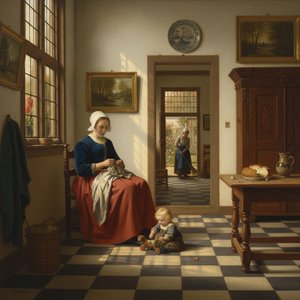
Pieter de Hooch: Illuminating Dutch Domestic Life & Golden Age Charm
Explore the captivating world of Pieter de Hooch, a master of Dutch Golden Age painting. Discover his innovative use of light, intimate domestic scenes, and lasting influence on art history. Learn more at OriginalUniqueArt.

Willem van de Velde the Elder: Master of Maritime Painting & Chronicler of the Dutch Golden Age
Discover the captivating maritime paintings of Willem van de Velde the Elder, a master chronicler of the Dutch Golden Age. Explore his unparalleled realism and lasting influence on naval art history.

Hollandske Mestre: Top 10 Værker fra Guldalderen – Kunst til Dit Hjem
Oplev de 10 mest ikoniske værker fra den hollandske guldalder! Rembrandt, Vermeer og andre mestre afsløres. Find inspiration til dit hjem & køb museumskvalitets kunsttryk på OriginalUniqueArt.com.


