Skift til printsalg
 Vis mere







































 For kunstværker eller reproduktioner, der er større end 105 cm (ca. 41 tommer) på en hvilken som helst side, vil rammen blive leveret som et adskilt sæt. Denne metode sikrer sikker levering og forhindrer skader under transport.


A Pivotal Moment in Mondrian’s Artistic Journey
Piet Mondrian, a foundational figure in modern abstract art, created the captivating painting Red Tree in 1908. This oil on canvas masterpiece is currently housed at the Haags Gemeentemuseum in the Netherlands. As we delve into the world of Mondrian’s early work, it becomes evident that "Red Tree" represents a pivotal moment in his artistic journey.Post-Impressionist Roots
Mondrian's transition from figurative painting to pure abstraction is well-documented. Red Tree exemplifies the post-impressionist style, characterized by its emphasis on capturing light and color. The painting features a blue tree with branches devoid of leaves, symbolizing winter. The striking red trunk stands out against the serene blue background, creating a sense of contrast that draws the viewer’s attention. This juxtaposition mirrors the stylistic explorations prevalent during this period—a conscious departure from traditional representation toward conveying emotion and atmosphere through color palettes reminiscent of artists like Cézanne and Van Gogh.Influence of Divisionism
Divisionism, also known as chromoluminarism, played a significant role in Mondrian's work during this period. This style, pioneered by Georges Seurat, involves separating colors into individual dots or patches to achieve maximum luminosity. Although Red Tree does not strictly adhere to divisionist principles, it reflects the influence of this movement in its use of vibrant, distinct colors. The careful placement and layering of these dots contribute to a textural quality that subtly hints at the underlying geometric structure—a precursor to Mondrian’s later embrace of neoplasticism.Proto-Cubism and Beyond
Mondrian's work during the early 1900s was also influenced by proto-cubism. This transitional phase saw artists experimenting with geometric forms and reduced color palettes. While Red Tree does not fully embrace cubist principles—specifically the fragmentation of objects into multiple perspectives—it foreshadows Mondrian’s later shift towards neoplasticism. The simplified shapes and planar surfaces anticipate the revolutionary approach to form championed by Picasso and Braque, establishing a crucial link between Impressionism and Cubism.Artistic Evolution
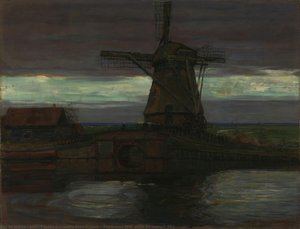
Mondrian's artistic evolution is evident in his subsequent works. For example, Piet Mondrian: Red Tree and Piet Mondrian: Silver Tree showcase his exploration of different styles. His later work, such as Piet Mondrian: Composition with yellow patch, reflects a more abstract and geometric approach. This progression demonstrates Mondrian’s unwavering commitment to distilling art down to its essential elements—a quest for universal beauty that would define his legacy as one of the most influential artists of the 20th century.For more information on Piet Mondrian and his works, visit Piet Mondrian at OriginalUniqueArt. To learn about the styles that influenced him, see Divisionism and Proto-Cubism.
Spørgsmål og svar
Hvad foreslås der at bruge "Rødt træ" af Piet Mondrian til?
En reproduktion af "Rødt træ" af Piet Mondrian anbefales til Accentfarve. Denne anbefaling er baseret på værkets motiv, stemning og farver.
Hvilken lysstyrke har "Rødt træ" af Piet Mondrian?
Farverne i "Rødt træ" har en Blød skygge luminans.
Hvilken stilart og hvilken epoke tilhører "Rødt træ" af Piet Mondrian?
I "Rødt træ" af Piet Mondrian mødes Andet-stilen med Moderne tid-æraen.
 Se i rummet
 Del som kort
 Del
Del
 Detaljer
 Guide
Guide

 Download
 Lignende værker
 Røntgenundersøgelse
 Diasshow
 Spørgsmål og svar
 Statistikker