Expressionism
Self-portrait (Paula Modersohn-Becker)
Paula Modersohn-Becker (1876–1907) har skabt Self-portrait. Det tilhører Expressionism-bevægelsen. Den er udført i Oil On Canvas. Det opbevares på Paula Modersohn-Becker Museum i Bremen, Germany.
- Oil On Canvas
- Paula Modersohn-Becker Museum, Bremen

 Se i rummet

 Håndmalet oliemalerie
 Del som kort
 Del
 Faktablad


 Download
 Lignende værker
 Røntgenundersøgelse
 Diasshow
 Spørgsmål og svar

 Statistikker
Self-portrait kort fortalt
- Titel
- Self-portrait
- Kunstner
- Paula Modersohn-Becker (1876–1907)
- Kunstner født i
- Dresden, Tyskland
- Medium
- Oil On Canvas
- Hvor det kan ses
- Paula Modersohn-Becker Museum, Bremen, Germany
- Bevægelse
- Expressionism
- Periode
- Modern
- Motiv
- woman, face, eyes, hair, skin, brown
Hvad forestiller Self-portrait?
Identification of the Self-portrait
The work titled Self-portrait is a creation by the German Expressionist painter and draftswoman Paula Modersohn-Becker. It captures a moment of quiet intensity through the artist's own likeness. This specific piece belongs to a vast body of work produced during her active life, a period that saw the creation of more than 700 paintings and over 1000 drawings.
Born on 8 February 1876 in Dresden, Germany, the artist developed a singular visual language. Her life was brief, ending in Worpswede on 30 November 1907. In this self-representation, she turns her gaze toward the viewer, using her own features to explore the essence of her identity. The image remains a direct encounter with the artist's presence.
Composition and Visual Elements
The composition is a tight enclosure. It focuses on the face and the upper torso, cropping the view just below the collarbone. This close-up framing pushes the subject forward, leaving little room for the background to breathe. Because of this narrow focus and the lack of detail behind her, the painting feels largely flat. The woman meets the viewer with a direct and intense gaze that anchors the entire arrangement.
Color arrives in muted, earthy tones. Browns, creams, and whites settle alongside quiet greens. These hues do not compete; they exist in a state of restraint. Lines define the contours of the face and the hair, yet they refuse to remain sharp. Instead, they soften into the surrounding colors. The shapes are organic and flowing, following the natural curves of the human form without the interruption of hard edges.
Light falls across the skin in a diffused, even manner. There are no heavy shadows or bright highlights to disrupt the surface. This evenness contributes to the sense of quietude. The subject remains still within her muted, tonal world. A steady, searching eye looks out from the center.
Technique and Artistic Style
The paint clings to the canvas in a rough, impasto-like texture. It is an oil work where colors are blended directly upon the surface, leaving behind the evidence of the hand. Visible brushstrokes mark the skin and hair, suggesting a spontaneous and expressive approach. This tactile application gives the surface a raw, immediate quality.
The style leans toward Expressionism, favoring the weight of feeling over the precision of academic tradition. A deliberate flattening of perspective removes the illusion of deep space, pushing the subject forward. The forms are simplified and almost primal, stripped of unnecessary detail to reach a core essence. The composition relies on these organic shapes to define the contours of the face and torso.
The artist rejects the polished finish of the past. Instead, she uses a heavy, direct method to build the presence of the figure. The light remains even and diffused, avoiding sharp shadows to maintain a sense of quiet intensity. The work exists as a direct encounter between the artist and the medium.
Related Works by the Artist
The artist’s gaze often turned toward her own reflection, seeking a quiet truth in the glass. In 1906, she painted Self-Portrait Looking Slightly Left, a work that shares the same searching quality found in her other studies of identity. During that same year, she produced Self-Portrait at 6th Wedding Anniversary and Self-Portrait on the 6th Wedding Anniversary, capturing a specific moment of transition. These works exist alongside her 1906 Self-Portrait nude with amber necklace, where the jewelry rests against her skin. She also created Self-Portrait with Red Flower Wreath and Necklace, a somber composition that explores the weight of her own presence.
Flowers often appear as silent companions in her compositions. Between 1906 and 1907, she worked on Self Portrait with Camellia Branch, a piece that emphasizes the intersection of the female form and the natural world. This connects to Self Portrait with Two Flowers, where she cradles blossoms with a deliberate, steady intention. Earlier, around 1904, she produced Self-Portrait with a bowl and a glass, a work from a period of intense exploration. Each image remains a fragment of a life lived through the brush. The paint dries on the canvas, holding a steady, unblinking stare.
Hvilket museum udstiller Self-portrait?
Paula Modersohn-Becker Museum
Bremen, Germany
The History of Paula Modersohn-Becker Museum Located in Bremen, Germany, the Paula Modersohn-Becker Museum holds a specific place in institutional history. It was established as a museum in 1927. This institution is the first in the world dedicated to the work of a female painter.
Højopløselige billeder af Self-portrait
Public domain: kunstneren døde i 1907.
Paula Modersohn-Becker, Self-portrait, Paula Modersohn-Becker Museum. Public domain
Spørgsmål om Self-portrait besvaret
Hvor kan jeg se det originale værk "Self-portrait" af Paula Modersohn-Becker?
Du kan se det originale værk "Self-portrait" på Paula Modersohn-Becker Museum, Bremen, Germany.
Hvilket medie er "Self-portrait" af Paula Modersohn-Becker udført i?
"Self-portrait" af Paula Modersohn-Becker er udført i Oil On Canvas. Reproduktionerne har til formål at gengive denne tekniks visuelle udtryk.
Hvad forestiller "Self-portrait" af Paula Modersohn-Becker?
"Self-portrait" af Paula Modersohn-Becker forestiller: woman, face, eyes, hair, skin, brown, cream, white.
Er billedet af "Self-portrait" af Paula Modersohn-Becker frit tilgængeligt i det offentlige domæne?
Ophavsretsstatus for "Self-portrait" af Paula Modersohn-Becker: værket er i det offentlige domæne – ophavsretten er udløbet. Dette afgør, om der frit må foretages reproduktioner af billedet.
Hvilken kunstner tilskrives "Self-portrait"?
"Self-portrait" tilskrives Paula Modersohn-Becker.
Hvilken stilart tilhører "Self-portrait"?
Kunstretningen forbundet med "Self-portrait" af Paula Modersohn-Becker er Expressionism. Denne klassificering placerer værket blandt relaterede kunstnere og kunstværker.
Hvor i Paula Modersohn-Beckers karriere placerer "Self-portrait" sig?
"Self-portrait" tilhører Mature Period i Paula Modersohn-Beckers karriere. Denne klassificering knytter værket til kunstnerens udvikling.
Hvorfor er ophavsretsstatus for "Self-portrait" som den er?
"Self-portrait" af Paula Modersohn-Becker er i det offentlige domæne – ophavsretten er udløbet. Ophavsretten beregnes ud fra kunstnerens dødsår, og Paula Modersohn-Becker døde i 1907.
Blev "Self-portrait" i kunstnerens hjemland?
Nej – kunstværket opbevares i udlandet. Paula Modersohn-Becker blev født i Tyskland, og det originale værk "Self-portrait" opbevares på et museum i Germany.
Om kunstneren, Paula Modersohn-Becker

1876–1907, Tyskland
Paula Modersohn-Becker
En Pioner i Indre Vision: Livet og Kunsten hos Paula Modersohn-Becker Paula Modersohn-Becker, et navn der klinger med stille kraft i kunsthistoriens annaler, var en kunstner, der turde se indad. Født Minna Hermine Paula Becker den 8. februar 1876 i Dresden, Tyskland, var hendes liv tragisk kort – hun døde den 30. november 1907 i Worpswede – men inden for disse tre årtier banede hun en vej af bemærkelsesværdig kunstnerisk innovation og personlig modstandskraft.
Om Paula Modersohn-Becker Bemærkelsesværdige værker af Paula Modersohn-Becker
Også af Paula Modersohn-Becker
 Portrait of a young woman with red hat1900
 Half-length portrait of an old farmer1903
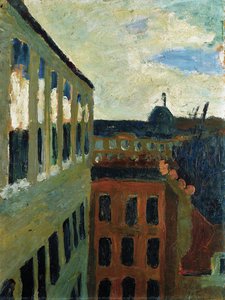 View from the studio window of the artist in Paris1900
 Still life with plant, lemon and orange1906
Essays om Self-portrait
 Egon Schiele: Top 25 Kunstværker – En Dybdegående Guide til Mesteren af EkspressionismenOplev Egon Schiele's 25 mest ikoniske kunstværker. Dyk ned i ekspressionismens intensitet, portrætter og nøgenkunst. Find inspiration til d…
 James Abbott McNeill Whistler: Top 25 Kunstværker – Skønhed, Harmoni & Historie | OriginalUniqueArtOplev James Abbott McNeill Whistlers 25 mest ikoniske kunstværker. Fordyb dig i æstetismens verden, tonale malerier & harmoniske kompositio…
 Polish artworks of the 1900sPolish Symbolism in the 1900s features masterpieces by Jacek Malczewski, Olga Boznańska, and Józef Mehoffer. View the full collection at Or…