Abstract Expressionism
Head (Jackson Pollock)
Jackson Pollock (1912–1956) har skabt Head. Det tilhører Abstract Expressionism-bevægelsen. Den er udført i Acrylic On Canvas.
- Acrylic On Canvas

 Se i rummet

 Håndmalet oliemalerie
 Del som kort
 Del
 Faktablad


 Download
 Lignende værker
 Røntgenundersøgelse
 Diasshow
 Spørgsmål og svar

 Statistikker
Head kort fortalt
- Titel
- Head
- Kunstner
- Jackson Pollock (1912–1956)
- Kunstner født i
- Cody, USA
- Medium
- Acrylic On Canvas
- Bevægelse
- Abstract Expressionism
- Periode
- Modern
- Motiv
- psychological, distortion, multiple eyes, chaos, surrealism, archetypal imagery
Hvad forestiller Head?
A Visceral Exploration of the Human Condition
Jackson Pollock’s *Head*, a work shrouded in some mystery due to its lack of definitive dating and detailed documentation, presents a profoundly unsettling yet captivating vision. It is not a portrait in any traditional sense; rather, it's a fragmented, distorted exploration of the human form pushed to the very edge of recognition. The image assaults the viewer with a multiplicity of eyes and mouths, scattered across a seemingly chaotic surface. This isn’t an attempt at realistic representation but a raw, visceral expression of inner turmoil, anxiety, and perhaps even existential dread. The painting feels less like looking *at* a head and more like being immersed *within* a fractured psyche.Echoes of Surrealism and the Primal Self
To understand *Head*, one must consider Pollock’s artistic journey during its creation – likely in the late 1930s or early 1940s. He was deeply influenced by the Surrealist movement, which sought to unlock the power of the unconscious mind. However, Pollock wasn't simply mimicking Surrealism; he was forging his own path. The multiple eyes and mouths suggest a breakdown of boundaries – a loss of control over perception and expression. This resonates with Jungian psychology, an area Pollock actively explored through therapy during this period. His psychoanalyst encouraged him to express himself through art, leading to drawings that delved into archetypal imagery and the darker recesses of the human psyche. The work also reveals echoes of Picasso’s explorations of distorted figures, particularly his interpretations of mythological creatures like the Minotaur – a symbol of primal instincts and inner conflict. Pollock wasn't merely copying these influences; he was internalizing them and transforming them into something uniquely his own.The Genesis of a Revolutionary Technique
While *Head* doesn’t yet exhibit Pollock’s signature “drip” technique in its fully developed form, it foreshadows the radical innovations that would soon define his career. The layering of forms, the sense of movement and energy within the composition, hint at the all-over painting style he would later perfect. He was beginning to move away from traditional easel painting and explore more direct, physical ways of applying paint to canvas. This experimentation stemmed from a desire to bypass conscious control and tap into a more authentic, spontaneous form of expression. The very act of creating *Head* – the building up of layers, the distortion of form – can be seen as a precursor to his later action paintings, where the process itself became as important as the final product. It’s a crucial stepping stone in understanding how Pollock moved from representational work towards complete abstraction.A Powerful Statement for Modern Interiors
For those considering a reproduction of *Head*, it's essential to understand its emotional weight and visual impact. This is not a painting that will blend seamlessly into the background; it demands attention, provokes thought, and sparks conversation. Its dark, unsettling energy can be surprisingly effective in modern interiors, particularly those with minimalist or industrial aesthetics. The fragmented forms and bold composition create a striking focal point, adding depth and complexity to any space. *Head* is more than just an artwork; it’s a statement – a testament to the power of art to confront us with uncomfortable truths about ourselves and the world around us. It's a piece that will resonate with those who appreciate challenging, thought-provoking art and are unafraid to embrace the darker side of human experience.Højopløselige billeder af Head
Public domain: kunstneren døde i 1956.
Jackson Pollock, Head. Public domain
Spørgsmål om Head besvaret
Hvilken teknik er "Head" udført med?
"Head" af Jackson Pollock er udført i Acrylic On Canvas. Reproduktionerne har til formål at gengive denne tekniks visuelle udtryk.
Hvad forestiller "Head" af Jackson Pollock?
"Head" af Jackson Pollock forestiller: psychological, distortion, multiple eyes, chaos, surrealism, archetypal imagery, emotional intensity.
Er billedet af "Head" af Jackson Pollock frit tilgængeligt i det offentlige domæne?
Hvad angår ophavsret, er "Head" i det offentlige domæne – ophavsretten er udløbet.
Hvem er kunstneren bag "Head"?
Kunstneren bag "Head" er Jackson Pollock. Værket er katalogiseret under Jackson Pollocks navn.
Hvilken kunstretning tilhører "Head" af Jackson Pollock?
Kunstretningen forbundet med "Head" af Jackson Pollock er Abstract Expressionism. Denne klassificering placerer værket blandt relaterede kunstnere og kunstværker.
Hvor i Jackson Pollocks karriere placerer "Head" sig?
"Head" repræsenterer Jackson Pollocks Mature Period.
Er "Head" af Jackson Pollock i det offentlige domæne, og hvorfor?
"Head" af Jackson Pollock er i det offentlige domæne – ophavsretten er udløbet. Ophavsretten beregnes ud fra kunstnerens dødsår, og Jackson Pollock døde i 1956.
Hvor placerer "Head" sig i forhold til Jackson Pollocks samlede værk?
"Head" deler med Jackson Pollocks øvrige værker sin Abstract Expressionism-stil og de gennemgående temaer: surrealist echoes, psychological depth, picasso’s distortion, jungian exploration, early technique foreshadowing.
Hvordan relaterer motivet i "Head" sig til Jackson Pollocks sædvanlige temaer?
Blandt Jackson Pollocks gennemgående temaer – surrealist echoes, psychological depth, picasso’s distortion, jungian exploration, early technique foreshadowing – bringer "Head" sit eget fokus på psychological, distortion, multiple eyes, chaos, surrealism, archetypal imagery, emotional intensity.
Om kunstneren, Jackson Pollock

1912–1956, USA
Jackson Pollock
Tidligt liv, familie og uddannelse Historien om Jackson Pollock begynder i det barske landskab i Cody, Wyoming, hvor han blev født den 28. januar 1912. Han var den yngste af fem brødre, født af Stella May McClure og LeRoy Pollock. Hans far arbejdede som landmåler, et erhverv der krævede konstant bevægelse over det enorme amerikanske Vesten.
Om Jackson Pollock Bemærkelsesværdige værker af Jackson Pollock
Også af Jackson Pollock
 Efterårskirtage Nr. 30, 1950
 Nummer 1, 19491950
 Konvergensen
 Nr. 1A
Essays om Head
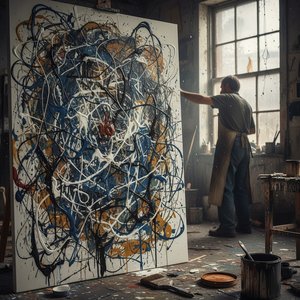 Paul Jackson Pollock: A Radical Departure – Exploring Abstract Expressionism's Pioneering Figure and His Enduring LegacyExplore the revolutionary art of Jackson Pollock & Abstract Expressionism. Discover his iconic drip paintings, lasting impact, and consider…
 Lucian Freud: A Psychological Portraiture of Post-War ExistenceExplore the profound psychological depth of Lucian Freud's portraits. Discover his unique realism, artistic evolution, and lasting influenc…
 Tre Lærreder, Én Sjæl: Valgets Emotionelle Landskab i KunstoplevelsenUdforsk kunsten som et spejl af sjælen! Dyk ned i emotionernes historie, æstetisk oplevelse og kurateringens kunst. Få ekspertråd til at væ…