Skift til printsalg
 Vis mere







































 For kunstværker eller reproduktioner, der er større end 105 cm (ca. 41 tommer) på en hvilken som helst side, vil rammen blive leveret som et adskilt sæt. Denne metode sikrer sikker levering og forhindrer skader under transport.


Paul Cézanne: A Revolutionary Vision
Paul Cézanne, born on January 19, 1839, in Aix-en-Provence, France, was a pivotal figure in the transition from late 19th-century Impressionism to early 20th-century Cubism. His father was a successful hatmaker who later became a banker, providing Cézanne with financial security that allowed him to pursue his artistic passions without immediate economic pressure. Initially intended to follow in his father’s footsteps and enter the legal profession, Cézanne eventually abandoned these plans to dedicate himself fully to art.
Early influences included Romanticism and the Barbizon school of landscape painting. He studied briefly at the Académie Suisse in Paris but largely developed his style independently. The works of Paul Gauguin and Georges Seurat, particularly their explorations of color and form, also played a significant role in shaping Cézanne’s artistic direction.
The Painting Style
Self-Portrait (Hermitage) is characterized by repetitive, exploratory brushstrokes and an emphasis on geometric forms. The painting features bold and vibrant colors, which were a hallmark of Cézanne's Post-Impressionist style. The artist’s use of thick and heavy brushstrokes adds a sense of texture and depth to the painting.
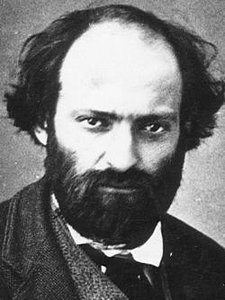
The image is a painting of a man with a beard and mustache, wearing glasses. He has a bald head and appears to be looking at the viewer. The man’s attire includes a suit and tie, giving him a formal appearance. The painting is in black and white, which adds an artistic touch to the image. The background of the painting features a yellow color that contrasts with the man’s outfit, creating a visually appealing composition.
Overall, the painting captures the essence of the man’s personality and style through its details and colors.
Significance in Portrait Painting
Self-Portrait (Hermitage) is an important work in the history of portrait painting, as it showcases Cézanne’s ability to capture the essence of his subjects while also experimenting with new techniques and approaches. The painting is housed in the State Hermitage Museum in Russia, where it remains one of the most popular attractions.
- For more information on https://OriginalUniqueArt.com
- Explore the collection of hand-made oil paintings reproductions at https://OriginalUniqueArt.com
- Learn more about Post-Impressionism and its key artists on Wikipedia
Discover the beauty of Cézanne’s works and the significance of Self-Portrait (Hermitage) in the world of art. Visit https://OriginalUniqueArt.com to explore a wide range of hand-made oil paintings reproductions, including works by Cézanne and other renowned artists.
Experience the magic of Post-Impressionism and the innovative style of Cézanne through his remarkable painting, Self-Portrait (Hermitage).
Spørgsmål og svar
Hvor kan jeg se en forhåndsvisning af "Self-portrait (Hermitage)"?
Se en forhåndsvisning af "Self-portrait (Hermitage)" af Paul Cézanne på værkets Forhåndsvisning-side.
Hvilken farvepalette og hvilken dominerende farve definerer "Self-portrait (Hermitage)"?
Farveidentiteten i "Self-portrait (Hermitage)" af Paul Cézanne: en Dark palet, domineret af Driftwood (#c2af3b).
Hvor harmonisk spiller farverne i "Self-portrait (Hermitage)" sammen?
Farveharmonien i "Self-portrait (Hermitage)" er beskrevet som Unified Palette.
 Se i rummet
 Del som kort
 Del
Del
 Detaljer
 Guide
Guide

 Download
 Lignende værker
 Røntgenundersøgelse
 Diasshow
 Spørgsmål og svar
 Statistikker