

 Se i fuld skala
 Del
Del Del
Del
 Detaljer

 Download
 Lignende værker
 Røntgenundersøgelse
 Diasshow
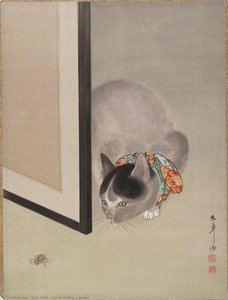
Cat Watching a Spider
 1888
1888 38.0 x 28.0 cm
 Se mere
Køb et højopløst, forbedret digitalt billede, der er langt bedre end online-forhåndsvisningen.
Hver fil er omhyggeligt forberedt af vores interne specialister ved hjælp af avancerede værktøjer og ekspertmæssig manuel retuschering. Vi sikrer, at hvert billede har enestående klarhed, præcis farvegengivelse og fine detaljer.
Den endelige fil leveres via e-mail inden for 72 timer og er optimeret til øjeblikkelig brug i professionelle, redaktionelle og trykte miljøer. Det er den samme kvalitet, som førende designstudier, forlag og gallerier har tillid til.
Digitalt billede
Download en højopløselig fil til personlig fremvisning, print og kreative projekter. ( Køb print Køb håndlavet maleri)
Inkluderet i alle ordrer på digitale billeder
Ekspert digital levering, garanteret
Når du vælger OriginalUniqueArt.com, får du ikke blot et billede – du modtager et professionelt optimeret digitalt kunstværk, skabt med præcision og sikret med en tilfredshedsgaranti. Her er alt, hvad din ordre automatisk indeholder:

Hurtig levering via e-mail
Din højkvalitets digitale billedfil vil blive sendt til din e-mail inden for 72 timer efter bestilling – klar til øjeblikkelig brug.

AI-optimeret digital fil
Dit kunstværk optimeres professionelt ved hjælp af avancerede AI-værktøjer og manuel redigering, hvilket sikrer maksimal detaljegrad, klarhed og farvenøjagtighed.

Gratis livslang genlevering
Har du ved en fejl slettet eller mistet din fil? Ingen bekymring – vi sender den igen til enhver tid, helt gratis.

Ingen importgebyrer – nogensinde
Nyd dit kunstværk med det samme uden told, afgifter eller leveringsgebyrer – digitale downloads er altid skattefrie.

Garanteret farvenøjagtighed
Vi sikrer, at dit digitale billede gengiver de originale farver så præcist som muligt ved hjælp af professionelle værktøjer og farvestyring.

60 dages tilfredshedsgaranti
Hvis du ikke er tilfreds med dit digitale billede, vil vi revidere det eller refundere 100% inden for 60 dage – uden spørgsmål.

100% Pengene tilbage-garanti
Ik tilfreds? Få fuld refusion inden for 60 dage efter modtagelse af din digitale fil – uden spørgsmål.

Mængderabat
Køb 3 billeder, spar 10% - Køb 5, spar 15% - Køb 10+, spar 20%. Ideelt til kreative projekter, gallerier og bureauer.
Kunstnerens biografi
Oide Tōkō: A Master of Subtle Emotion in the Meiji Era
Born in Tokyo in 1841, Oide Tōkō (also known as Ōide Aya) emerged during a pivotal period in Japanese history – the Meiji Restoration (1868-1912). This era witnessed rapid modernization and Westernization alongside a fervent desire to preserve traditional Japanese aesthetics. Tōkō’s work stands as a compelling testament to this complex interplay, offering intimate glimpses into daily life and profound explorations of human emotion within a distinctly Japanese framework.
Early biographical details about Tōkō are somewhat sparse, though he was recognized as a skilled painter from an early age. His formal training remains largely undocumented, suggesting he may have been part of a guild system or learned through apprenticeship – common practices for artists at the time. The name “Kagyu-zuruya” (蝸牛窟), often associated with his work, translates to "snail shell cave," hinting at a secluded and contemplative artistic practice. His courtesy name, Sōkyō 素巧, meaning “simple skill,” reflects a dedication to understated elegance and naturalism in his compositions.
A Palette of Quiet Observation
Tōkō’s style is characterized by its remarkable subtlety and psychological depth. He primarily worked in ink and color on silk or paper, employing a delicate brushwork that prioritized capturing fleeting moments and nuanced expressions. Unlike the grand narratives often favored during the Meiji period, Tōkō's paintings frequently depict solitary figures engaged in quiet activities – a woman tending to her garden, a child playing with a toy, or a man gazing pensively into the distance. These scenes are not dramatic; rather, they convey a sense of serene contemplation and understated emotion.
His most famous work, “Cat Watching a Spider” (猫と蜘蛛), exemplifies this approach perfectly. The painting isn’t about action or spectacle but about the quiet observation of two creatures sharing a space. The cat's expression is ambiguous – curiosity, boredom, perhaps even a touch of melancholy – inviting viewers to project their own emotions onto the scene. This ability to evoke such complex feelings with minimal visual elements was a hallmark of Tōkō’s artistry.
Influences and Artistic Context
Tōkō's work is deeply rooted in traditional Japanese painting techniques, particularly those associated with the yamato-e style – a school emphasizing naturalism and emotional expression. However, he also absorbed influences from Western art, notably Impressionism’s focus on capturing light and atmosphere. The subtle gradations of color in his paintings, reminiscent of Monet or Renoir, demonstrate this assimilation without sacrificing the core tenets of Japanese aesthetics.
During the Meiji period, there was a conscious effort to promote both Western and Eastern art forms. Tōkō’s work gained recognition as Japan sought to establish its own unique artistic identity. His paintings were exhibited in Japan and internationally, contributing to a growing appreciation for Japanese art abroad.
Legacy and Market Value
Oide Tōkō died in 1905, leaving behind a relatively small but highly valued body of work. His paintings have been offered at auction multiple times, with prices ranging from $1,000 to $5,000, reflecting their increasing recognition as significant examples of Meiji-era Japanese art. His ability to capture the quiet dignity and emotional resonance of everyday life continues to resonate with collectors and viewers today.
His work is a poignant reminder that beauty and profound meaning can be found not in grand gestures but in the subtle details of human experience – a lesson beautifully articulated by Oide Tōkō through his evocative paintings. The Dictionary of Artists in Japan (DAJ) highlights his birthdate as May 24, 1841, and his death date as March 14, 1905, solidifying his place within the historical record of Japanese art.
oide tōkō
1841 - 1905 , Japan
Kort om kunstneren
- Artistic Movement Or Style: Meiji period art
- Date Of Birth: 1841-05-24
- Date Of Death: 1905-03-14
- Full Name: oide tōkō
- Nationality: Japanese
- Notable Artworks: ['Cat Watching a Spider']
- Place Of Birth: Tokyo, Japan

