
 Se i fuld skala
 Del
Del Del
Del
 Detaljer

 Download
 Lignende værker
 Røntgenundersøgelse
 Diasshow
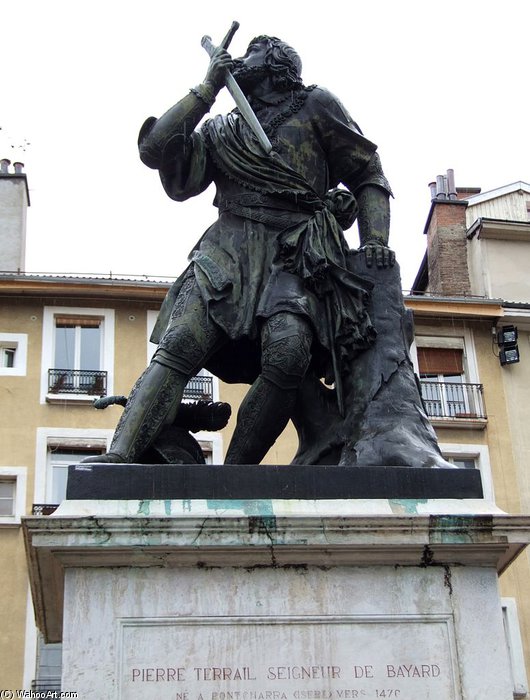
Statue Du Chevalier Bayard
 Se mere
Håndlavet oliereproduktion
Håndmalet olie på lærred i din valgte størrelse og ramme, udført efter bestilling af vores kunstnere. ( Køb print Køb billede)




































Vælg mellem vores forudindstillede størrelser, der matcher kunstværkets originale proportioner.

Du kan indtaste dine egne mål for at passe til en bestemt ramme eller plads. Hvis den valgte størrelse ikke stemmer overens med det originale billedes proportioner, vil vi enten beskære kunstværket eller udvide maleriet med yderligere håndmalede elementer. En digital skitse sendes til din godkendelse, før produktionen påbegyndes.
Bemærk venligst, at forhåndsvisningen på skærmen ikke afspejler den faktiske beskæring eller udvidelse. Kun skitsen vil nøjagtigt vise den endelige komposition.
Selvom specialmål er mulige, anbefaler vi at vælge en dimension fra den foruddefinerede liste for at bevare de originale proportioner.
Efter bestilling vil OriginalUniqueArt.com team sende en e-mail til kunden for at få instruktioner og levere et udkast til en skitse.
Levering i hele verden () på 3/4 uger i stedet for de standard 5 uger. (20 august). Ingen kompromiser med kvaliteten.

Gratis ekspresforsendelse til hele verden

Lærred af linned i høj kvalitet

Fuld transportforsikring

Garanti for refusion af told og importafgifter

Garanti for præcis farvegengivelse

60 dages returret (kun ved fabrikationsfejl)

100% Tilfredshedsgaranti

Mængderabat tilgængelig
 Glasmulighed er kun tilgængelig i størrelser under 110 cm

Statue Du Chevalier Bayard
Reproduktionsmetode
Størrelse på reproduktion
-


Samlet pris
$ 300
Kunstnerens biografi
The Marble Legacy of Nicolas Bernard Raggi
In the heart of Carrara, Italy, where the mountains yield their purest white stone, the destiny of Nicolas Bernard Raggi was etched into the very landscape of his birth. Born in 1790, Raggi emerged from a lineage of craftsmanship, the son of a sculptor who provided him with more than just an education; he provided a direct connection to the soul of the marble. This early immersion in the tactile reality of stone allowed Raggi to develop a profound intimacy with his medium, a skill that would later allow him to transform cold, unyielding blocks into breathing monuments of French history. His formative years were defined by the pursuit of classical perfection, heavily influenced by the shadows of masters like Antonio Canova, whose principles of idealized beauty and anatomical grace became the cornerstone of Raggi’s artistic language.
As his career migrated from the quarries of Italy to the imperial splendor of France, Raggi’s talent found its true purpose: the immortalization of greatness. During the reign of Napoleon III, he ascended to the heights of the sculptural hierarchy, becoming the preferred hand for commissions that required both monumental scale and psychological depth. His work was not merely about capturing a likeness, but about projecting an aura of stability, nobility, and historical continuity for the French nation. Through his mastery of Carrara marble, Raggi achieved a rare feat in neoclassical sculpture—the ability to imbue stone with a palpable vitality, where the subtle gradations of light across a carved drapery or the soft tension in a hero's gaze suggested a life caught in a moment of eternal stillness.
Monuments of Chivalry and Crown
The true significance of Raggi’s oeuvre lies in his ability to personify the legends of France. He did not merely sculpt men; he sculpted the very essence of French identity. His most celebrated achievements are found in the colossal figures that continue to grace the urban landscape of Paris and beyond, serving as silent sentin's of a bygone era of chivalry and monarchy.
- The Spirit of Chivalry: In his depictions of Bayard, the legendary knight, Raggi captured the rugged nobility of the "knight without fear and beyond reproach." His ability to render the weight of armor and the resolute expression of a warrior created a symbol of courage that resonated deeply with the romantic ideals of his time.
- The Majesty of Monarchy: Through his monumental portraits of Henri IV, Raggi utilized the pristine clarity of Carrara marble to evoke the grandeur of the Bourbon era. These works served as powerful political instruments, using the permanence of stone to reinforce the legitimacy and historical weight of the French crown.
- Historical Continuity: His versatility extended to figures such as Hugues Capet, demonstrating a capacity to traverse different eras of French history, weaving together the threads of the Carolingian past with the imperial present through a unified neoclassical aesthetic.
Raggi’s technical prowess was characterized by an extraordinary command over texture and form. He possessed the rare ability to manipulate marble so that it mimicked the softness of skin or the heavy folds of royal velvet, creating a sensory experience for the viewer. This meticulous approach ensured that his sculptures were not merely static objects of veneration but dynamic narratives in stone. Even as the political tides of France shifted, Raggi’s works remained steadfast, providing a sense of permanence and dignity. His legacy remains etched in the public squares of Europe, where his marble heroes continue to stand as testament to an era when art was the ultimate vessel for national memory and the pursuit of classical perfection.

nicolas bernard raggi
1790 - 1862 , Italy
Kort om kunstneren
- Artistic Movement Or Style: Neoclassical Sculpture
- Artists Or Movements Influenced By This Artist: ['Classical Art']
- Artists Who Influenced This Artist: ['Antonio Canova']
- Date Of Birth: Carrara, Italy (1790)
- Date Of Death: 1862
- Full Name: Nicolas Bernard Raggi
- Nationality: Italian
- Notable Artworks:
- Henri IV
- Monument To Comte Frochot
- Hugues Capet
- Place Of Birth: Carrara

