

 Se i rummet
 Send
Send Del
Del
 Detaljer
 Studieguide til kunstværker

 Download
 Lignende værker
 Røntgenundersøgelse
 Se diasshow
 Statistik
Gethsemane
 Oil On Board
- Neo-Romanticism
 1926
1926- Modern
 42.0 x 32.0 cm
 Bergen Kunstmuseum
 Læs mere
Håndlavet oliereproduktion
Håndmalet olie på lærred i din valgte størrelse og ramme, udført efter bestilling af vores kunstnere. ( Skift til printversion Skift til digitalt billede)




P118B Dkr10

P118H Dkr10

P118W Dkr10

P438Z Dkr10

P508JH Dkr12

P508YH Dkr12

P805H Dkr10

P805Z Dkr10

P919BZ Dkr10

P919G Dkr10

P919XJ Dkr10

P959ZH Dkr10

P968JZ Dkr12

W106C Dkr8

W218G Dkr10

W218JH Dkr8

W218Y Dkr10

W307PJ Dkr10

W316G Dkr10

W316PJ Dkr8

W316Y Dkr10

W398PJ Dkr8

W4111J Dkr10

W500HY Dkr15

W500JH Dkr15

W692G Dkr12

W849H Dkr8

W940BG Dkr15

W953PJ Dkr8




Vælg mellem vores forudindstillede størrelser, der matcher kunstværkets originale proportioner.

Indtast den bredde og højde, du har brug for, så det passer til din ramme eller din væg. Da dette er håndmalet, kan kunstneren ved en anden form på størrelsen male lidt mere rundt om billedet eller skære lidt væk — det er op til dig. Vi sender dig et digitalt mockup til godkendelse, før maleriet påbegyndes. Billedet, der vises på denne side, viser ikke det endelige resultat — det er kun mockuppet, der gør.
Efter bestilling vil OriginalUniqueArt.com team sende en e-mail til kunden for at indhente instruktioner og fremsende et udkast til gennemgang.
Levering i hele verden () på 3-4 uger i stedet for de standard 5 uger. (21 oktober). Ingen kompromiser med kvaliteten.

Gratis ekspresforsendelse til hele verden

Lærred af linned i høj kvalitet

Komplet transportforsikring

Garanti for refusion af told og importafgifter

Garanti for autentisk farvegengivelse

100 dages returret ved fabrikationsfejl

100% fuld returret

Mængderabat ved flere køb
 Glasmulighed er kun tilgængelig i størrelser under 110 cm

Gethsemane
Reproduktionsmateriale
Reproduktionsstørrelse
-


Samlet pris
Dkr 1957
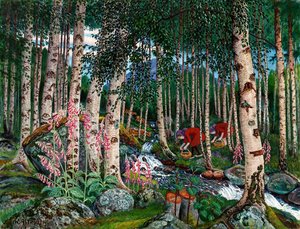
A Visionary Encounter in the Norwegian Garden
In the quiet, evocative depths of Nikolai Astrup’s 1926 masterpiece, Gethsemane, the boundaries between biblical history and the intimate landscapes of Norway begin to dissolve. While the title refers to the sacred garden in Jerusalem where Christ faced his darkest hour, Astrup performs a profound act of artistic localization. He transports this monumental moment of spiritual agony into the familiar, lush surroundings of the parsonage garden in Ålhus. This is not merely a religious illustration; it is a dreamlike fusion of the divine and the terrestrial. The viewer is invited into a space where the heavy atmosphere of the crucifixion narrative meets the verdant, mystical textures of the West Norwegian landscape, creating a scene that feels both ancient and deeply personal.
The composition breathes with a sense of quiet drama, capturing a moment of profound transition. As the eye wanders through the painting, one encounters a scene that oscillates between a somber historical event and a visionary hallucination. The presence of figures—some appearing caught in the weight of the narrative, others seemingly lost in a trance-like state—suggests a world where the veil between reality and the supernatural is perilously thin. This sense of mystery is heightened by the scattered birds that drift through the sky and perch upon the landscape, acting as silent witnesses to the unfolding drama. For the collector or designer, this piece offers more than just a subject; it offers an atmosphere of contemplative depth that can anchor a room with its soulful, introspective energy.
Technique and the Language of Light
Astrup’s technical mastery is evident in his use of oil on cardboard, a medium that allows for a rich, concentrated application of pigment. His style, rooted in Neo-Romanticism, eschews clinical realism in favor of an intense, emotive color palette. The textures are tactile and layered, reflecting the artist's lifelong obsession with the "visual language" of his homeland. He employs light not just to illuminate form, but to evoke mood; the shadows are deep and heavy, yet they are pierced by a spectral luminosity that suggests the presence of a divine vision. This interplay of light and shadow creates a rhythmic movement across the canvas, guiding the viewer through the dense foliage and toward the heart of the spiritual struggle.
The brushwork possesses a certain raw, organic vitality that mirrors the ruggedness of the Norwegian fjords. There is no sterile perfection here; instead, there is a deliberate, expressive quality that celebrates the natural world's untamed spirit. For those seeking to incorporate fine art into a sophisticated interior, a high-quality reproduction of Gethsemane provides a centerpiece of immense character. The painting’s ability to command attention through its complex textures and brooding tones makes it an ideal choice for spaces designed for reflection, such as libraries, study alcoves, or quiet sitting rooms where the interplay of history and nature can be fully appreciated.
A Legacy of Spiritual and National Identity
To understand Gethsemane is to understand Nikolai Astrup’s broader mission: to capture the very soul of Norway. By situating a universal Christian narrative within his own local topography, he elevates the Norwegian landscape to a stage for the eternal. This technique of "sacralizing" the everyday—turning a simple garden patch into a site of cosmic significance—is what makes his work so enduringly powerful. The painting serves as a bridge between the theological and the topographical, making the profound accessible through the familiar.
For the discerning art lover, owning a reproduction of this work is an opportunity to possess a fragment of this visionary legacy. It is a piece that invites continuous re-examination, revealing new layers of symbolism and emotion with every viewing. Whether one is drawn to its historical weight, its masterful use of color, or its ability to evoke the misty, magical atmosphere of a Norwegian night, Gethsemane remains a breathtaking testament to the power of art to transform the world we see into a world we feel.
Spørgsmål & svar
Er "Gethsemane" af Nikolai Astrup i det offentlige domæne, og hvorfor?
Ophavsretsstatus for "Gethsemane" - i det offentlige domæne – ophavsretten er udløbet - følger af kunstnerens død i 1928.
Hvilke motiver optræder i "Gethsemane" af Nikolai Astrup?
"Gethsemane" af Nikolai Astrup forestiller: biblical scene, religious, jesus christ, gethsemane, norway landscape, night scene, visionary.
Hvordan er "Gethsemane" placeret historisk set?
Historisk set er "Gethsemane" et Neo-Romanticism værk fra den bredere Modern æra.
Om kunstneren
Nikolai Astrup: En visionær fra Vestlandet
Nikolai Astrup (1880 – 1928) står som en enestående skikkelse i norsk kunsthistorie—en maler, hvis dybe forbindelse til landskaberne og traditionerne i Vestlandet cementerede hans plads blandt de mest markante nyromantiske kunstnere i sin tid. Astrup blev født i Bremanger, Sogn og Fjordane, og hans opvækst midt iblandt de rå fjorde og fredfyldte dale formede hans kunstneriske sans dybtgående. Dette drev ham mod en stil karakteriseret ved intense farvepaletter og en urokkelig dedikation til at skildre hverdagslivet i det landlige Norge. Hans eftermæle findes ikke blot i æstetisk smukke lærreder, men også i hans pionerarbejde med at indfange et "nationalt visuelt sprog", der fremmanede traditionerne og folkloren fra hans hjemland.- Tidligt liv og uddannelse: Astrups formative år var præget af en familiær fromhed, indgydt af hans far, Christian Astrup, en sognepræst der opmuntrede ham til teologiske studier. På trods af de indledende tilbøjeligheder mod præsteministeriet, førte Astrups passion for tegning og maleri ham i sidste ende til at forlade Trondheim Katedralskole til fordel for kunstneriske bestræbelings i Kristiania (Oslo), hvor han forfinede sine færdigheder under Harriet Backers vejledning.
- <Parisisk indflydelse: Et kort ophold i Paris eksponerede Astrup for den spirende avantgarde-bevægelse, hvilket skabte forbindelser til medkunstnere som Christian Krohg og berigede hans forståelse for impressionistiske teknikker. Denne periode cementerede hans engagement i eksperimenter og udvidede hans kunstneriske horisonter.
- <Hjemkomsten til Jølster og kunstnerisk udvikling: Da han vendte tilbage til sit arvested i Jølster i 1902, etablerede Astrup et hjem centreret omkring sin hustru, Engel Sunde, med hvem han fik otte børn. De økonomiske udfordringer i deres liv nærede hans kunstneriske drivkraft og motiverede ham til fuldt ud at fordybe sig i skildringen af sine omgivelser—et landskab, der fungerede som en evig kilde til inspiration.
- <Bemærkelsesværdige udstillinger: Astrups kunstneriske ry voksede støt gennem tre betydningsfulde udstillinger i Kristiania (1905), Bergen (1908) og Oslo (1911). Disse fremvisninger høstede kritisk anerkendelse og etablerede ham som en ledende stemme inden for den norske kunstscene.
- <Store bedrifter og eftermæle: Astrups vedvarende bidrag til norsk kunst ligger i hans urokkelige stræben efter kunstnerisk autenticitet—en forpligtelse til at skildre Vestlandets skønhed og ånd med kompromisløs ærlighed. Hans malerier fortsætter med at resonere i dag og tjener som kraftfulde symboler på national kulturarv, mens de legemliggør nyromantikkens idealer.
Nikolai Astrup
1880 - 1928 , Norge
Hurtige fakta
- Artistic Movement Or Style: Nyromantik
- Artists Or Movements Influenced By This Artist: ['Skandinavisk kunst']
- Artists Who Influenced This Artist: ['Christian Krohg']
- Date Of Birth: 1880
- Date Of Death: 1928
- Full Name: Nikolai Johannes Astrup
- Nationality: Norsk
- Notable Artworks:
- Den ivrige frier
- Nøgne træer
- Pige der spinder
- Place Of Birth: Bremanger, Norge
Relaterede artikler

Johan Christian Dahl: Pioneering Norwegian Romantic Landscape Painting
Explore the life & art of Johan Christian Dahl, Norway's first great Romantic painter. Discover his iconic landscapes, cultural impact, and lasting legacy with OriginalUniqueArt.

Romantikkens Landskaber: Top 10 Malerier der Definerede En Æra | OriginalUniqueArt
Oplev romantikkens storhedstid! Dyk ned i top 10 landskabsmalerier af Caspar David Friedrich, Turner & Constable. Historiske fortællinger og museumskvalitets reproduktioner på OriginalUniqueArt.com – find din inspiration til væggen her!

John Constables 25 Mesterværker: En Hyldest til Englands Landskabskunst | OriginalUniqueArt.com
Oplev John Constables 25 mest ikoniske værker! Fordyb dig i engelsk romantik, betagende landskaber og tidløs skønhed. Køb museumskvalitets reproduktioner af 'The Hay Wain' & mere på OriginalUniqueArt.com – inspiration til dit hjem.

Evocations of Place: A Historical Journey Through Landscape Art
Explore the rich history of landscape art with OriginalUniqueArt. Discover renowned artists, movements like Impressionism & Romanticism, and expert guidance for collecting timeless pieces. Find your perfect serene escape today!

The Sublime and the Picturesque: Exploring Emotion & Nature in Romantic Landscape Painting
Explore the emotional power of Romantic landscape painting! Discover the sublime & picturesque traditions, key artists like Friedrich & Cole, and find your perfect artwork at OriginalUniqueArt.