

 Se i rummet
 Del som kort
 Del
Del
 Detaljer
 Guide
Guide

 Download
 Lignende værker
 Røntgenundersøgelse
 Diasshow
 Q&A
Q&A Statistikker
The Examination (Das Verhören)
 Oil On Canvas
- WallArt
- 19th Century Realism
 1868
1868 66.0 x 54.0 cm
 Det Jødiske Museum
 Vis mere
Giclée / Kunsttryk
Giclée- eller lærredstryk i museumskvalitet med hurtig produktion og fleksible muligheder for finish. ( Køb håndmalet maleri Skift til digitalt billede)




P118B Dkr10

P118H Dkr10

P118W Dkr10

P438Z Dkr10

P508JH Dkr12

P508YH Dkr12

P805H Dkr10

P805Z Dkr10

P919BZ Dkr10

P919G Dkr10

P919XJ Dkr10

P959ZH Dkr10

P968JZ Dkr12

W106C Dkr8

W218G Dkr10

W218JH Dkr8

W218Y Dkr10

W307PJ Dkr10

W316G Dkr10

W316PJ Dkr8

W316Y Dkr10

W398PJ Dkr8

W4111J Dkr10

W500HY Dkr15

W500JH Dkr15

W692G Dkr12

W849H Dkr8

W940BG Dkr15

W953PJ Dkr8




Vælg mellem vores forudindstillede størrelser, der matcher kunstværkets originale proportioner.

Indtast den bredde og højde, du har brug for, så det passer til din ramme eller din væg. Et print kan kun beskæres, aldrig gøres større end selve billedet, så en størrelse med et andet format vil medføre, at dele af motivet går tabt. Vi sender dig en digital mockup til godkendelse, før vi printer noget. Billedet vist på denne side viser ikke den faktiske beskæring — det er kun mockuppen, der gør.
Verdensomspændende levering () på 2 uger i stedet for de sædvanlige 4/5 uger. (29 oktober)

Gratis ekspresforsendelse til hele verden

Lærred af linned i høj kvalitet

Fuld transportforsikring

Garanti for refusion af told og importafgifter

Garanti for præcis farvegengivelse

100 dages returret ved fabrikationsfejl

100% fuld returret

Mængderabat ved flere køb
 Glasmulighed er kun tilgængelig i størrelser under 110 cm

The Examination (Das Verhören)
Giclée / Kunsttryk
Størrelse på reproduktion
-


Samlet pris
Dkr 533
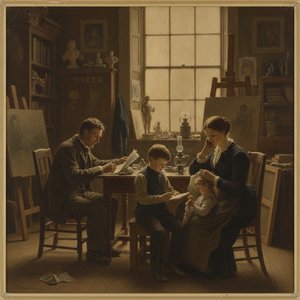
The Intimate Portrait of Family Life: Moritz Daniel Oppenheim’s “The Examination”
Moritz Daniel Oppenheim's "The Examination," painted in 1868, is more than just a domestic scene; it’s a poignant window into the heart of 19th-century Jewish family life. This intimate portrait, rendered with remarkable sensitivity and detail, captures a moment of quiet contemplation within a warmly lit living space – a space that speaks volumes about tradition, education, and familial bonds. The painting immediately draws the viewer in, not with grand gestures or dramatic action, but through the subtle interplay of glances, postures, and the palpable sense of connection between father and daughters.
Oppenheim’s style leans heavily towards Realism, yet it transcends mere representation. He masterfully employs a muted color palette – predominantly browns, creams, and ochres – to create an atmosphere of understated elegance and domestic tranquility. The lighting is particularly noteworthy; it's diffused and natural, casting gentle shadows that enhance the three-dimensionality of the figures and their surroundings. The artist’s brushwork is deliberate and controlled, meticulously building up layers of paint to achieve a rich texture and a sense of depth. Notice how he subtly captures the textures of the fabrics – the worn velvet chair, the simple wooden table, the folds in the women's dresses – adding an incredible level of realism and grounding the scene.
A Glimpse into Jewish Life and Education
The painting’s subject matter is deeply rooted in the social and cultural context of its time. “The Examination” depicts a father, presumably a scholar or religious leader, seated with his two daughters. He's absorbed in reading a book, while they attentively observe him, suggesting a scene of learning and guidance. This wasn’t simply a casual family gathering; it represented a crucial element of Jewish upbringing – the transmission of knowledge and tradition from one generation to the next. The presence of the books scattered around the room reinforces this theme, hinting at a home filled with intellectual pursuits and a commitment to education.
Oppenheim’s decision to portray a family scene within a Jewish context was groundbreaking for its time. While many artists were depicting Jewish subjects, Oppenheim's work focused on portraying everyday life, familial relationships, and religious practices – offering a more nuanced and intimate representation of the Jewish community than previously seen in Western art. This focus aligns with the burgeoning “Wissenschaft des Judentums” (Jewish knowledge) movement, which sought to study Judaism as an academic discipline, documenting its history, culture, and traditions.
Symbolism and Emotional Resonance
Beyond its straightforward depiction of a family moment, "The Examination" is rich in symbolic detail. The vase positioned centrally on the table – holding fresh fruit – can be interpreted as representing knowledge, wisdom, or even reward. The gesture of the father pointing to the book, combined with the daughters’ attentive expressions, suggests a process of learning and understanding. The overall mood is one of quiet dignity and affection, conveying a sense of warmth and familial harmony.
Furthermore, the painting subtly alludes to the importance of Jewish tradition and heritage. The setting itself – a comfortable home filled with books – speaks to a commitment to intellectual pursuits and the preservation of cultural values. The scene evokes a feeling of stability, continuity, and the enduring strength of family bonds. It’s a testament to Oppenheim's ability to capture not just a visual likeness but also the emotional essence of his subjects.
A Timeless Masterpiece – Reproduction Considerations
Reproductions of “The Examination” offer a remarkable opportunity to bring this evocative artwork into your home or office. When selecting a reproduction, consider the quality of the print and the canvas or paper used. A high-resolution digital print on archival-quality canvas will ensure that the colors and details are faithfully reproduced, capturing the painting’s subtle nuances and rich textures. The original's muted palette translates beautifully to a wide range of interior design styles – from traditional to contemporary – adding a touch of understated elegance and intellectual warmth.
As an investment piece, a high-quality reproduction of “The Examination” is more than just a decorative item; it’s a window into the past, a celebration of family life, and a testament to the artistic vision of Moritz Daniel Oppenheim. It's a reminder that even in quiet moments, profound beauty and enduring values can be found.
Spørgsmål og svar
Hvilken følelse vækker "The Examination (Das Verhören)" som gave?
Med sin Reflective stemning anbefales "The Examination (Das Verhören)" af Moritz Daniel Oppenheim som en gave til Wedding.
Hvor lys eller mørk fremstår "The Examination (Das Verhören)" af Moritz Daniel Oppenheim?
I forhold til den oplevede lysstyrke er "The Examination (Das Verhören)" af Moritz Daniel Oppenheim deep_shadow.
Hvem sælger håndmalede kopier af "The Examination (Das Verhören)" af Moritz Daniel Oppenheim?
"The Examination (Das Verhören)" er tilgængelig som en håndmalet oliereproduktion på lærred af hør. Du kan bestille den på dens Håndmalet reproduktion-side, hvor du kan vælge mellem forskellige størrelser.
Kunstnerbiografi
En visionær af jødisk identitet
Moritz Daniel Oppenheim (1800-1882) står som en enestående skikkelse i den tyske kunsthistories annaler, som en dybsindig pioner inden for jødisk kunstnerisk repræsentation. Han blev født i Hanau, Tyskland, og hans liv og virke var dybt forankret i en dedikation til at dokumentere og fejre nuancerne i det jødiske liv og kultur under det transformative 19. århundrede. Han blev ofte hyldet som den første jødiske maler, der opnåede bred anerkendelse i det etablerede kunstneriske landskab, idet han bevægede sig ud over blot biografiske detaljer for at skabe et værk, der udgør en vital visuel registrering af et samfund, der navigerede gennem moderniseringens kompleksiteter, mens det stræbte efter at bevare sine hellige traditioner.
Oppenheims kunstneriske rejse begyndte med den grundlæggende uddannelse under Conrad Westermayr i hans fødeby, hvor han først opsugede principperne i tysk romantisk maleri. Hans sande professionelle opstigning blev dog katalyseret af hans indskrivning på Münchens Kunstakademi i en alder af sytten år. Det var i disse prestigefyldte sale, at han forfinede sin tekniske mesterlighed side om side med samtidige som Wilhelm Leibl og Johann Baptist Eberhard Krauss. I søgen efter at udvide sine horisonter begav Oppenheim sig ud på en transformativ periode med studier i udlandet, hvor han rejste til Paris for at studere under Jean-Baptiste Regnault og senere til Rom. I Italien, vejledt af lysende skikkelser som Bertel Thorwaldsen og den nazarenske maler Johann Friedrich Overbeck, udviklede hans stil sig til en sofistikeret blanding af minutiøs observation og klassisk indflydelse. Denne romerske periode var særligt afgørende, da den indgydede hans arbejde med en følelse af historisk tyngde, som senere ville præge hans skildringer af jødiske ritualer og dagligliv.
Kunsten om intimitet og tradition
Kernen i Oppenheims bidrag til kunsten ligger i hans evne til at transformere den hjemlige sfære til en scene for dybe kulturelle fortællinger. Hans malerier fokuserer ofte på intime scener fra det jødiske familieliv, hvor han indfanger ritualernes stille værdighed og de fælles bånds varme. Gennem hans pensel bliver det hverdagsagtige monumentalt. I værker som Sabbattens afslutning (Sabbath-Ausgang) anvender han mesterlig realisme og subtil symbolik til at skildre den rørende overgang fra sabbattens hellige hvile tilbage til den verdslige verden, hvilket inviterer beskueren til at vidne om familiens ritualers hellighed.
Hans evne til at væve historisk kontekst sammen med personlig følelse er måske tydeligst i hans genremalerier, der dokumenterer specifikke kulturelle milepæle. For eksempel:
- Brylluppet (Die Trauung): En bjergtagende detaljeret skildring af et jødisk bryllup i 1866 i Frankfurt-ghettoen, hvor Oppenheim indfanger de traditionelle klædedragters pragt og bryllupsbaldakinens højtidelighed, hvilket tilbyder et sjældent og bevaret glimt af en forsvindende livsform.
- Frivilligens hjemkomst: I dette storslåede oliemaleri fra 1834 udforsker han krydsfeltet mellem jødisk arv og den bredere europæiske historie ved at portrættere en soldat, der vender hjem fra befrielseskrigene til en familie, der stadig lever efter gamle skikke, hvilket effektivt illustrerer spændingen mellem napoleonskrigenes politiske skift og en vedvarende religiøs identitet.
Eftermæle og historisk betydning
Udover hans tekniske kunnen er Oppenheims arbejde uadskilleligt forbundet med Wissenschaft des Judentums-bevægelsen – et videnskabeligt bestræbelse på at etablere jødisk historie og kultur som et respekteret akademisk felt. Hans malerier fungerede som visuel forskning, der leverede en værdig og autentisk repræsentation af et samfund, som ofte var marginaliseret i den bredere europæiske kunstkanon. Ved at portrættere jødiske motiver med samme grad af detaljerigdom, værdighed og romantisk storhed, som normalt var forbeholdt aristokratiske eller mytologiske temaer, udfordrede han eksisterende fordomme og cementerede betydningen af jødisk identitet i den tyske kulturelle struktur.
I sidste ende er Moritz Daniel Oppenheims eftermæle et vidnesbyrd om modstandskraft og synlighed. Han malede ikke blot scener; han konstruerede et visuelt sprog for en brydningstid. Hans evne til at indfange den delikate balance mellem den gamle og den nye verden sikrer, at hans værk forbliver et essentielt referencepunkt for forståelsen af det 19. århundredes jødiske erfaringer, hvilket gør ham til en uundværlig skikkelse i både den tyske romantiks historie og den globale fortælling om jødisk kunst.

Moritz Daniel Oppenheim
1800 - 1882 , Tyskland
Kort om kunstneren
- Artistic Movement Or Style: Romantikken
- Artists Who Influenced This Artist:
- Jean-Baptiste Regnault
- Bertel Thorwaldsen
- Barthold Georg Niebuhr
- Johann Friedrich Overbeck
- Date Of Birth: 7. januar 1800
- Date Of Death: 1882
- Full Name: Moritz Daniel Oppenheim
- Nationality: Tysk
- Notable Artworks:
- Frivilligens hjemkomst
- Mignon og harpespilleren
- Italiensk genrebillede
- Konfirmation
- Sabbatsvelsignelse
- Place Of Birth: Hanau, Tyskland
Relaterede artikler

Familieportrættets Udvikling: En Krønike af Personlig Kunst og Generationer
Oplev familieportrættets udvikling og bestil et unikt, håndmalet portræt hos dygtige kunstnere. Bevar minder for generationer – invester i personlig kunst af høj kvalitet.
Victorian Realism: Capturing the Soul and Intricate Detail of a Golden Era
Explore the exquisite world of Victorian Realism. Discover how 19th-century masters captured unparalleled detail and emotion through oil painting, and learn to curate these timeless masterpieces for your luxury interior collection.

Romantic Realism's Finest: 10 Masterpieces for Your Home | OriginalUniqueArt
Explore 10 defining masterpieces of Romantic Realism! Discover Courbet, Millet & Daumier's powerful paintings—capturing emotion and social realities. Find museum-quality reproductions for your home at OriginalUniqueArt.com.

Victorian Naturalism: The Raw, Hyper-Real Aesthetic That Defined an Era
Explore the raw power of Victorian Naturalism. Discover how 19th-century artists rejected romantic idealism to capture the gritty, hyper-real truth of the industrial era through masterful observation and unmatched technical precision.

The Gaze of a Changing World: Victorian Realism & Modern Life
Explore the captivating world of Victorian Realism! Discover genre painting's rise, social commentary in art, & masters like Fedotov and Wilkie. Expert analysis & high-quality reproductions at OriginalUniqueArt.