 Oliemaleriet her
 Alt om Titan




































 For kunstværker eller reproduktioner, der er større end 105 cm (ca. 41 tommer) på en hvilken som helst side, vil rammen blive leveret som et adskilt sæt. Denne metode sikrer sikker levering og forhindrer skader under transport.


The Depiction of Titan by Max Klinger
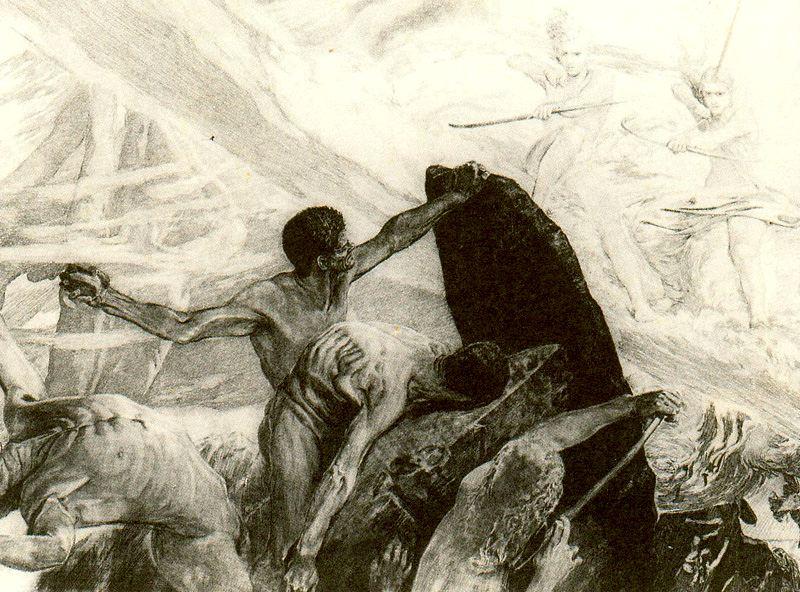
In the drawing Titan, Max Klinger captures a moment of immense physical struggle. A muscular figure strains against a massive, dark stone block, the weight of the object seemingly pressing down with an overwhelming force. The scene pulses with the tension of heavy labor, as the man’s body contorts under the pressure of his task. One might wonder if this figure is a mythological giant, perhaps reminiscent of Atlas bearing the crushing weight of the world upon his shoulders. The sheer scale of the stone compared to the human form suggests a struggle against forces far greater than any single individual.
This depiction of exertion reaches beyond mere physical toil to touch upon the nature of human ambition. The figure’s desperate effort to move the immovable block mirrors the internal challenges of overcoming life's most daunting obstacles. There is a sense of profound struggle embedded in the very anatomy of the subject, as if the act of lifting is a metaphor for the heavy burdens of existence. Max Klinger presents a scene where the limits of human strength are tested against the gravity of an unrelenting task.
Composition and Visual Elements of the Work
The frame feels crowded and immediate, tightly cropped to trap the viewer within the center of a desperate struggle. A massive, dark block dominates the upper right, its heavy presence looming over the scene like an inescapable fate. Below this weight, a muscular man strains against the stone, his body locked in a moment of extreme physical exertion. The composition relies on aggressive diagonal lines, born from the sharp angle of the stone and the desperate tilt of the man's pose, to drive a sense of constant, restless movement through the space.
Tension pulls at the edges of the view. In the lower left corner, other figures appear partially, their forms suggesting they are either assisting the effort or watching the struggle unfold from the shadows. These overlapping shapes create a sense of depth, pushing the central figure forward while the surrounding debris and darker areas recede. The arrangement of these elements creates a feeling of overwhelming odds, where the scale of the stone seems to threaten to swallow the human forms entirely.
Technique and Materials Used in the Drawing
The artist works with the quiet precision of graphite pencil on paper, a choice that allows for a profound range of grey tones. Every stroke feels intentional, as if the hand is tracing the very essence of weight and resistance. Through the careful application of graphite, the paper transforms into a space of intense physical struggle. The medium allows for a delicate balance between the sharpest edges and the softest transitions, capturing a moment of immense strain.
Detailed hatching and cross-hatching define the landscape of the struggle. These rhythmic, intersecting lines carve out the rough, granular surface of the massive stone block, giving the viewer a sense of its crushing density. The lines do not merely sit on the surface; they build volume, creating a tactile reality that makes the stone feel heavy and unyielding. This meticulous approach to line work is essential in defining the jagged textures of the debris surrounding the central figure.
Anatomical precision guides the rendering of the human form. The artist employs blending and varied line density to map the complex musculature of the straining body. Every tendon and muscle group is captured through careful observation, ensuring that the physical exertion is felt in the very structure of the figure. This technical mastery of form ensures that the anatomy is not just a shape, but a vessel for the immense effort being exerted against the weight of the world.
Lighting and Tonal Range of the Artwork
A dramatic, directional light sweeps across the scene, striking the central figure from the left. This intense illumination carves out the anatomy of the man, casting deep shadows that cling to the grooves of his muscles. Every strain and every heave of his body is made visible through this sharp contrast. The light does not merely reveal; it emphasizes the immense weight of the stone and the sheer physical effort required to move it. The shadows pool in the recesses of the figure, heightening the sense of struggle.
The entire composition exists within a grayscale world. The palette remains strictly limited, relying on a sophisticated range of grey tones to build its atmosphere. There is no color to distract the eye, only the interplay of light and dark. Lighter areas pull the viewer forward, bringing the straining limbs and the edges of the stone into sharp relief. Meanwhile, the darker regions recede into the background, creating a sense of depth that swallows the surrounding space. This careful management of tone ensures that the focus remains locked on the tension between the man and his burden.
Texture and Form in the Composition
The composition breathes through a heavy tension between organic and geometric shapes. The central figure and the surrounding debris are defined by irregular, flowing forms that mirror the raw chaos of the scene. These human shapes, strained and twisting, collide with the massive, dark block that dominates the upper right. While the stone itself possesses a certain geometric presence, its edges feel softened by the sheer weight it exerts. The overlapping of these forms creates a sense of physical depth, establishing a clear spatial relationship between the straining man and the immovable mass he seeks to shift.
Every surface tells a story of resistance through tactile detail. The stone appears rough and granular, its surface seemingly biting into the air with a coarse, unyielding grit. In stark contrast, the skin of the figures appears taut and muscular, stretched tight over bone and sinew by the immense effort of the struggle. This intense physical reality is achieved through the careful manipulation of lines and shading, where dense hatching and cross-hatching build the volume of a muscle or the jagged face of a rock. The interplay of these textures makes the weight of the stone feel palpable, as if the very grain of the paper holds the friction of the labor.
Spørgsmål og svar
Er Titan malet i hånden eller er det et print?
Håndmalet: en uddannet maler kopierer Titan i olie på lærred.
Hvilken størrelse skal jeg vælge til Titan?
Størrelserne går fra 27.2 x 36.8 cm (Dkr1664) til 181.1 x 244.8 cm (Dkr12717); tabellen på denne side viser de mest almindelige størrelser og deres priser.
Hvor lang leveringstid er der?
Levering tager 4 til 5 uger med gratis ekspresforsendelse over hele verden; en mulighed for hasteproduktion tilbydes på denne side. Du kan returnere varen inden for 100 dage med fuld refusion, uden betingelser.
Er originalen af Titan en tegning eller et maleri?
En tegning: Max Klinger udførte den i Graphite Pencil.
 Se i rummet

 Del som kort
 Del
 Detaljer
 Faktablad


 Download
 Lignende værker
 Røntgenundersøgelse
 Diasshow
 Spørgsmål og svar

 Statistikker


