

 Se i fuld skala
 Del
Del Del
Del
 Detaljer

 Download
 Lignende værker
 Røntgenundersøgelse
 Diasshow
Clown with the yellow goat
 Lithograph
- WallArt
- Naive Art
 1982
1982 90.0 x 60.0 cm
 Se mere
Giclée / Kunsttryk
Giclée- eller lærredstryk i museumskvalitet med hurtig produktion og fleksible muligheder for finish. ( Køb håndlavet maleri Køb billede)




P118B $10

P118H $10

P118W $10

P438Z $10

P508JH $12

P508YH $12

P805H $10

P805Z $10

P919BZ $10

P919G $10

P919XJ $10

P959ZH $10

P968JZ $12

W106C $8

W218G $10

W218JH $8

W218Y $10

W307PJ $10

W316G $10

W316PJ $8

W316Y $10

W398PJ $8

W4111J $10

W500HY $15

W500JH $15

W692G $12

W849H $8

W940BG $15

W953PJ $8




Vælg mellem vores forudindstillede størrelser, der matcher kunstværkets originale proportioner.

Du kan indtaste dine egne mål for at passe til en specifik ramme eller et bestemt område. Hvis den valgte størrelse ikke stemmer overens med det originale billedes proportioner, vil vi enten beskære kunstværket eller udvide billedet med en spejlet eller ensfarvet kant. En digital mockup vil blive sendt til din godkendelse, før produktionen påbegyndes.
Bemærk venligst, at forhåndsvisningen på skærmen ikke afspejler den faktiske beskæring eller udvidelse. Kun mockuppen vil nøjagtigt vise den endelige komposition.
Selvom specialmål er tilgængelige, anbefaler vi at vælge et mål fra den foruddefinerede liste for at bevare de originale proportioner.
Verdensomspændende levering () på 2 uger i stedet for de sædvanlige 4/5 uger. (25 august)

Gratis ekspresforsendelse til hele verden

Lærred af linned i høj kvalitet

Fuld transportforsikring

Garanti for refusion af told og importafgifter

Garanti for præcis farvegengivelse

60 dages returret (kun ved fabrikationsfejl)

100% Tilfredshedsgaranti

Mængderabat tilgængelig
 Glasmulighed er kun tilgængelig i størrelser under 110 cm

Clown with the yellow goat
Giclée / Kunsttryk
Størrelse på reproduktion
-


Samlet pris
$ 81
Beskrivelse af samlerobjektet
Marc Chagall’s “Clown with the Yellow Goat”: A Symphony of Joyful Surrealism
The lithograph "Clown with the Yellow Goat," created by Marc Chagall in 1982, stands as a quintessential embodiment of the artist's distinctive vision—a realm where folklore intertwines with dreamlike abstraction and vibrant color pulsates with an infectious spirit. More than just a depiction of figures and animals, it’s a carefully orchestrated tableau designed to evoke profound emotions and invite contemplation on themes of innocence, celebration, and the boundless imagination that fueled Chagall's prolific oeuvre.Composition & Style: Dynamic Movement Amidst Familiar Forms
Chagall’s masterful composition immediately captures the eye with its energetic dynamism. At its core lies a tender embrace between a clown and a yellow goat—symbols laden with significance—surrounded by a throng of musicians, dancers, and onlookers. The figures aren't merely arranged; they swirl and overlap, creating an illusion of movement that mirrors Chagall’s fascination with the rhythms of life and memory. Bold black outlines delineate each element, simplifying shapes into stylized forms characteristic of Cubism and Expressionism—influences that blended seamlessly within his artistic lexicon. Curved lines dominate, propelling the scene forward while simultaneously conveying a sense of fluidity and spontaneity. This deliberate disregard for strict perspective contributes to the artwork’s immersive quality, transporting viewers into Chagall's fantastical world.Color Palette & Technique: Flat Brilliance Reflecting Childhood Memories
The lithograph’s color palette explodes with hues reminiscent of childhood summers—greens dominate, punctuated by splashes of yellow and red – mirroring Chagall’s recollections of Vitebsk, Belarus, his birthplace and lifelong muse. Broad strokes and patches of pigment create a luminous surface that eschews traditional shading, favoring instead a flattened aesthetic akin to Naïve Art. This technique prioritizes color intensity over realism, channeling the artist's emotional response to visual stimuli rather than striving for photographic accuracy. The printing process itself—lithography—further enhances this effect, transferring an image from stone or metal plate to paper with remarkable precision while maintaining textural impressions.Symbolism & Emotional Resonance: Merriment and Mythic Undertones
The clown represents merriment and carefree abandon – a playful counterpoint to the solemnity of religious iconography prevalent in Chagall’s upbringing. The yellow goat, often interpreted as representing fertility and innocence, symbolizes renewal and spiritual purity. Together, they embody the artist's belief in the transformative power of imagination and his unwavering connection to Jewish folklore traditions. Viewing “Clown with the Yellow Goat” evokes feelings of joy, wonder, and nostalgia—a poignant reminder of simpler times and a celebration of life’s inherent beauty. It speaks to our innate desire for escapism into realms beyond the everyday, mirroring Chagall's own lifelong pursuit of artistic expression as a conduit for conveying profound emotional truths.Historical Context & Legacy: A Reflection of Chagall’s Artistic Journey
Created in 1982 during Chagall’s mature period, “Clown with the Yellow Goat” exemplifies his unwavering commitment to exploring themes of spirituality and memory—continuing a trajectory begun decades earlier. Influenced by Surrealism alongside Cubism and Expressionism, Chagall's style solidified its place as one of the most recognizable and beloved artistic voices of the 20th century. Today, reproductions of this captivating lithograph continue to inspire collectors and interior designers alike, offering a glimpse into the artist’s extraordinary vision—a testament to his enduring ability to capture the essence of human experience through color, form, and symbolism.Kunstnerens biografi
A Life Painted in Dreams: The World of Marc Chagall
Marc Chagall, born Moishe Shagal in 1887 in the small Belarussian town of Liozna near Vitebsk, wasn’t merely a painter; he was a poet of color, a weaver of dreams, and a chronicler of memory. His life, spanning nearly a century, mirrored the tumultuous currents of the 20th century, yet his art remained steadfastly rooted in a deeply personal vision—one infused with the folklore of his Hasidic Jewish upbringing and an unwavering belief in the power of imagination. Vitebsk itself was more than just a birthplace; it became the emotional core of his artistic universe, a recurring motif populated by flying figures, whimsical animals, and the vibrant hues of remembered landscapes. The town’s unique blend of cultures—Russian Orthodox churches alongside bustling Jewish marketplaces—forged an aesthetic sensibility that would defy easy categorization throughout his long career. Though he sought formal training first with a local sign painter and later in St. Petersburg under Léon Bakst, and then in Paris at the Académie de la Grande Chaumière, Chagall never fully embraced any single artistic movement. He absorbed elements of Cubism, Symbolism, and Fauvism, but always filtered them through his own intensely personal lens, creating a style that was uniquely, unmistakably Chagall.Early Years and Artistic Beginnings
Chagall’s formative years were marked by hardship and displacement. Born into a family of impoverished Jewish artisans, he experienced the trauma of pogroms—violent attacks against Jews—which instilled in him a profound awareness of persecution and loss. Despite these challenges, Chagall pursued his artistic ambitions with unwavering determination. He initially studied sign painting in Vitebsk, honing his technical skills while simultaneously nurturing his imaginative spirit. His early works already hinted at the distinctive language he would develop – paintings like I and the Village (1911) are not simply depictions of place; they are explorations of identity, memory, and the relationship between the individual and community. The village isn’t rendered realistically but as a fragmented collection of recollections, imbued with symbolic meaning. This ability to transmute personal experience into universal themes became a hallmark of his art. His palette was bold and expressive, often employing vibrant, non-naturalistic colors to convey emotion rather than literal representation. Figures float and dance across the canvas, defying gravity and logic, creating a dreamlike atmosphere that invites viewers into his inner world. This stylistic approach wasn’t accidental; it stemmed from a desire to move beyond mere imitation of reality and capture the essence of feeling, the weight of memory, and the power of folklore.The Symbolist Influence and Vitebsk's Landscape
Chagall’s artistic development was significantly shaped by the Symbolist movement, which championed emotion and imagination over objective representation. Artists like Gustave Moreau and Edvard Munch profoundly influenced his visual vocabulary, encouraging him to prioritize expressive color and evocative imagery. Vitebsk itself became an enduring source of inspiration for Chagall—a recurring motif populated by flying figures, whimsical animals, and the vibrant hues of remembered landscapes. The town’s unique blend of cultures—Russian Orthodox churches alongside bustling Jewish marketplaces—forged an aesthetic sensibility that would defy easy categorization throughout his long career. He captured these scenes with a lyrical sensitivity, conveying not just what he saw but also what he felt – the nostalgia for his childhood home and the complexities of cultural identity.The Revolution and Artistic Transformation
The Russian Revolution of 1917 irrevocably altered Chagall’s life trajectory. Returning to Vitebsk after years abroad, he became involved in cultural initiatives, establishing an art school that briefly flourished before succumbing to the restrictions imposed by the new regime. This period was marked by both creative energy and political disillusionment – a tension that would continue to shape his artistic trajectory. He experimented with Surrealist techniques, incorporating dreamlike imagery and illogical juxtapositions into his paintings. Works like Over Vitebsk (1920-1922) demonstrate his continued engagement with his childhood memories, while simultaneously reflecting the anxieties of a rapidly changing world.International Recognition and Legacy
Chagall’s artistic reputation soared internationally in the 1930s and 40s. He gained acclaim for his monumental stained glass windows commissioned for the Jerusalem synagogue, which embody his profound spiritual convictions and masterful craftsmanship. His paintings—such as White Crucifixion (1938)—became powerful statements about suffering and resilience during World War II. Following the war, Chagall settled in New York City, where he continued to produce innovative works that explored themes of exile and displacement. He received numerous prestigious commissions, including the ceiling of the Paris Opera (1964), a breathtaking explosion of color and form that celebrated musical masterpieces. Marc Chagall’s legacy extends beyond his paintings; it resides in the enduring power of his vision—a vision that celebrates love, memory, and the boundless possibilities of the human imagination. He left behind a body of work that is both deeply personal and universally accessible, inviting viewers to lose themselves in a world painted with dreams and illuminated by hope. His art continues to inspire, challenge, and move us, ensuring that his vibrant and imaginative spirit will live on for generations to come.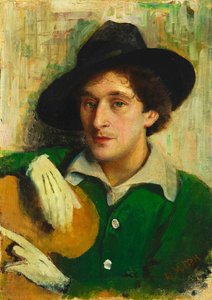
Marc Chagall
1887 - 1985 , Hviderusland
Kort om kunstneren
- Artistic Movement Or Style: Modernisme, Kubisme
- Artists Or Movements Influenced By This Artist:
- Surrealisme
- Moderne kunst
- Artists Who Influenced This Artist:
- Bakst
- Delaunay
- Borovikovsky
- Date Of Birth: 7. juli 1887
- Date Of Death: 28. marts 1985
- Full Name: Marc Chagall
- Nationality: Russisk-Fransk
- Notable Artworks:
- I og byen
- Over Vitebsk
- Hvid korsfæstelse
- Place Of Birth: Liozna, Belarus
Relaterede artikler
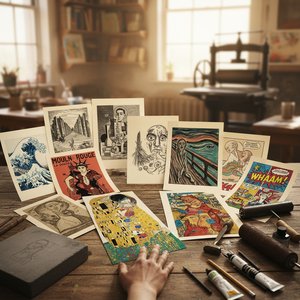
Top 10 Litografiske Mesterværker: Kunst der Ændrede Historien – OriginalUniqueArt.dk
Oplev de 10 mest legendariske litografier, der ændrede kunsthistorien! Fra Picasso til Munch – dyk ned i mesterværker, teknikker og farver. Find museumskvalitets reproduktioner & inspiration til din indretning på OriginalUniqueArt.com.
Top 10 Mesterværker i Kromgul: Kunst, Historie og Indretningsinspiration
Oplev top 10 berømte malerier domineret af kromgul! Fra Van Goghs solsikker til Monets impressionisme – udforsk kunsthistorien, farvernes betydning og find inspiration til din boligindretning. Køb museumskvalitets reproduktioner på OriginalUniqueArt.com.
Top 10 Berømte Malerier Domineret af Okkergule Nuancer – Kunst og Indretning
Oplev de 10 mest berømte malerier domineret af okkergule nuancer! Fra Van Gogh til Monet – dyk ned i kunsthistorien og lær om teknikken bag disse tidløse mesterværker. Find din perfekte reproduktion på OriginalUniqueArt.com.
The Golden Hue: Exploring Symbolism & Emotion in Yellow Art
Explore the rich symbolism & emotional power of yellow in art history! From Van Gogh to Kandinsky, discover how artists used this vibrant hue. Expert analysis & high-quality reproductions at OriginalUniqueArt.
The Essence of Naïve Art: A Professional Guide to Unfiltered Creativity and Aesthetic Sincerity
Explore the profound beauty of Naïve Art. Discover its unique characteristics, historical significance, and how this unfiltered, sincere aesthetic can elevate professional interior design through high-quality, hand-painted reproductions.



