Se i rummet
 Del som kort
 Del
Del
 Detaljer
 Guide
Guide

 Download
 Lignende værker
 Røntgenundersøgelse
 Diasshow
 Q&A
Q&A Statistikker
St Augustine Altarpiece (left wing)
 Oil On Canvas
- WallArt
- High Renaissance
 1498
1498 146.0 x 76.0 cm
 Staatliche Museen zu Berlin
 Vis mere
Giclée / Kunsttryk
Giclée- eller lærredstryk i museumskvalitet med hurtig produktion og fleksible muligheder for finish. ( Køb håndmalet maleri Skift til digitalt billede)




P118B Dkr10

P118H Dkr10

P118W Dkr10

P438Z Dkr10

P508JH Dkr12

P508YH Dkr12

P805H Dkr10

P805Z Dkr10

P919BZ Dkr10

P919G Dkr10

P919XJ Dkr10

P959ZH Dkr10

P968JZ Dkr12

W106C Dkr8

W218G Dkr10

W218JH Dkr8

W218Y Dkr10

W307PJ Dkr10

W316G Dkr10

W316PJ Dkr8

W316Y Dkr10

W398PJ Dkr8

W4111J Dkr10

W500HY Dkr15

W500JH Dkr15

W692G Dkr12

W849H Dkr8

W940BG Dkr15

W953PJ Dkr8




Vælg mellem vores forudindstillede størrelser, der matcher kunstværkets originale proportioner.

Indtast den bredde og højde, du har brug for, så det passer til din ramme eller din væg. Et print kan kun beskæres, aldrig gøres større end selve billedet, så en størrelse med et andet format vil medføre, at dele af motivet går tabt. Vi sender dig en digital mockup til godkendelse, før vi printer noget. Billedet vist på denne side viser ikke den faktiske beskæring — det er kun mockuppen, der gør.
Verdensomspændende levering () på 2 uger i stedet for de sædvanlige 4/5 uger. (29 oktober)

Gratis ekspresforsendelse til hele verden

Lærred af linned i høj kvalitet

Fuld transportforsikring

Garanti for refusion af told og importafgifter

Garanti for præcis farvegengivelse

100 dages returret ved fabrikationsfejl

100% fuld returret

Mængderabat ved flere køb
 Glasmulighed er kun tilgængelig i størrelser under 110 cm

St Augustine Altarpiece (left wing)
Giclée / Kunsttryk
Størrelse på reproduktion
-


Samlet pris
Dkr 534
Luca Signorelli’s St Augustine Altarpiece (Left Wing): A Window into Renaissance Devotion
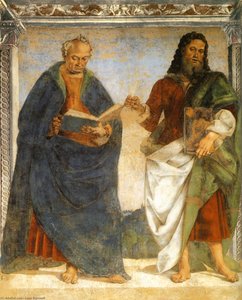
The left wing of Luca Signorelli's “St Augustine Altarpiece,” completed in 1498 for the Bichi Chapel within the church of Sant’Agostino in Siena, is more than just a beautiful painting; it’s a profound meditation on faith, charity, and the intertwined destinies of earthly and divine figures. Measuring a modest 146 x 76 centimeters, this panel offers an intimate glimpse into the artistic sensibilities of a master navigating the complexities of late Renaissance Italy. Signorelli, already establishing himself as a draftsman of exceptional skill – evidenced by his early work in Arezzo and Castelli – here demonstrates a remarkable ability to imbue a seemingly simple scene with layers of meaning and emotional resonance.
The composition immediately draws the eye to the central trio: three women draped in rich crimson robes, their gestures conveying both solemnity and profound compassion. The woman on the left cradles a baby, a potent symbol of innocence and new life – a direct reference to Mary holding infant Jesus. Beside her stands another woman, supporting a child, mirroring the Virgin’s protective embrace. The third figure, positioned slightly further back, gazes downwards with an expression of quiet contemplation, perhaps reflecting on the spiritual journey or offering solace to those she observes. These women are not merely decorative elements; they represent key figures in Christian iconography – Mary Magdalene, Saint Catherine of Siena, and Saint Jerome, each embodying a specific virtue and contributing to the altarpiece’s overarching theme of divine grace.
Adding depth to this devotional tableau are two men, subtly integrated into the scene. One stands near the center, engaged in conversation with the women, while the other is positioned on the left side, seemingly observing the proceedings. Their presence suggests a community united by faith and shared devotion – a microcosm of Renaissance society reflecting upon spiritual matters. Signorelli’s masterful use of foreshortening, a technique he honed during his time in Florence under Piero della Francesca, creates a sense of spatial realism, drawing the viewer into this intimate tableau. The figures appear to be caught in a moment of genuine interaction, their expressions conveying a palpable sense of warmth and connection.
Technique and Style: High Renaissance Refinement
Signorelli’s style within this altarpiece is firmly rooted in the High Renaissance, yet it possesses a distinctly Italian character. He skillfully blends classical influences with his own innovative approach to composition and color. The use of *sfumato*, a technique popularized by Leonardo da Vinci, softens the edges of the figures and creates an atmospheric haze that enhances the sense of depth and realism. The rich crimson robes are rendered with meticulous detail, their textures suggesting luxurious fabrics while simultaneously conveying a sense of solemnity. Signorelli’s palette is restrained yet vibrant, dominated by earthy tones – ochres, siennas, and umbers – punctuated by flashes of red and gold.
Signorelli's mastery of drawing is immediately apparent in the precise rendering of the figures’ anatomy and drapery. He demonstrates a deep understanding of human form, capturing both its beauty and vulnerability with remarkable accuracy. The subtle gradations of light and shadow – *chiaroscuro* – further enhance the sense of realism, creating a three-dimensional effect that draws the viewer into the scene. The composition is carefully balanced, with each figure occupying a specific space within the frame, contributing to the overall harmony and visual impact of the work.
Historical Context: Siena and the Renaissance
To fully appreciate the “St Augustine Altarpiece,” it’s crucial to understand its historical context. Siena in the late 15th century was a thriving center of commerce, art, and religious devotion. The Bichi Chapel, where the altarpiece resided, served as a focal point for community life, reflecting the city's wealth and piety. The commission itself underscores the importance of religious patronage during this period – wealthy families like the Piccolominis sought to demonstrate their faith through lavish displays of art and architecture.
Signorelli’s work reflects the broader trends of the High Renaissance, which emphasized humanism, classical learning, and a renewed interest in naturalism. However, unlike some of his contemporaries who embraced Mannerist styles characterized by elongated figures and distorted perspectives, Signorelli maintains a sense of balance and clarity. His altarpiece embodies a harmonious blend of tradition and innovation, reflecting the artistic sensibilities of a master navigating the complexities of his time.
A Timeless Reflection on Faith and Humanity
The “St Augustine Altarpiece (Left Wing)” is more than just a beautiful painting; it’s a poignant meditation on faith, charity, and the enduring power of human connection. Signorelli's masterful composition, skillful technique, and profound understanding of religious iconography combine to create an image that continues to resonate with viewers centuries after its creation. Reproductions capture the essence of this work, allowing us to experience its beauty and emotional depth in our own homes. It serves as a reminder of the enduring legacy of Renaissance art – a testament to the power of human creativity to express profound spiritual truths.
Spørgsmål og svar
Hvilket rum passer bedst til "St Augustine Altarpiece (left wing)" af Luca Signorelli, når man ser på dets farver?
Med hensyn til dets Earthy farver foreslås "St Augustine Altarpiece (left wing)" til et Living Room.
Hvordan finder jeg kunstværker, der minder om "St Augustine Altarpiece (left wing)" af Luca Signorelli?
Se lignende værker til "St Augustine Altarpiece (left wing)" af Luca Signorelli på denne side: Lignende værker
Hvor bør en reproduktion af "St Augustine Altarpiece (left wing)" af Luca Signorelli hænges op?
Med sin Tall form foreslås en reproduktion af "St Augustine Altarpiece (left wing)" til et Living Room.
Kunstnerbiografi
Early Life and Training
Luca Signorelli, født omkring 1450 i den maleriske by Cortona i Toscana, var en mand bundet til sin hjemby og samtidig en kunstner med et internationalt rækkevidde. Hans præcise fødselsdato er uklar, men det antages at være mellem 1441 og 1445. Signorelli voksede op i en tid af stor kunstnerisk forandring, hvor den gamle middelalderlige stil langsomt gav plads til de nye idéer og æstetiske principper fra Renæssancen. Hans barndom var præget af den florentinske kunstscene, der var et centrum for innovation og eksperimentering. Han modtog sin tidlige uddannelse i Perugia, hvor han blev påvirket af stilarne hos kunstnere som Benedetto Bonfigli, Fiorenzo di Lorenzo og Pinturicchio – alle kendte for deres evner indenfor detaljerede freskomalerier og en dyb forståelse for menneskekroppen. En central figur i hans tidlige karriere var LaZZaro Vasari, hans mors bror, som fungerede som mentor og vejleder. Giorgio Vasari, Luca’s kusine, beskrev ham som en ung mand med et naturligt talent og en stærk interesse for kunstens principper. Det er dog Piero della Francesca, der ofte fremhæves som den mest indflydelsesrige tidlige lærer, da Vasari angiveligt havde arrangeret, at Luca blev hans lærling. Denne tidlige uddannelse lagde grundlaget for Signorelli’s senere udvikling som en mester i perspektiv, anatomi og komposition.Artistic Career and Early Works
Signorelli’s kunstneriske rejser begyndte tidligt, og han fik hurtigt erfaring med forskellige stilarter og teknikker. Han arbejdede i Arezzo i 1472 og Città di Castello i 1474, hvor han allerede demonstrerede sin evne til at skabe realistiske og dynamiske billeder. En af hans tidligste kendte værker er et banner med Madonna og Flagellation, der blev malet for en lokal fraternitetskirke i Fabriano. Dette værk viser allerede hans interesse for dramatik og detaljerigdom. I 1483 rejste han til Rom, hvor han fik muligheden for at bidrage til udsmykningen af det hellige kors i Kapellamurano i Basilica di San Paolo fuori le Mura. Her skabte han et imponerende vægmaleri, der fremhævede hans evner indenfor perspektiv og farve. I 1485 malede han Sacra Conversazione for Perugia-domkirken, et billede der viser en samtale mellem Maria og Jomfru Margarete. Dette maleri er kendt for sin harmoniske komposition og den rolige atmosfære, som det skaber.The Last Judgment and Orvieto Cathedral
Signorelli’s mest berømte værk, og uden tvivl hans mesterværk, er freskomaleriene i Cappella Nuova (den nye kapel) i Orvieto-domkirken. Arbejdet med disse monumentale billeder begyndte i 1499 og fortsatte indtil 1503. De forestiller enden på verden og Dommedag, og er et imponerende eksempel på den renæssancekunstners evne til at skabe dramatiske og følelsesladede scener. I disse fresker viser Signorelli en dyb forståelse for menneskelig anatomi og psykologi, og han bruger farver og lys til at skabe en intens atmosfære af spænding og frygt. Han var ikke den første til at male enden på verden i Orvieto; Fra Angelico havde allerede begyndt arbejdet 50 år tidligere. Signorelli forstærkede og udvidede Angelicos vision, og tilføjede et nyt lag af drama og realisme. Hans brug af foreshortening – teknikken til at vise objekter, der ser større eller mindre ud end de er i virkeligheden – var særlig innovativ og bidrog til den intense følelse af rum og dybde i malerierne.Influence and Legacy
Luca Signorelli’s kunst havde en enorm indflydelse på udviklingen af renæssancekunsten, især indenfor freskomalerier. Hans evne til at skabe realistiske og dynamiske figurer, kombineret med hans innovative brug af perspektiv og farve, inspirerede mange efterfølgende kunstnere. Han var en pioner indenfor brugen af foreshortening, og hans teknik blev efterfulgt af store mestre som Michelangelo. Signorelli’s arbejde i Orvieto-domkirken er anerkendt som et af de mest betydningsfulde eksempler på renæssancekunsten, og det tiltrækker stadig tusindvis af besøgende hvert år. Hans arv lever videre gennem hans værker, der findes i museer og kirker over hele Italien, og som fortsat er genstand for studier og beundring. Han var en mand, der med sin kunst formåede at fange essensen af den menneskelige tilstand og skabe billeder, der stadig kan berøre os tusind år senere.
Luca Signorelli
1450 - 1523 , Italien
Kort om kunstneren
- Artistic Movement Or Style: Renaissance
- Artists Or Movements Influenced By This Artist: ['Fra Angelico']
- Artists Who Influenced This Artist: ['Piero della Francesca']
- Date Of Birth: ca. 1441/1445
- Date Of Death: 16. oktober 1523
- Full Name: Luca d’Egidio di Ventura Signorelli
- Nationality: Italiensk
- Notable Artworks:
- Det Sidste Dommedag
- Skolen ved Pan
- Place Of Birth: Cortona, Toscana
Relaterede artikler

The Enduring Muse: Women as Subject & Symbol in Art History
Explore the rich history of women in art – from iconic muses to groundbreaking artists. Discover feminist movements, global perspectives & reclaim female narratives with OriginalUniqueArt.
Sacred Expressions: A Journey Through Devotional Art Across Cultures & Eras
Explore the rich history of devotional art across cultures & eras with expert insights! Discover iconic masterpieces, symbolism, and artistic techniques. A guide for collectors & enthusiasts.
Sacred Expressions: A Journey Through Devotional Art Across Cultures & Eras
Explore the rich history of devotional art across cultures & eras. Discover iconic masterpieces, symbolism, and artistic techniques. Expert insights for collectors & enthusiasts.
The Enduring Muse: Women as Subject & Symbol in Art History
Explore the rich history of women in art – from archetypal representations to contemporary voices challenging norms. Discover iconic artists & movements, and learn about reclaiming female narratives through painting and beyond.

Sacred Narratives on Canvas: Exploring Devotional Imagery Across Art History
Explore the rich history of devotional art! Discover iconic masterpieces, symbolism & techniques from antiquity to the Renaissance. Expert insights for collectors & enthusiasts at OriginalUniqueArt.