Russian Modernism · 1922
Samarkand Sultan (Léon Bakst, 1922)
Léon Bakst (1866–1924) har skabt Samarkand Sultan. Det er fra 1922. Det tilhører Russian Modernism-bevægelsen. Den er udført i Ink On Paper.
- 1922
- Ink On Paper

 Se i rummet

 Håndmalet oliemalerie
 Del som kort
 Del
 Faktablad


 Download
 Lignende værker
 Røntgenundersøgelse
 Diasshow
 Spørgsmål og svar

 Statistikker
Samarkand Sultan kort fortalt
- Titel
- Samarkand Sultan
- Kunstner
- Léon Bakst (1866–1924)
- Kunstner født i
- Hrodna, Belarus
- Dato
- 1922
- Medium
- Ink On Paper
- Bevægelse
- Russian Modernism
- Periode
- Modern
- Motiv
- eastern costume, ornate design, theatrical figure, stylized portrait, vibrant colors, russian culture
Hvad forestiller Samarkand Sultan?
A Study in Grandeur
In this 1922 work, we encounter a figure of quiet authority, a Samarkand Sultan rendered with a graphic precision that feels both ancient and modern. The subject is centered, filling the frame with a verticality that commands attention without needing to shout. He is draped in a robe of deep reds and blues, a garment defined by its intricate geometric patterns—triangles, diamonds, and stripes that dance across the fabric. There is a certain stillness in his expression, a tranquil gaze that suggests a man accustomed to the weight of his own status. His dark beard is long and neatly kept, providing a sharp contrast to the luminous colors of his attire.
The composition relies on a sophisticated layering of shapes and colors to create a sense of presence. While the perspective remains somewhat flattened, reminiscent of theatrical sketches or costume studies, the use of shading gives the figure a tangible, sculptural quality. The light appears to fall from above, catching the edges of his elaborate headwear and the subtle folds of his sleeves.
The Language of Ornament
The detail in the Sultan's attire reveals a meticulous approach to pattern and texture. The artist uses line and color to suggest materials that one can almost feel through the visual surface:
- A large turban adorned with blue and white beads and a singular, striking white feather.
- Sleeves and hems lined with a soft, heavy fur that adds a sense of tactile luxury.
- A complex arrangement of geometric motifs that break up the saturated fields of color.
This work belongs to the Art Nouveau movement, a period where the boundaries between fine art and decorative design often blurred. The influence of Orientalism is palpable here, not as a mere imitation of the East, but as a way to explore new visual languages through exotic silhouettes and intense color palettes. The use of ink and watercolor allows for a certain fluidity, where bold outlines meet softer, shaded transitions.
A Vision of the Stage
There is an inherent theatricality to this piece, as if we are catching a glimpse of a character just before the curtain rises. The stylized forms and exaggerated features move away from photographic realism, opting instead for a heightened sense of character. It feels less like a portrait of a specific historical individual and more like an exploration of an idea—the idea of power, of ceremony, and of the exotic. The emotional weight of the piece lies in this tension between the graphic, almost two-dimensional quality of the illustration and the profound sense of dignity held in the subject's eyes.
Højopløselige billeder af Samarkand Sultan
Public domain: kunstneren døde i 1924.
Léon Bakst, Samarkand Sultan (1922). Public domain
Spørgsmål om Samarkand Sultan besvaret
Hvornår er "Samarkand Sultan" af Léon Bakst skabt?
"Samarkand Sultan" stammer fra 1922. Datoen placerer værket i Léon Bakst's karriere og dets tidsalder.
Hvilken teknik er brugt til "Samarkand Sultan" af Léon Bakst?
Léon Bakst brugte Ink On Paper-teknikken til "Samarkand Sultan". Teknikken definerer det originale værks materielle karakter.
Hvad forestiller "Samarkand Sultan"?
"Samarkand Sultan" af Léon Bakst forestiller: eastern costume, ornate design, theatrical figure, stylized portrait, vibrant colors, russian culture, decorative art.
Er "Samarkand Sultan" fri for ophavsret?
Ophavsretsstatus for "Samarkand Sultan" af Léon Bakst: værket er i det offentlige domæne – ophavsretten er udløbet. Dette afgør, om der frit må foretages reproduktioner af billedet.
Hvem er kunstneren bag "Samarkand Sultan"?
Kunstneren bag "Samarkand Sultan" er Léon Bakst. Værket er katalogiseret under Léon Baksts navn.
Hvilken kunstretning tilhører "Samarkand Sultan" af Léon Bakst?
"Samarkand Sultan" er et værk fra Russian Modernism. Denne stilart angiver den kunstneriske tradition, som værket indgår i.
Hvilken fase af Léon Baksts kunstneriske udvikling repræsenterer "Samarkand Sultan"?
"Samarkand Sultan" repræsenterer Léon Baksts Early Modernism.
Hvor gammel var Léon Bakst, da "Samarkand Sultan" blev skabt i 1922?
Da "Samarkand Sultan" blev skabt i 1922, var Léon Bakst – født i 1866 – 56 år gammel.
Er "Samarkand Sultan" af Léon Bakst i det offentlige domæne, og hvorfor?
Ophavsretsstatus for "Samarkand Sultan" – i det offentlige domæne – ophavsretten er udløbet – følger af kunstnerens død i 1924.
Om kunstneren, Léon Bakst
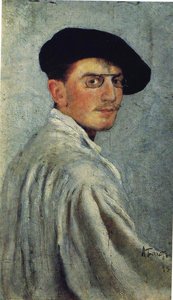
1866–1924, Belarus
Léon Bakst
Tidlig Liv og Frøene til Kunstnerisk Opprør Léon Bakst, egentlig Leyb-Khaim Izrailevich Rosenberg, ble født i 1866 i Grodno, en by som da var en del av det russiske imperiet. Hans barndom var preget av de begrensningene og utfordringene som møtte jødiske individer i det tsaristiske Russland på den tiden. Familien hans tilhørte imidlertid en komfortabel middelklasse, og hadde forbindelser til den keiserlige hoffet gjennom farens bakgrunn som en anerkjent skredder. Dette ga Bakst tidlig en bevissthet om kulturelle nyanser, kombinert med en tidlig lidenskap for tegning, demonstrert da han vant en konkurranse allerede i tolv års alder.
Også af Léon Bakst
 Design med blomster i gitter
 Operatic costume designs1911
 Costume design for the ballet ''Cleopatra''1909
 Drawing young divinity Narcisse costume, ballet Diaghilev1911
Essays om Samarkand Sultan
 The Soft Soul of Art: Exploring the Tactile Beauty and Timeless Narrative of Textile MasterpiecesEmbark on a sensory journey through the tactile beauty of textile art. Explore how thread, silk, and loom weave human history, from ancient…
 French artworks of the 1860s1860s French masterpieces by Édouard Manet, Claude Monet, and Gustave Courbet. View the full collection online at OriginalUniqueArt.com.
 Masterpieces of Emotion: The Top 25 Artworks by Théodore GéricaultExplore 25 iconic works by Théodore Géricault, from Romanticism to his greatest masterpieces. Discover the full collection on OriginalUniqu…