 Oliemaling-udgave
 Alt om Photogram







































 For kunstværker eller reproduktioner, der er større end 105 cm (ca. 41 tommer) på en hvilken som helst side, vil rammen blive leveret som et adskilt sæt. Denne metode sikrer sikker levering og forhindrer skader under transport.


The Photogram by László Moholy-Nagy
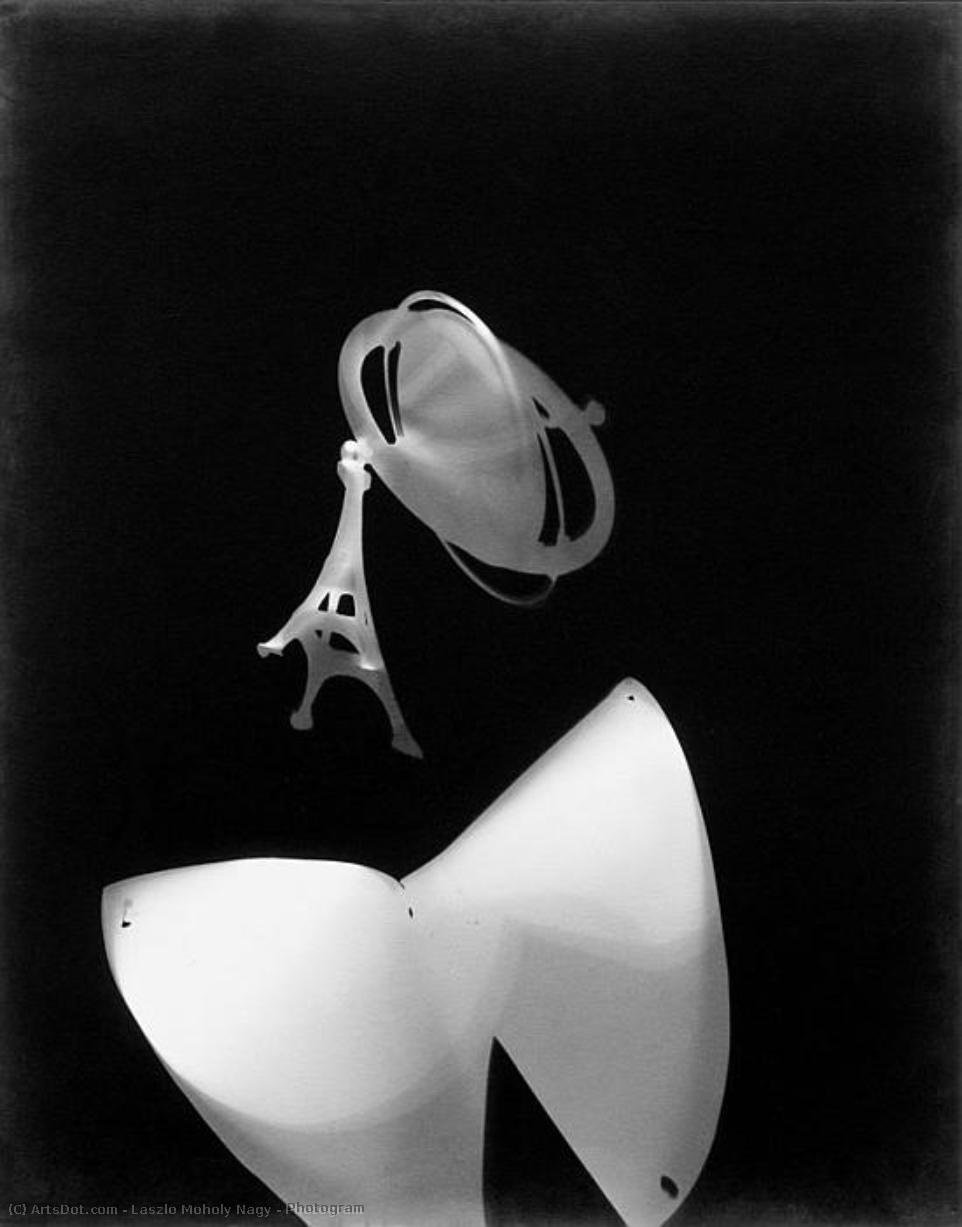
In this Photogram, László Moholy-Nagy moves away from the traditional constraints of the camera to explore the fundamental properties of light. Born in 1895 in Bácsborsód, Hungary, the artist developed a practice that sought to understand how light interacts with physical matter. This specific work is purely abstract, eschewing recognizable figures or scenes in favor of a direct investigation into the essence of perception. It is a quiet study of how objects can be translated into a language of pure form.
The composition relies on the interplay between light and shadow to define its presence. Rather than depicting a specific subject, the work focuses on the relationship between form, texture, and light. There is a certain stillness in how the shapes emerge from the darkness, inviting a closer look at the subtle gradations of tone. By removing the lens, Moholy-Nagy allows the light to act as a primary sculptor, shaping the edges and surfaces of the objects into something entirely new. It is a disciplined approach to abstraction that remains central to his legacy until his death in 1946.
Composition and Visual Elements
The composition is defined by a deliberate asymmetry that directs the eye through a series of shifting weights. A large, sweeping curve dominates the lower portion of the frame, providing a grounded, organic foundation. Above this, a more complex and fragmented form appears to float, creating a sense of dynamic tension within the space. This arrangement avoids traditional perspective, offering instead a flattened view of the objects that emphasizes their essential geometry.
Light and shadow are the primary architects of this space. There is a stark contrast between the luminous, almost glowing forms of the objects and the deep, absolute darkness of the background. This void does not feel empty; rather, the blackness creates an illusion of infinite space stretching behind the subjects. The interplay between the bright contours and the surrounding darkness gives the work a quiet, sculptural presence.
Technique and Artistic Materials
In this work, the artist moves away from the traditional camera to engage directly with the medium of photography. The process relies on the photogram technique, a method of cameraless photography where the distinction between the object and the image begins to dissolve. By placing physical items directly onto light-sensitive photographic paper, the artist bypasses the lens entirely, allowing for a more immediate interaction with the light source.
The primary materials here are quite elemental: light and photographic paper. Through the method of direct contact printing, the light interacts with the objects to create a range of tones. This specific approach produces sharp details and unique textures that a standard lens might struggle to capture. The resulting imagery is a study of how light defines form through shadow and exposure.
Related Works by the Artist
To understand the breadth of Moholy-Nagy’s experimentation, one might look to his monochrome studies from the mid-1920s. Around 1925, he produced Flower, a work currently held in the Georges Pompidou Center in Paris. This piece utilizes the same photogram technique to explore organic forms through light and shadow. He also created Untitled, Dessau, a work that demonstrates his ability to find stillness within a monochromatic tableau.
His investigations into the movement of light and space extended into three-dimensional forms and moving images. In 1930, he completed the kinetic sculpture Light-Space Modulator, which used moving parts to project dynamic patterns. This interest in how light interacts with volume and time is further reflected in his film work. He produced the film Lobsters in 1935, followed by New Architecture and the London Zoo in 1936.
Spørgsmål og svar
Er dette Photogram malet i hånden eller er det et print?
Håndmalet: en uddannet maler kopierer Photogram i olie på lærred.
Hvilken størrelse skal jeg vælge til Photogram?
Størrelserne går fra 35.7 x 28.0 cm (Dkr1340) til 248.3 x 194.7 cm (Dkr11874); tabellen på denne side viser de vigtigste trin og deres priser.
Hvor lang tid tager leveringen?
Levering tager 4 til 5 uger med gratis ekspresforsendelse over hele verden; en mulighed for hasteproduktion tilbydes på denne side. Du kan returnere varen inden for 100 dage med fuld refusion, uden betingelser.
Hvilket medie brugte László Moholy-Nagy til Photogram?
Photography
Læs mere om dette maleri
 Del som kort
 Del
 Detaljer
 Faktablad


 Download
 Lignende værker
 Diasshow
 Spørgsmål og svar

 Statistikker


