
 Se i rummet
 Send
Send Del
Del
 Detaljer
 Studieguide til kunstværker

 Download
 Lignende værker
 Røntgenundersøgelse
 Se diasshow
 Statistik
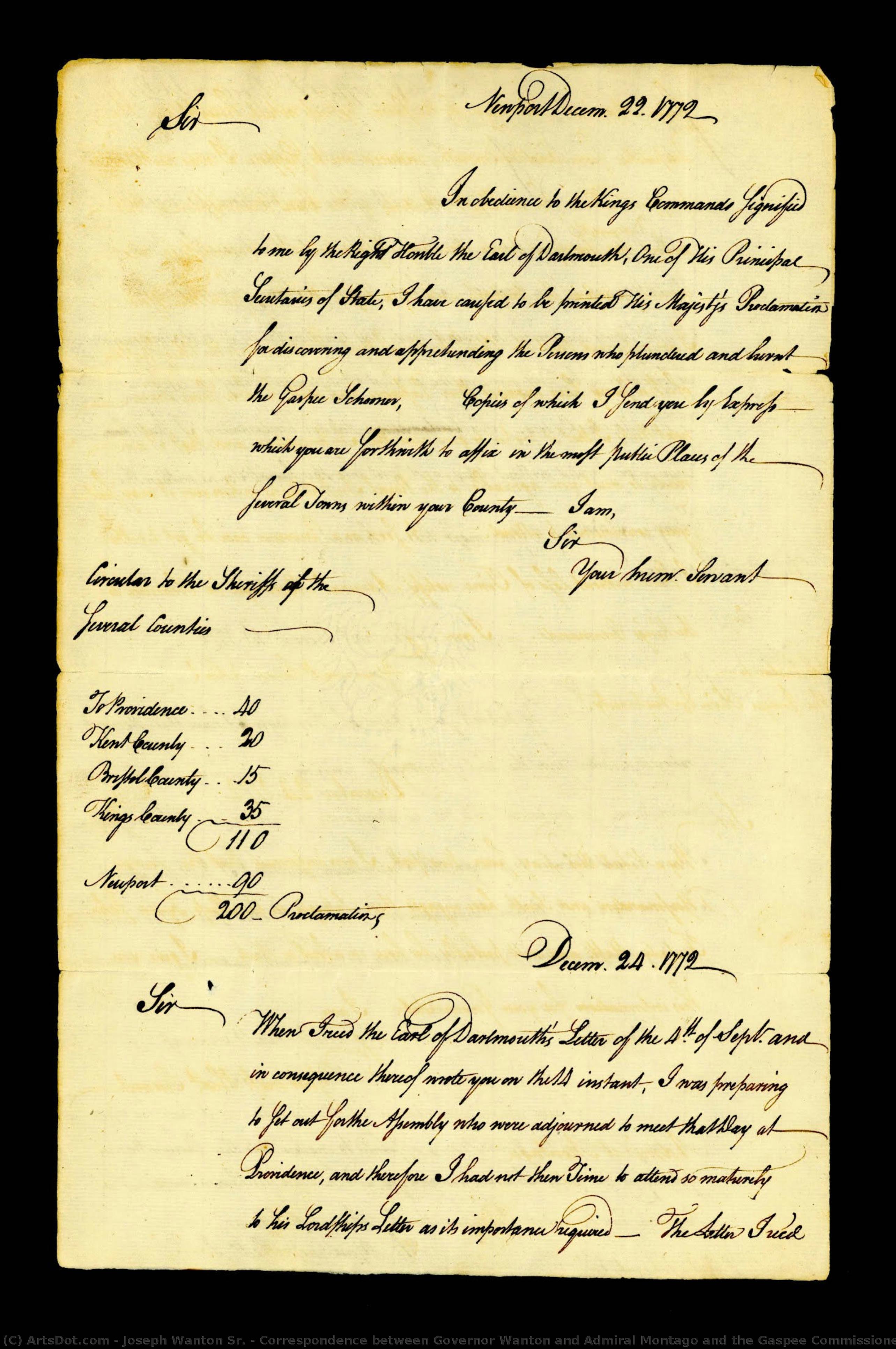
Correspondence between Governor Wanton and Admiral Montago and the Gaspee Commissioners Correspondence between Governor Wanton and Admiral Montago and the Gaspee Commissioners, page 1


 Læs mere
Håndlavet oliereproduktion
Håndmalet olie på lærred i din valgte størrelse og ramme, udført efter bestilling af vores kunstnere. ( Skift til printversion Skift til digitalt billede)




































Vælg mellem vores forudindstillede størrelser, der matcher kunstværkets originale proportioner.

Du kan indtaste dine egne mål for at passe til en bestemt ramme eller plads. Hvis den valgte størrelse ikke stemmer overens med det originale billedes proportioner, vil vi enten beskære kunstværket eller udvide maleriet med yderligere håndmalede elementer. En digital skitse sendes til din godkendelse, før produktionen påbegyndes.
Bemærk venligst, at forhåndsvisningen på skærmen ikke afspejler den faktiske beskæring eller udvidelse. Kun skitsen vil nøjagtigt vise den endelige komposition.
Selvom specialmål er mulige, anbefaler vi at vælge en dimension fra den foruddefinerede liste for at bevare de originale proportioner.
Efter bestilling vil OriginalUniqueArt.com team sende en e-mail til kunden for at indhente instruktioner og fremsende et udkast til gennemgang.
Levering i hele verden () på 3-4 uger i stedet for de standard 5 uger. (25 september). Ingen kompromiser med kvaliteten.

Gratis ekspresforsendelse til hele verden

Lærred af linned i høj kvalitet

Komplet transportforsikring

Garanti for refusion af told og importafgifter

Garanti for autentisk farvegengivelse

100 dages returret ved fabrikationsfejl

100% fuld returret

Mængderabat ved flere køb
 Glasmulighed er kun tilgængelig i størrelser under 110 cm

Correspondence between Governor Wanton and Admiral Montago and the Gaspee Commissioners Correspondence between Governor Wanton and Admiral Montago and the Gaspee Commissioners, page 1
Reproduktionsmateriale
Reproduktionsstørrelse
-


Samlet pris
$ 300
Om kunstneren
A Life Intertwined with Colonial Currents: Joseph Wanton Sr.
Joseph Wanton Sr., born in Newport, Rhode Island, in 1705, was a figure whose life epitomized the complexities of colonial America. Though not an artist in the traditional sense, his existence became interwoven with artistic representation through depictions like John Greenwood’s lively “Sea Captains Carousing,” and his extensive correspondence provides invaluable insight into the socio-political landscape of 18th-century Rhode Island. Wanton's story isn’t one of brushstrokes and canvases, but rather a narrative etched in mercantile ventures, political maneuvering, and the burgeoning tensions that would ultimately ignite the American Revolution. He emerged from a prominent Quaker family deeply rooted in the colony’s affairs, inheriting both a legacy of influence and a shrewd business acumen. This foundation propelled him into a successful merchant career, navigating the intricate web of colonial trade with skill and ambition. His rise wasn't merely economic; it was a testament to his ability to thrive within the established order while subtly challenging its constraints.From Merchant Prince to Reluctant Governor
Wanton’s ascent continued as he transitioned from successful merchant to governor of Rhode Island in 1769. This appointment placed him squarely at the center of a rapidly escalating conflict between Great Britain and its American colonies. His administration coincided with growing unrest, most notably culminating in the infamous Gaspee Affair of 1772. The burning of the British schooner *Gaspee*, aggressively enforcing trade regulations, became a potent symbol of colonial defiance. Wanton’s response was characteristically cautious yet strategically astute. He skillfully shielded those involved from prosecution by the Crown, demonstrating a commitment to colonial autonomy without necessarily advocating for outright independence. This delicate balancing act reveals a man deeply concerned with preserving stability while acknowledging the legitimate grievances of his constituents. His actions weren't born of radical fervor but rather a pragmatic assessment of the situation and a desire to avoid immediate confrontation. He understood the power dynamics at play and navigated them with a calculated restraint that would define his governorship.Navigating the Tempest: The Road to Revolution
As the specter of revolution loomed larger, Wanton’s cautious approach increasingly clashed with the more radical elements within the Rhode Island General Assembly. While he maintained communication with other colonial governors and contributed to the founding of Brown University (originally New College), his reluctance to embrace armed conflict created friction. He wasn't opposed to reform, but believed a measured response was crucial, fearing that hasty action would lead to disastrous consequences. This position, though perhaps reasonable in its intent, proved untenable as public sentiment shifted towards independence. In 1775, when asked to pledge support for raising an army and commissioning new officers, Wanton refused. This defiance of the assembly’s demands led to his removal from office, replaced by Nicholas Cooke, a figure more aligned with the growing revolutionary zeal. Despite this political setback, Wanton retired peacefully to his Newport home, spared the turmoil of war and living until 1780.A Legacy Beyond Governance: Historical Significance
Joseph Wanton Sr.’s legacy extends beyond his tenure as governor. He offers a valuable lens through which to examine the complexities of colonial governance during a period of immense change. His story highlights the diverse opinions within the colonies regarding independence, demonstrating that not all colonists were ardent revolutionaries. The Gaspee Affair, in which he played a pivotal role, underscores the escalating tensions between Britain and its American possessions. Furthermore, his contribution to the founding of Brown University cemented his place as a benefactor of education and intellectual growth. His surviving letters, meticulously preserved, provide a unique historical record, offering intimate glimpses into 18th-century colonial life. While not celebrated for artistic creation itself, Wanton’s depiction in Greenwood's “Sea Captains Carousing” serves as a visual testament to his prominence within the merchant class and offers a fascinating glimpse into the social dynamics of the era. He remains a significant figure, not as a revolutionary icon, but as a representative of a more cautious, pragmatic approach to navigating the turbulent waters leading to American independence.Artistic Echoes & Enduring Records
Though primarily known for his political and mercantile endeavors, Joseph Wanton Sr.'s connection to the artistic world is embodied in John Greenwood’s “Sea Captains Carousing in Surinam.” This painting, a vibrant snapshot of colonial life, captures Wanton amongst fellow merchants and seafarers engaged in convivial – and somewhat raucous – revelry. The artwork serves as a visual document of the era's social customs and economic pursuits, immortalizing Wanton as a key player within this world. Beyond this pictorial representation, his enduring legacy lies in the wealth of correspondence he left behind. These letters are not merely historical documents; they are windows into the mind of a man grappling with momentous decisions during a pivotal period. They reveal his anxieties, his calculations, and his unwavering commitment to what he believed was best for Rhode Island.- The Gaspee Affair correspondence offers direct insight into his diplomatic efforts.
- His letters regarding the founding of Brown University demonstrate his dedication to education.
- Personal correspondence reveals a nuanced portrait of a man navigating complex family and business relationships.

Joseph Wanton Sr.
1705 - 1780 , United States of America
Hurtige fakta
- Artistic Movement Or Style: Historical documents
- Date Of Birth: 1705
- Date Of Death: 1780
- Full Name: Joseph Wanton Sr.
- Nationality: American
- Notable Artworks:
- Correspondence w/ Montago
- Letter to Admiral Montagu
- Copy of a letter to Montagu
- Place Of Birth: Newport, USA
Relaterede artikler
Joseph Kleitsch: Bridging Impressionism & California Regionalism – A Study of Light and Identity
Explore the life & work of Joseph Kleitsch, a pivotal California Impressionist painter. Discover his vibrant landscapes, portraits, and legacy within the Laguna Beach art colony. A comprehensive study for collectors & enthusiasts.
Iconic Art of the 18th & 19th Centuries: Masterpieces for Your Home | OriginalUniqueArt
Journey through 18th & 19th century art! Explore iconic masterpieces by Monet, Van Gogh & more. Discover the stories behind these timeless paintings and find museum-quality reproductions for your home at OriginalUniqueArt.com.

Reflections of an Age: Social Commentary & Artistic Representation in 18th-Century Society
Explore the social commentary & artistic representation of 18th-century society. Discover Rococo masterpieces, portraiture's power, and shifting historical perspectives. Expert insights for art lovers.

Joseph Highmore: Moral Tales & Domestic Genre in 18th-Century British Art
Explore the captivating world of Joseph Highmore, a leading British Rococo painter. Discover his elegant portraits, insightful 'Pamela' illustrations & contributions to 18th-century art history. Learn more at OriginalUniqueArt.
1700-tallets Mestre: Top 10 Kunstværker & Historisk Skønhed til Dit Hjem
Oplev 1700-tallets storhedstid! Udforsk top 10 kunstværker fra rokokokunstens elegance til portrætmaleriets finesse. Fragonard, Gainsborough & mere – find inspiration og køb museumskvalitets reproduktioner på OriginalUniqueArt.com.