
 Del
Del Del
Del
 Detaljer

 Download
 Lignende værker
 Diasshow
Isabella II


 Se mere
Håndlavet oliereproduktion
Håndmalet olie på lærred i din valgte størrelse og ramme, udført efter bestilling af vores kunstnere. ( Køb print Køb billede)




































Vælg mellem vores forudindstillede størrelser, der matcher kunstværkets originale proportioner.

Du kan indtaste dine egne mål for at passe til en bestemt ramme eller plads. Hvis den valgte størrelse ikke stemmer overens med det originale billedes proportioner, vil vi enten beskære kunstværket eller udvide maleriet med yderligere håndmalede elementer. En digital skitse sendes til din godkendelse, før produktionen påbegyndes.
Bemærk venligst, at forhåndsvisningen på skærmen ikke afspejler den faktiske beskæring eller udvidelse. Kun skitsen vil nøjagtigt vise den endelige komposition.
Selvom specialmål er mulige, anbefaler vi at vælge en dimension fra den foruddefinerede liste for at bevare de originale proportioner.
Efter bestilling vil OriginalUniqueArt.com team sende en e-mail til kunden for at få instruktioner og levere et udkast til en skitse.
Levering i hele verden () på 3/4 uger i stedet for de standard 5 uger. (18 august). Ingen kompromiser med kvaliteten.

Gratis ekspresforsendelse til hele verden

Lærred af linned i høj kvalitet

Fuld transportforsikring

Garanti for refusion af told og importafgifter

Garanti for præcis farvegengivelse

60 dages returret (kun ved fabrikationsfejl)

100% Tilfredshedsgaranti

Mængderabat tilgængelig
 Glasmulighed er kun tilgængelig i størrelser under 110 cm

Isabella II
Reproduktionsmetode
Størrelse på reproduktion
-


Samlet pris
$ 300
Beskrivelse af kunstværket
A Royal Glimpse into the Era of Cartomania
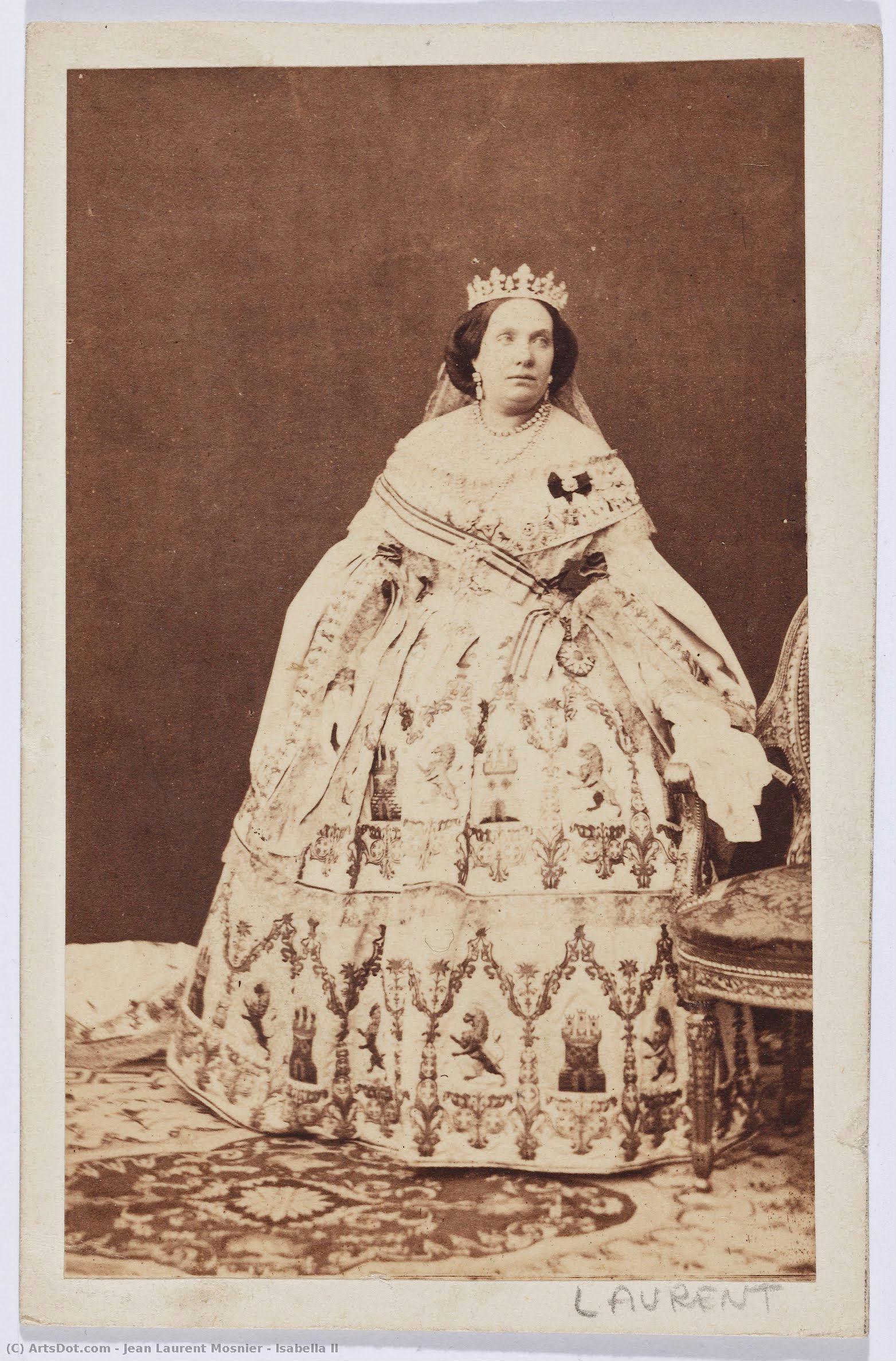
In this exquisite 1860 carte de visite, we are transported back to the mid-19th century, an era where the burgeoning art of photography began to weave itself into the very fabric of social identity. The subject, Queen Isabella II of Spain, is captured in a moment of profound regality, presented full-length in her magnificent dress uniform. Every detail of her attire speaks to the splendor of the Spanish court; from the sumptuous tiara resting upon her head to the delicate pearl adornments and the sash draped across her chest, the image serves as a masterclass in royal iconography. This piece is not merely a portrait but a relic of "cartomania," a period when the collection of small, photographic portraits in ornate albums became a widespread cultural phenomenon, allowing even the most devoted subjects to feel a tangible connection to their sovereign.
The photograph, captured by the skilled hands of Jean Laurent—a photographer whose name became synonymous with the royal portraiture of Madrid—utilizes the stark, evocative power of black and white to emphasize texture and form. Without the distraction of color, the viewer’s eye is drawn to the intricate interplay of light on the Queen's decorations and the heavy, luxurious folds of her uniform. The composition, though intimate in its 6 x 10 cm scale, possesses a grand architectural quality. The presence of chairs positioned at the periphery of the frame adds a sense of depth and staged elegance, suggesting a formal studio setting that mirrors the structured etiquette of the era.
Symbolism and the Art of Presence
Beyond its historical value, this portrait functions as a powerful symbol of legitimacy and continuity. The decorations and regalia worn by Isabella II are not merely decorative; they are a visual language of power, representing her lineage, her triumphs, and her divine right to rule. For the contemporary collector or interior designer, this piece offers a profound sense of historical weight. It captures a transition point in human history—the moment when the painterly traditions of the past met the mechanical precision of the new photographic age. The way Laurent manages to imbue a small photographic print with the dignity typically reserved for large-scale oil paintings is nothing short of remarkable.
Integrating a high-quality reproduction of this work into a curated space can evoke a sense of timeless sophistication. Whether placed in a gallery-style arrangement or used as a focal point in a classic study, the image invites contemplation on the nature of fame, memory, and the enduring allure of royalty. It is an ideal acquisition for those who appreciate art that tells a story—a piece that brings the whispered elegance of 19th-century Madrid into the modern home, offering a window into a world of vanished grandeur.
Kunstnerens biografi
A Life Painted in Elegance: The World of Jean-Laurent Mosnier
Jean-Laurent Mosnier, a name resonating with the refined grace of 18th and early 19th century portraiture, was more than just a painter; he was a chronicler of an era. Born in Paris in 1743, his life unfolded against a backdrop of immense social and political upheaval – from the opulent reign of Louis XVI to the tumultuous years of the French Revolution and beyond. Mosnier’s artistic journey reflects this shifting landscape, marked by both aristocratic patronage and a remarkable adaptability that allowed him to flourish even amidst exile. He wasn't merely depicting faces; he was capturing the essence of a world on the brink of transformation, preserving its elegance and anxieties for posterity.From Royal Courts to Distant Shores: A Career in Transition
Mosnier’s early training followed the established path within the French academic system, honing his skills at the Académie de Saint-Luc before achieving mastery in 1766. His talent quickly garnered recognition, leading to a coveted position as *Peintre de la Reine* – court painter to Marie Antoinette in 1776. This appointment placed him squarely within the heart of French aristocratic society, and his portraits from this period exude the refined sensibilities of the Ancien Régime. He was accepted into the Académie Royale in 1788, a testament to his growing reputation. However, the storm clouds of revolution were gathering, and Mosnier’s world was about to be irrevocably altered. The French Revolution forced him to seek new horizons, embarking on a peripatetic career that took him first to London around 1790, then to Hamburg, and finally to St. Petersburg in 1801. This wasn't simply an escape; it was a testament to his resilience and artistic prowess. He didn’t abandon portraiture but rather adapted his style to suit the tastes of each new locale, demonstrating a remarkable ability to connect with diverse audiences while maintaining his signature elegance.Influences and Artistic Style: A Neoclassical Refinement
Mosnier's artistic voice was deeply rooted in the Neoclassical movement, characterized by its emphasis on clarity, balance, and meticulous detail. His compositions are harmonious, lines are precise, and his attention to texture and form is unwavering. While he absorbed influences from contemporaries like Élisabeth Louise Vigée Le Brun and Adélaïde Labille-Guiard – both celebrated portraitists in their own right – Mosnier developed a distinctive style that blended aristocratic refinement with a subtle psychological depth. His miniatures, in particular, are exquisite examples of his craftsmanship, showcasing a delicate rendering of features and an unparalleled attention to detail. He possessed a remarkable ability to capture not just the likeness but also the personality and social standing of his sitters. His self-portrait with pupils, thought to be inspired by Labille-Guiard’s work, reveals both his ambition as an artist and his dedication to passing on his skills to the next generation.A Legacy in Portraiture: Notable Works and Lasting Impact
Mosnier's oeuvre is a rich tapestry of portraits reflecting the lives of prominent individuals across Europe. His depictions of Louis XVI and Marie Antoinette stand as poignant reminders of a bygone era, capturing the royal couple before the storm of revolution engulfed them. In London, he painted numerous members of the British nobility, while in St. Petersburg, he secured commissions from leading Russian families. The portrait of Admiral George Brydges Rodney, completed in 1791, is a particularly striking example of his ability to convey power and dignity through masterful brushwork and composition. Beyond these celebrated works, Mosnier’s portraits of figures like Jean Sylvain Bailly – the first mayor of Paris – offer valuable insights into the personalities who shaped the course of history. His legacy extends beyond individual masterpieces; it lies in his ability to document a period of profound change, providing us with a visual record of the fashion, customs, and social dynamics of the 18th and early 19th centuries. He stands as a testament to the enduring power of portraiture – its capacity not only to immortalize individuals but also to illuminate the world they inhabited.
jean laurent mosnier
1743 - 1808 , France
Kort om kunstneren
- Artistic Movement Or Style: Neoclassical
- Artists Who Influenced This Artist:
- Vigée Le Brun
- Labille-Guiard
- Date Of Birth: 1743
- Date Of Death: 1808
- Full Name: Jean-Laurent Mosnier
- Nationality: French
- Notable Artworks:
- Louis XVI portrait
- Marie Antoinette portrait
- Admiral Rodney portrait
- Place Of Birth: Paris, France
Relaterede artikler

Hvide Mesterværker: Top 10 Maler der Fascinerer – Kunst til Dit Hjem | OriginalUniqueArt.dk
Oplev skønheden i hvide malerier! Fra Monet til Van Gogh – udforsk 10 ikoniske kunstværker og deres historie. Find inspiration til dit hjem & køb museumskvalitets reproduktioner på OriginalUniqueArt.com.

Sort i Kunsten: Top 10 Berømte Malerier & Deres Mystik | OriginalUniqueArt.dk
Oplev 10 berømte malerier domineret af sort – fra Rembrandts drama til Goyas mystik. Lær historierne bag disse ikoniske kunstværker og find inspiration til dit hjem. Køb museumskvalitets reproduktioner på OriginalUniqueArt.com

Monochrome Visions: Exploring the Aesthetic & Historical Significance of Black & White Photography
Explore the rich history & artistic power of black and white photography. From early techniques to iconic masters like Ansel Adams, discover why monochrome continues to captivate art lovers today. Expert insights for collectors.
Shadow & Soul: Why Black & White Photography Remains the Ultimate Power Move in Modern Art
Discover why black & white photography remains a powerful force in contemporary art. Explore the impact of light, shadow, and texture through a visual journey of monochrome mastery and learn how to elevate your space with timeless grayscale aesthetics.
Mørkets Mestre: Top 10 Maler Domineret af Sort – Kunst & Indretning
Oplev 10 ikoniske malerier domineret af sort – fra Rembrandts dramatiske skygger til Munchs ekspressive mørke. Lær historien bag mesterværkerne og find inspiration til din indretning. Køb kunsttryk i museumskvalitet på OriginalUniqueArt.com

