
 Se i rummet
 Del som kort
 Del
Del
 Detaljer
 Guide
Guide

 Download
 Lignende værker
 Røntgenundersøgelse
 Diasshow
 Spørgsmål og svar
 Statistikker
Annunciation

- 112.0 x 131.0 cm


 Vis mere
Få en printklar fil, der rækker langt ud over web-forhåndsvisningen. Hvert digitalt billede, vi sælger, stammer fra en højopløst master i vores database — typisk mellem 5.000 og 15.000 pixels i bredden — så du med selvtillid kan printe stort, beskære tæt eller gengive fine detaljer.
Ingen fil forlader vores studie uden at være blevet behandlet. En digital ekspert kontrollerer farverne i forhold til det originale maleri og korrigerer dem efter behov, hvorefter klarhed og detaljer forbedres med professionelle retoucheringsværktøjer — altid med fuld respekt for kunstnerens penselstrøg og stil. Resultatet er et billede, der ligner selve maleriet, og ikke blot et scannet billede med et filter.
Du godkender først, når du er tilfreds: Vores ekspert sender billedet til din gennemgang via e-mail inden for 72 timer. Ikke tilfreds? Bed om rettelser eller forbedringer, eller anmod om en refundering, hvis kvaliteten ikke lever op til forventningerne.
Dette er den kvalitet, som forlag, designstudier, gallerier og trykkerier stoler på.
Digitalt billede
Download en højopløselig fil til personlig fremvisning, print og kreative projekter. ( Skift til printsalg Køb håndmalet maleri)
Inkluderet i alle ordrer på digitale billeder
Ekspertise i digital levering, garanteret
Når du vælger OriginalUniqueArt.com, får du ikke blot et billede – du modtager et professionelt optimeret digitalt kunstværk, skabt med præcision og sikret med en tilfredshedsgaranti. Her er alt, hvad din ordre automatisk indeholder:

Hurtig levering via e-mail
Din højtopløselige digitale billedfil sendes til din e-mail inden for 72 timer efter bestilling – klar til øjeblikkelig brug.

AI-optimeret digital fil
Dit kunstværk optimeres professionelt ved hjælp af avancerede AI-værktøjer og manuel redigering, hvilket sikrer maksimal detaljegrad, klarhed og farvenøjagtighed.

Gratis livslang genlevering
Har du ved en fejl slettet eller mistet din fil? Ingen bekymring – vi sender den igen til enhver tid, helt gratis.

Ingen importgebyrer – nogensinde
Nyd dit kunstværk med det samme uden told, afgifter eller leveringsgebyrer – digitale downloads er altid skattefrie.

Garanteret farvenøjagtighed
Vi sikrer, at dit digitale billede gengiver de originale farver så præcist som muligt ved hjælp af professionelle værktøjer og farvestyring.

100 dages tilfredshedsgaranti
Hvis du ikke er tilfreds med dit digitale billede, vil vi revidere det eller refundere 100% inden for 100 dage – uden spørgsmål.

100% Pengene tilbage-garanti
Ik tilfreds? Få fuld refusion inden for 100 dage efter modtagelse af din digitale fil – uden spørgsmål.

Mængderabat ved storkøb
Køb 3 billeder, spar 10% - Køb 5, spar 15% - Køb 10+, spar 20%. Ideelt til kreative projekter, gallerier og bureauer.
A Divine Encounter: The Sacred Stillness of Jan de Beer
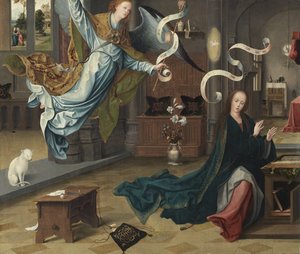
In the quiet, luminous atmosphere of the early sixteenth century, Jan de Beer captured a moment of profound spiritual intersection in his masterpiece, Annunciation. This painting serves as more than just a religious depiction; it is a window into a world where the celestial and the terrestrial breathe the same air. The scene unfolds with a breathtaking intimacy, centering on the Virgin Mary as she receives the divine message. An angel hovers gracefully above her, clutching a sacred scroll that signifies the unfolding of a divine prophecy. There is a palpable sense of weightlessness in the angel's presence, contrasted sharply by the grounded, domestic reality of the room, creating a tension between the eternal and the ephemeral that draws the viewer into a state of quiet contemplation.
The composition is a masterclass in Northern Renaissance storytelling, where every object placed within the frame serves as a silent witness to the miracle. As your eyes wander through the scene, you encounter a meticulously rendered interior that feels lived-in and authentic. A dining table sits in the foreground, adorned with the humble yet symbolic remnants of daily life: scattered books, a delicate wine glass, and a solitary cup. These elements are not merely decorative; they represent the intellectual and spiritual nourishment of the era. The presence of two observers in the background—figures watching from the periphery—adds a layer of human witness to the event, reminding us that even the most profound miracles occur within the fabric of human society.
Technically, de Beer employs a level of detail that is nothing short of hypnotic. The way light interacts with the various surfaces—the sheen on the glassware, the texture of the parchment, and the soft folds of the Virgin's garments—demonstrates an extraordinary command over oil painting techniques. For the discerning collector or interior designer, this piece offers a sophisticated focal point that brings a sense of historical depth and serene elegance to any space. The muted yet rich palette allows the artwork to integrate seamlessly into classical or contemporary settings, providing a conversation piece that evokes feelings of peace, reverence, and timeless beauty.
To possess a reproduction of this Annunciation is to invite a sense of historical continuity into one's home. It is an invitation to slow down and appreciate the intricate details of the human experience and the divine mysteries that surround us. Whether placed in a sunlit study or a grand formal hall, the painting radiates an emotional warmth that transcends its age, offering a sanctuary of stillness in a modern, hurried world.
Spørgsmål og svar
Hvordan beskrives farvepaletten i "Annunciation" af Jan De Beer?
Farverne i "Annunciation" udgør en Earthy palet. Denne klassificering beskriver de dominerende farvefamilier.
Hvilke andre navne eller pseudonymer bruger Jan De Beer?
Jan De Beer optræder under de alternative navne Master Of The Milan Adoration.
Hvor kan jeg finde kunstværker, der ligner "Annunciation" af Jan De Beer?
Se lignende værker til "Annunciation" på siden Lignende værker.
Kunstnerens biografi
The Master of Antwerp Mannerism
Jan De Beer stands as a luminous figure from the dawn of the sixteenth century, a period of profound spiritual and artistic transition in the Low Countries. Active primarily in Antwerp, he was a central protagonist in a loose but influential group of painters known as the Antwerp Mannerists. For many years, his individual identity remained shrouded in mystery, as much of his oeuvre was attributed to the Master of the Milan Adoration. It was only through the diligent efforts of art historians in the twentieth century that De Beer was rediscovered and reclaimed from the shadows of anonymity, revealing a painter of immense technical skill and profound religious devotion.
Born into an artistic lineage as the son of the painter Claes de Beer, Jan’s path was paved with the traditions of his craft. His early training under Gillis van Everen provided him with a foundation in the meticulous Netherlandish style, yet he would go on to transcend mere imitation. By 1504, he had achieved the prestigious status of master within the Antwerp Guild of Saint Luke, eventually rising to the esteemed position of dean. His professional life was deeply intertwined with the vibrant, bustling commerce and religious fervor of Antwerp, where he operated a large and productive workshop that shaped the visual language of the era.
A Symphony of Devotion and Detail
The work of Jan De Beer is characterized by a breathtaking marriage of Northern Renaissance realism and a burgeoning sense of theatricality. His compositions often serve as sacred windows, inviting the viewer into moments of divine encounter. In masterpieces such as his Annunciation, one finds a world where the celestial and terrestrial realms breathe in unison. He possessed a singular ability to render the weight of a heavy, ceremonial garment or the delicate, translucent sheen of a wine glass with such precision that the objects seem to possess a life of their own. This mastery of the oil medium allowed him to employ subtle gradations of light and shadow, creating a sense of volume and depth that pulls the observer into the heart of the narrative.
Beyond mere technical virtuosity, De Beer’s art is steeped in a rich tapestry of symbolism. Whether through the presence of birds hinting at divine grace or the architectural grandeur of Gothic arches acting as bridges to the heavens, every element of his work is imbued with meaning. His triptychs, such as those dating from approximately 1510 and 1515, demonstrate a sophisticated command over narrative flow, using multiple panels to orchestrate complex religious dramas that move between intimate indoor sanctuaries and expansive, sunlit vistas. In these works, the meticulous craftsmanship of the Northern tradition meets an emerging interest in human interaction and architectural scale.
Legacy and Historical Significance
Though his name fell into obscurity following the end of the sixteenth century, Jan De Beer’s influence endured through the lasting impact of the Antwerp Mannerist style. He was a contemporary of other great figures like Quentin Matsys and may have even collaborated with landscape innovators such as Joachim Patinir. His ability to maintain fame and respect during his lifetime—as noted by the Italian biographer Lodovico Guicciardini—speaks to the high regard in which he was held by his peers.
Today, De Beer is recognized not merely as a skilled craftsman, but as an artist who captured the very soul of a period in transition. His rediscovered legacy offers a vital link to the spiritual intensity of the early sixteenth century, reminding us of an age where art served as the primary vessel for divine communication and where every brushstroke was an act of profound faith.
Jan De Beer
1475 - 1528 , Netherlands
Kort fortalt
- Artistic Movement Or Style: Antwerp Mannerism
- Full Name: Jan De Beer
- Notable Artworks:
- Madonna and Child with a pilgrim and an angel
- Triptych
- Annunciation
- Place Of Birth: Netherlands
- Date Of Birth: 1475
- Date Of Death: 1528