Symbolist Expressionism · 1895
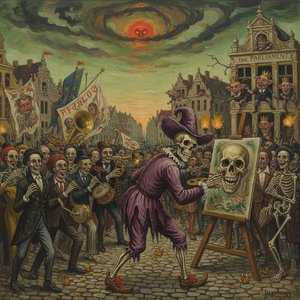
The Skeleton Painter (James Ensor, 1895)
James Ensor (1860–1949) har skabt The Skeleton Painter. Det er fra 1895. Det tilhører Symbolist Expressionism-bevægelsen. Den er udført i Acrylic On Canvas. Det opbevares på Koninklijk Museum voor Schone Kunsten i Antwerpen, Belgien.
- 1895
- Acrylic On Canvas
- Koninklijk Museum voor Schone Kunsten, Antwerpen

 Se i rummet

 Håndmalet oliemalerie
 Del som kort
 Del
 Faktablad


 Download
 Lignende værker
 Røntgenundersøgelse
 Diasshow
 Spørgsmål og svar

 Statistikker
The Skeleton Painter kort fortalt
- Titel
- The Skeleton Painter
- Kunstner
- James Ensor (1860–1949)
- Kunstner født i
- Oostende, Belgien
- Dato
- 1895
- Medium
- Acrylic On Canvas
- Hvor det kan ses
- Koninklijk Museum voor Schone Kunsten, Antwerpen, Belgien
- Bevægelse
- Symbolist Expressionism
- Motiv
- skeleton, artist, death, masks, paintings, room
Hvad forestiller The Skeleton Painter?
A Dance with Mortality: James Ensor’s “The Skeleton Painter”
James Ensor's "The Skeleton Painter," completed in 1895, is not merely a painting; it’s an unsettling plunge into the subconscious, a meticulously crafted tableau of morbidity and artistic obsession. The image, rendered with a distinctive and increasingly personal style, immediately confronts the viewer with a scene both bizarre and profoundly familiar – a room overflowing with art, dominated by a central figure: a skeleton diligently wielding a paintbrush. This isn’t a morbid spectacle intended to shock for shock's sake; rather, it’s a complex meditation on life, death, creativity, and the inescapable nature of artistic endeavor. Ensor, born in Ostend, Belgium, in 1860, cultivated an intensely individual vision, one deeply rooted in his upbringing amidst the vibrant chaos of a seaside resort town and fueled by a fascination with masks, disguise, and the theatricality of human experience.
The Artist’s Studio – A Realm of Shadows
The setting itself is crucial to understanding the painting's power. The room is crammed with canvases, each bearing witness to Ensor’s restless hand. A dining table, laden with objects—a clock, a partially consumed meal—suggests an interrupted life, a space where sustenance and creation intertwine. The presence of other skeletons, scattered amongst the chairs and leaning against walls, reinforces the pervasive theme of mortality. These aren't simply decorative elements; they are active participants in the scene, almost as if they’re observing or even contributing to the artist’s work. The inclusion of a cat, curled up near the left edge, adds an element of domesticity and perhaps a subtle critique – a creature of instinct and survival nestled within this world of intellectual pursuit.
Symbolism and Technique: A Palette of Unease
Ensor’s technique is immediately recognizable. He employed a thick, impasto application of paint, building up layers of color to create a tactile surface that seems almost sculptural. The palette is deliberately muted – browns, greys, ochres, and deep blues dominate—contributing to the painting's somber mood. The skeletal figure itself is rendered with remarkable detail, highlighting the fragility of bone while simultaneously conveying a sense of focused determination. Notice how Ensor uses strong diagonals – particularly in the arrangement of the chairs and paintings – to create a feeling of unease and instability. The use of color is not about beauty; it’s about evoking emotion, creating a visual atmosphere of melancholy and contemplation. His style evolved significantly throughout his career, moving away from academic influences towards a highly expressive, often unsettling, approach that anticipated the Symbolist movement.
Ensor's Exploration of Artistic Identity
"The Skeleton Painter" can be interpreted as an exploration of Ensor’s own artistic identity and his relationship to mortality. The skeleton artist represents not just death but also the inevitable end of creative endeavor, the fading of inspiration with time. It speaks to the paradox of the artist – someone who often seems detached from the everyday realities of life, yet is ultimately defined by their engagement with them. Ensor’s own struggles with artistic recognition and his rejection of traditional academic training likely fueled this preoccupation with themes of isolation and the ephemeral nature of existence. The painting isn't a celebration of art; it’s a questioning of its purpose and its ultimate significance in the face of oblivion. It invites us to consider what drives an artist to create, knowing that their work, like their own physical form, will eventually succumb to time.
OriginalUniqueArt offers exquisite, hand-painted reproductions of James Ensor’s “The Skeleton Painter,” allowing you to bring this haunting masterpiece into your home or office. Each reproduction is created with the same meticulous attention to detail and expressive technique as the original, capturing the painting's unique atmosphere and emotional depth. Explore our collection today and experience the unsettling beauty of Ensor’s vision.
Hvilket museum udstiller The Skeleton Painter?
Koninklijk Museum voor Schone Kunsten
Antwerpen, Belgien
Oprindelse og museets historie Koninklijk Museum voor Schone Kunsten blev grundlagt i 1810, men dets rødder strækker sig langt dybere ind i historien. Museets fundament er solidt forankret i arven fra Sankt Lukas-gildet i Antwerpen, en institutionel kraftfuld institution, der var aktiv fra slutningen af det 14. århundrede og frem til 1773.


Højopløselige billeder af The Skeleton Painter

Public domain: kunstneren døde i 1949.
Andre størrelser, beskæringer og kildehenvisning →James Ensor, The Skeleton Painter (1895), Koninklijk Museum voor Schone Kunsten. Public domain
Spørgsmål om The Skeleton Painter besvaret
Hvor kan jeg se det originale værk "The Skeleton Painter" af James Ensor?
Du kan se det originale værk "The Skeleton Painter" på Koninklijk Museum voor Schone Kunsten, Antwerpen, Belgien.
I hvilket år blev "The Skeleton Painter" af James Ensor skabt?
"The Skeleton Painter" stammer fra 1895. Datoen placerer værket i James Ensor's karriere og dets tidsalder.
Hvilket medie er "The Skeleton Painter" af James Ensor udført i?
"The Skeleton Painter" af James Ensor er udført i Acrylic On Canvas. Reproduktionerne har til formål at gengive denne tekniks visuelle udtryk.
Hvad forestiller "The Skeleton Painter" af James Ensor?
Temaerne i "The Skeleton Painter" af James Ensor omfatter skeleton, artist, death, masks, paintings, room, cat, decay, som tilsammen udgør værkets motivverden.
Er "The Skeleton Painter" fri for ophavsret?
Hvad angår ophavsret, er "The Skeleton Painter" i det offentlige domæne – ophavsretten er udløbet.
Hvilken kunstner tilskrives "The Skeleton Painter"?
"The Skeleton Painter" tilskrives James Ensor.
Hvilken stilart tilhører "The Skeleton Painter"?
"The Skeleton Painter" er et værk fra Symbolist Expressionism. Denne stilart angiver den kunstneriske tradition, som værket indgår i.
Hvilken periode i James Ensors karriere tilhører "The Skeleton Painter"?
"The Skeleton Painter" tilhører Late Period i James Ensors karriere. Denne klassificering knytter værket til kunstnerens udvikling.
Hvor gammel var James Ensor, da vedkommende skabte "The Skeleton Painter"?
Da "The Skeleton Painter" blev skabt i 1895, var James Ensor – født i 1860 – 35 år gammel.
Om kunstneren, James Ensor

1860–1949, Belgien
James Ensor
Tidligt liv, familie og kunstnerisk uddannelse James Ensor blev født den 13. april 1860 i Ostend, Belgien. Hans identitet blev formet af et helt særligt kulturelt krydsfelt: Hans far, James Frederic Ensor, var født i Bruxelles af engelske forældre, mens hans mor, Maria Catherina Haegheman, var belgisk. Denne dobbelte kulturarv lagde fundamentet for et perspektiv, der ofte befandt sig uden for de lokale traditioners snævre rammer.
Også af James Ensor
 Kristi indtog i Bruxelles1888
 Selvportræt med masker1899
 Badene i Ostend
 Skeletter der varmer sig1889

Essays om The Skeleton Painter
 Beauty in Mortality: Capturing the Soul of the Skull through the Luminous Lens of Impressionist ArtExplore the profound beauty of mortality through Impressionism. Discover how masters like Monet and Renoir transformed the Memento Mori tra…
 Legens psykologi: Udforskning af humoristiske og fantasifulde maleriers rolle i fremme af følelsesmæssigt velvære og social samhørighedUdforsk den psykologiske virkning af humoristisk og fantasifuld kunst! Opdag hvordan malerier fremmer velvære, styrker samhørighed & skaber…
 James Ensor's Grotesque Visions: Social Commentary & Artistic InnovationExplore the unsettling yet captivating world of James Ensor, a pioneer of Expressionism. Discover his satirical masterpieces, symbolic imag…