Expressionist Orientalism
Chinoiseries (James Ensor)
James Ensor (1860–1949) har skabt Chinoiseries. Det tilhører Expressionist Orientalism-bevægelsen. Den er udført i Acrylic On Canvas.
- Acrylic On Canvas

 Se i rummet

 Håndmalet oliemalerie
 Del som kort
 Del
 Faktablad


 Download
 Lignende værker
 Røntgenundersøgelse
 Diasshow
 Spørgsmål og svar

 Statistikker
Chinoiseries kort fortalt
- Titel
- Chinoiseries
- Kunstner
- James Ensor (1860–1949)
- Kunstner født i
- Oostende, Belgien
- Medium
- Acrylic On Canvas
- Bevægelse
- Expressionist Orientalism
- Motiv
- chinoiseries, james ensor, masks, figures, exoticism, belgium
Hvad forestiller Chinoiseries?
A World Within Walls: Unpacking James Ensor’s “Chinoiseries”
James Ensor's "Chinoiseries," painted in 1880, isn’t merely a depiction of an interior scene; it’s a carefully constructed psychological landscape. This captivating work, residing within the Royal Museums of Fine Arts of Belgium in Brussels, offers a glimpse into the artist’s uniquely unsettling and intensely personal vision. Ensor, born in Ostend to an English father and Belgian mother, possessed a sensibility deeply shaped by his upbringing amidst the vibrant chaos of a seaside resort town – a place saturated with masks, curiosities, and a potent sense of theatricality. This early exposure profoundly influenced his artistic trajectory, leading him away from conventional academic training and toward a fiercely independent style that would forever challenge the established norms of art.
The Dance of Form and Feeling: Style and Technique
“Chinoiseries” is a masterclass in Expressionist technique, subtly blended with elements of Orientalism. Ensor’s brushstrokes are not delicate or refined; they are bold, assertive, and often deliberately rough, conveying an underlying sense of unease and emotional intensity. The color palette—dominated by deep blues and greens—creates a claustrophobic atmosphere, intensifying the feeling of being trapped within the confines of the room. Notice how he utilizes contrasting colors – the vibrant reds and yellows of the decorative objects against the somber background – to draw the eye and heighten the drama. The composition itself is deliberately unbalanced, with the figures positioned in ways that disrupt any sense of harmony or stability. This deliberate distortion reflects Ensor’s interest in exploring the darker aspects of human experience.
- Oil on Canvas: The medium lends itself perfectly to Ensor's expressive style, allowing for rich textures and a dynamic application of paint.
- Bold Brushwork: Visible brushstrokes contribute significantly to the painting’s emotional impact.
- Color Palette: Deep blues and greens create an atmosphere of mystery and introspection.
Decoding the Symbols: Orientalism, Masks, and Human Connection
The title itself, “Chinoiseries,” immediately signals Ensor’s fascination with the exotic – specifically, Chinese-inspired motifs. The table laden with porcelain vases, bowls, and cups isn't simply decorative; it represents a deliberate attempt to introduce an element of the ‘other’ into a European setting. This reflects a broader trend in 19th-century art, where artists sought to explore and interpret foreign cultures through visual representation. However, Ensor doesn’t offer a romanticized view of the Orient. Instead, he presents these objects within a context that is unsettling and ambiguous. The two figures present – one standing, the other seated – are deliberately undefined, their faces obscured or averted, suggesting a lack of genuine connection. The cat, perched on the floor, adds another layer of intrigue, embodying mystery and perhaps even a touch of foreboding.
A Portrait of an Artist’s Mind: Context and Legacy
“Chinoiseries” is often compared to the work of Clyfford Still, a pioneer of Abstract Expressionism, due to their shared emphasis on emotional intensity and non-representational forms. However, Ensor's approach is far more rooted in psychological observation than pure abstraction. His paintings are not simply about depicting objects; they’re about conveying feelings – anxiety, isolation, and the unsettling nature of human relationships. The painting’s creation coincided with a period of significant social and artistic change, mirroring the growing anxieties of modern life. It's a testament to Ensor’s ability to capture the complexities of the human condition through a uniquely personal and often disturbing lens. Reproductions of “Chinoiseries” offer a remarkable opportunity to experience this powerful work firsthand, bringing its enigmatic atmosphere into any space.
Explore more captivating works by James Ensor and discover high-quality reproductions at OriginalUniqueArt.com. For deeper insights into the artist’s life and oeuvre, visit his Wikipedia profile: https://en.wikipedia.org/wiki/James_Ensor.
Højopløselige billeder af Chinoiseries

Public domain: kunstneren døde i 1949.
Andre størrelser, beskæringer og kildehenvisning →James Ensor, Chinoiseries. Public domain
Farverne er matchet til originalen af en digital ekspert, og filen er finretoucheret og tro mod kunstnerens penselstrøg.
Køb filen i høj opløsningSpørgsmål om Chinoiseries besvaret
Hvilken teknik er brugt til "Chinoiseries" af James Ensor?
James Ensor brugte Acrylic On Canvas-teknikken til "Chinoiseries". Teknikken definerer det originale værks materielle karakter.
Hvad forestiller "Chinoiseries" af James Ensor?
Temaerne i "Chinoiseries" af James Ensor omfatter chinoiseries, james ensor, masks, figures, exoticism, belgium, carnival, symbolism, som tilsammen udgør værkets motivverden.
Er "Chinoiseries" af James Ensor i det offentlige domæne?
"Chinoiseries" af James Ensor er i det offentlige domæne – ophavsretten er udløbet. Denne status bestemmer, hvordan billedet af værket må reproduceres.
Hvem har skabt "Chinoiseries"?
Kunstneren bag "Chinoiseries" er James Ensor. Værket er katalogiseret under James Ensors navn.
Hvilken kunstretning tilhører "Chinoiseries" af James Ensor?
Kunstretningen forbundet med "Chinoiseries" af James Ensor er Expressionist Orientalism. Denne klassificering placerer værket blandt relaterede kunstnere og kunstværker.
Hvilken periode i James Ensors karriere tilhører "Chinoiseries"?
Inden for James Ensors karriere tilhører "Chinoiseries" perioden Mature Period, hvilket gør det muligt at sammenligne værket med kunstnerens øvrige værker.
Hvorfor er ophavsretsstatus for "Chinoiseries" som den er?
Ophavsretsstatus for "Chinoiseries" – i det offentlige domæne – ophavsretten er udløbet – følger af kunstnerens død i 1949.
Hvor placerer "Chinoiseries" sig i forhold til James Ensors samlede værk?
"Chinoiseries" er et værk fra James Ensors Expressionist Orientalism-periode, hvis gennemgående temaer inkluderer expressionist distortion, oriental motifs, belgian identity, cultural fusion, masks, hidden emotions, satire, ensor’s unique visual language.
Hvor placerer "Chinoiseries" sig blandt James Ensors gennemgående motiver?
"Chinoiseries" skildrer chinoiseries, james ensor, masks, figures, exoticism, belgium, carnival, symbolism, mens James Ensors registrerede temaer er expressionist distortion, oriental motifs, belgian identity, cultural fusion, masks, hidden emotions, satire, ensor’s unique visual language. En sammenligning af de to viser, hvordan værket relaterer sig til kunstnerens sædvanlige motiver.
Om kunstneren, James Ensor

1860–1949, Belgien
James Ensor
Tidligt liv, familie og kunstnerisk uddannelse James Ensor blev født den 13. april 1860 i Ostend, Belgien. Hans identitet blev formet af et helt særligt kulturelt krydsfelt: Hans far, James Frederic Ensor, var født i Bruxelles af engelske forældre, mens hans mor, Maria Catherina Haegheman, var belgisk. Denne dobbelte kulturarv lagde fundamentet for et perspektiv, der ofte befandt sig uden for de lokale traditioners snævre rammer.
Også af James Ensor
 Kristi indtog i Bruxelles1888
 Selvportræt med masker1899
 Badene i Ostend
 Skeletons Warming Themselves1889

Essays om Chinoiseries
 Raw Emotion & Bold Strokes: Top 10 Neo-Expressionism MasterpiecesExplore iconic Neo-Expressionist works by Basquiat and Baselitz. Discover museum-quality art at OriginalUniqueArt.com.
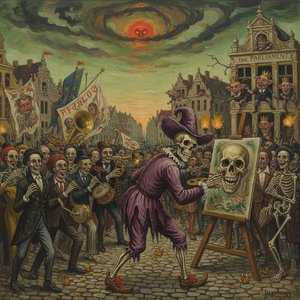 James Ensor's Grotesque Visions: Social Commentary & Artistic InnovationExplore the unsettling yet captivating world of James Ensor, a pioneer of Expressionism. Discover his satirical masterpieces, symbolic imag…
 Capturing the Exotic: A Journey Through the Allure and Complex Legacy of Orientalist ArtExplore the mesmerizing world of Orientalist art. From Napoleon's influence to Renoir's exotic textures, discover the history, beauty, and …