Skift til printsalg
 Vis mere







































 For kunstværker eller reproduktioner, der er større end 105 cm (ca. 41 tommer) på en hvilken som helst side, vil rammen blive leveret som et adskilt sæt. Denne metode sikrer sikker levering og forhindrer skader under transport.


A Study in Coastal Solitude
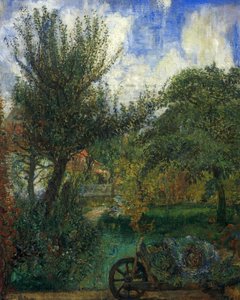
Step closer and observe the quiet tension held within this seaside scene. At first glance, one might see only a simple coastal village, yet there is an unmistakable weight to the atmosphere. The composition centers on a small white house resting upon the sand, its presence marked by a sense of isolation. Near the shore, a boat sits quietly, while an empty wheelbarrow rests in the foreground, adding a touch of stillness to the landscape. The sky above is heavy with clouds and shades of blue, suggesting that a storm may be gathering just beyond the horizon. It is a moment caught in transition, where the tranquility of the beach meets an underlying sense of unease.
The palette is restrained, relying on muted blues and greys to build this mood of impending change. This choice of color avoids any bright distractions, focusing instead on the subtle shifts in light and shadow that define the coastal air. There is a certain flatness to the perspective here, which brings the elements of the scene closer together, creating a space that feels somewhat enclosed despite being outdoors.
The Texture of Expression
The physical presence of the paint is quite significant when you look at the surface. Ensor utilized oil paint to create thick, textured brushstrokes that lend a sense of movement to the work. You can see the materiality of the medium in the way the light catches the ridges of the paint, particularly in the depiction of the weathered shingles on the roof of the hut. These tactile details ground the painting in a certain reality, even as the overall mood leans toward the psychological.
This technique moves away from mere observation and toward an expression of internal feeling. The heavy application of paint mirrors the artist's interest in physicality and the raw energy of the scene. By emphasizing the texture of the shingles and the weight of the clouds, the work communicates a sense of gravity. It is a deliberate departure from more traditional, smooth finishes, opting instead for a surface that feels as restless as the sea itself.
Symbolism and the Unseen
There is much to consider beneath the surface of this landscape. The solitary nature of the hut can be read as a reflection of isolation, standing vulnerable against the vastness of the sky. Even the empty wheelbarrow carries a weight of meaning, perhaps suggesting a sense of stagnation or the end of a period of activity. These small, quiet details invite us to look for deeper truths hidden within the scenery.
The muted tones of the sky do more than just set a weather pattern; they evoke a feeling of melancholy and foreshadowing. In this way, the painting functions as an exploration of what lies beneath appearances. The artist uses the familiar elements of a beach setting to touch upon themes of mortality and decay, suggesting that even in a moment of apparent peace, there is a deeper, more turbulent reality at work.
Spørgsmål og svar
Hvilken kunstretning tilhører "Bathing Hut" af James Ensor?
"Bathing Hut" af James Ensor tilhører Expressionist Movement-bevægelsen. Denne bevægelse giver den stilistiske kontekst for værket.
Er farverne i "Bathing Hut" af James Ensor mættede eller dæmpede?
Farverne i "Bathing Hut" af James Ensor har en Muted mætning. Mætning beskriver, hvor livlige eller dæmpede farverne er.
Hvilken farvepalette er brugt i "Bathing Hut" af James Ensor?
Farvepaletten i "Bathing Hut" af James Ensor beskrives som Neutrals. Det er en kortfattet beskrivelse af værkets farver.
 Se i rummet

 Del som kort
 Del
 Detaljer
 Guide


 Download
 Lignende værker
 Røntgenundersøgelse
 Diasshow
 Spørgsmål og svar
 Statistikker