Symbolism · 1903
Art (Jacek Malczewski, 1903)
Jacek Malczewski (1854–1929) har skabt Art. Det er fra 1903. Det tilhører Symbolism-bevægelsen. Den er udført i Oil On Canvas. Det opbevares på National Museum in Wrocław i Wrocław, Poland. Målene er 70 × 98 cm.
- 1903
- Oil On Canvas
- 70 × 98 cm
- National Museum in Wrocław

 Se i rummet

 Håndmalet oliemalerie
 Del som kort
 Del
 Faktablad


 Download
 Lignende værker
 Røntgenundersøgelse
 Diasshow
 Spørgsmål og svar

 Statistikker
Art kort fortalt
- Titel
- Art
- Kunstner
- Jacek Malczewski (1854–1929)
- Kunstner født i
- Radom, Polen
- Dato
- 1903
- Medium
- Oil On Canvas
- Dimensioner
- 70 × 98 cm
- Hvor det kan ses
- National Museum in Wrocław, Wrocław, Poland
- Bevægelse
- Symbolism
- Periode
- 19th Century
- Motiv
- symbolism, polish art, mythology, portraiture, national identity, allegory
Hvad forestiller Art?
Identification of the Artwork and Artist
Art is an oil on canvas painting executed by Jacek Malczewski in 1903. The work belongs to the Symbolist movement, a style in which Malczewski established himself as a central figure. His practice often integrated themes of national identity and folklore into complex allegorical compositions.
Malczewski was a Polish symbolist painter. His approach frequently utilized mythological and religious motifs to explore psychological and existential states. This specific work, created at the turn of the twentieth century, reflects the artist's characteristic use of symbolic imagery to communicate ideas beyond literal representation.
Composition and Visual Elements
The composition is tightly framed, focusing the viewer's attention on the faces and upper bodies of the clustered figures. This arrangement creates a sense of intimacy and shared experience among the subjects, though the overall placement feels somewhat chaotic yet deliberate. A large, golden horse dominates the background, its head acting as a visual anchor that stabilizes the grouping of humans in the foreground.
The color palette is dominated by earthy tones, including browns, beiges, and muted greens. These base colors are contrasted by the vibrant golden hue of the horse and subtle touches of red in the hair and clothing of the figures. Lighting is diffused and soft, appearing to emanate from multiple sources without creating harsh shadows or strong contrasts. This gentle illumination contributes to the dreamlike quality of the scene.
The perspective is somewhat flattened due to the close-up framing, which limits the sense of spatial recession. Depth is achieved primarily through the layering of figures and the placement of the equine subject in the background. Organic and rounded shapes define the human forms and the natural contours of the horse, avoiding sharp angles or geometric structures.
Technique and Material Composition
Executed in oil on canvas, the work utilizes a method of blended brushstrokes to achieve its specific visual effects. The application of paint involves a visible layering process, which contributes to the depth and richness of the composition. This layering allows for a subtle transition between the earthy tones of the background and the more luminous highlights found on the figures and the equine subject.
The surface texture appears relatively smooth, a result of the extensive blending of the oil paints. This technique softens the edges of the forms, particularly in the rendering of hair and the drape of clothing. Consequently, the lines defining the facial features remain somewhat indistinct, contributing to a dreamlike quality. The interplay of light and shadow is achieved through these soft transitions rather than through harsh, high-contrast edges.
Related Works by Jacek Malczewski
The artist's exploration of symbolic and allegorical themes is evident in several other compositions. His 1901 work, Self-portrait with the Vistula in the Background, offers a different perspective on his relationship with the Polish landscape. Other significant pieces include Chimera 1 and the Thanatos series, which further investigate the psychological and spiritual dimensions central to his practice.
Malczewski also drew heavily from folklore and mythology to construct his visual language. This is particularly evident in his collection titled Bajki (Fables). These works, alongside his various symbolic studies, demonstrate the breadth of his engagement with national and universal motifs.
Hvilket museum udstiller Art?
National Museum in Wrocław
Wrocław, Poland
The Architecture of the National Museum in Wrocław The National Museum in Wrocław occupies a former Silesian regency building situated on the banks of the Odra river. Constructed between 1883 and 1886, the structure reflects the architectural language of the late 19th century. Its Neo-Renaissance design provides a formal setting for the collections housed within its three floors.


Højopløselige billeder af Art

Public domain: kunstneren døde i 1929.
Andre størrelser, beskæringer og kildehenvisning →Jacek Malczewski, Art (1903), National Museum in Wrocław. Public domain
Spørgsmål om Art besvaret
Hvilket museum udstiller det originale "Art"?
"Art" af Jacek Malczewski er udstillet på National Museum in Wrocław, Wrocław, Poland. Museets fortegnelse henviser til det originale værk og ikke til reproduktioner.
Hvornår blev "Art" skabt?
"Art" af Jacek Malczewski er dateret til 1903.
Hvilken teknik er brugt til "Art" af Jacek Malczewski?
"Art" af Jacek Malczewski er udført i Oil On Canvas. Reproduktionerne har til formål at gengive denne tekniks visuelle udtryk.
Hvad er målene på det originale værk "Art"?
Det originale værk "Art" af Jacek Malczewski måler 70 x 98 cm.
Hvad forestiller "Art" af Jacek Malczewski?
Temaerne i "Art" af Jacek Malczewski omfatter symbolism, polish art, mythology, portraiture, national identity, allegory, artistic inspiration, som tilsammen udgør værkets motivverden.
Er "Art" af Jacek Malczewski i det offentlige domæne?
Ophavsretsstatus for "Art" af Jacek Malczewski: værket er i det offentlige domæne – ophavsretten er udløbet. Dette afgør, om der frit må foretages reproduktioner af billedet.
Hvilken kunstner tilskrives "Art"?
"Art" tilskrives Jacek Malczewski.
Hvilken stilart tilhører "Art"?
"Art" er et værk fra Symbolism. Denne stilart angiver den kunstneriske tradition, som værket indgår i.
Hvor i Jacek Malczewskis karriere placerer "Art" sig?
"Art" tilhører Mature Period i Jacek Malczewskis karriere. Denne klassificering knytter værket til kunstnerens udvikling.
Om kunstneren, Jacek Malczewski
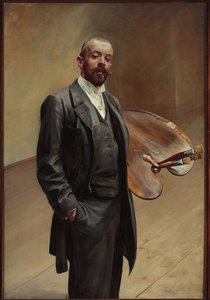
1854–1929, Polen
Jacek Malczewski
En Sjæl Fyldt med Polsk Længsel Jacek Malczewski, født i 1854 i Radom, en by dengang beliggende inden for det russisk-kontrollerede Kongrespolen, var mere end blot en maler; han var et visuelt udtryk for polsk national identitet og en dyb stemme for en nation, der længtes efter selvbestemmelse. Hans livsforløb og kunstneriske vision var uadskilleligt forbundet med de romantiske idealer om uafhængighed, dybt indpodet af hans far, Julian Malczewski – en dedikeret patriot, der dyrkede i den unge Jacek en ustrammelig kærlighed til polsk kultur, litteratur og historie. Denne tidlige indflydelse blev grundlaget for hans kreative udtryk, hvilket formede ham til den førende figur inden for polsk symbolisme og gav ham det ærede titel af “polsk symbolismes fader”. Hans formative år var gennemsyret af fortællinger om heltemod, ofre og en hjerteskærende bevidsthed om Polens turbulente fortid – temaer der ville resonere gennem hele hans værk.
Om Jacek Malczewski Bemærkelsesværdige værker af Jacek Malczewski
Også af Jacek Malczewski
 Self-portrait in armor with violin.1908
 Madonna and Children1897
 Portrait of artist's sister Helene with lute1906
 The Artist's death1909
Essays om Art
 19th century Polish painters19th-century Polish art comes alive through the masterpieces of Jan Matejko and Jacek Malczewski. View the full collection online at Origin…
 Masterpieces of the Soil: The Top 25 Jean-François Millet ArtworksImmerse yourself in the soul of French Realism with our curated list of the top 25 Jean-François Millet artworks. From iconic peasant scene…
 20th century Polish painters20th-century Polish painters like Tamara de Lempicka, Sigmar Polke, and Aleksandra Ekster define an era. Find museum-quality reproductions …