

 Se i rummet
 Send
Send Del
Del
 Detaljer
 Studieguide til kunstværker

 Download
 Lignende værker
 Røntgenundersøgelse
 Se diasshow
 Statistik
Housemaid with Pram


 Læs mere
Giclée / Kunsttryk
Giclée- eller lærredstryk i museumskvalitet med hurtig produktion og fleksible muligheder for finish. ( Bestil håndmalet reproduktion Skift til digitalt billede)




P118B $10

P118H $10

P118W $10

P438Z $10

P508JH $12

P508YH $12

P805H $10

P805Z $10

P919BZ $10

P919G $10

P919XJ $10

P959ZH $10

P968JZ $12

W106C $8

W218G $10

W218JH $8

W218Y $10

W307PJ $10

W316G $10

W316PJ $8

W316Y $10

W398PJ $8

W4111J $10

W500HY $15

W500JH $15

W692G $12

W849H $8

W940BG $15

W953PJ $8




Vælg mellem vores forudindstillede størrelser, der matcher kunstværkets originale proportioner.

Du kan indtaste dine egne mål for at passe til en specifik ramme eller et bestemt område. Hvis den valgte størrelse ikke stemmer overens med det originale billedes proportioner, vil vi enten beskære kunstværket eller udvide billedet med en spejlet eller ensfarvet kant. En digital mockup vil blive sendt til din godkendelse, før produktionen påbegyndes.
Bemærk venligst, at forhåndsvisningen på skærmen ikke afspejler den faktiske beskæring eller udvidelse. Kun mockuppen vil nøjagtigt vise den endelige komposition.
Selvom specialmål er tilgængelige, anbefaler vi at vælge et mål fra den foruddefinerede liste for at bevare de originale proportioner.
Verdensomspændende levering () på 2 uger i stedet for de sædvanlige 4/5 uger. (25 september)

Gratis ekspresforsendelse til hele verden

Lærred af linned i høj kvalitet

Komplet transportforsikring

Garanti for refusion af told og importafgifter

Garanti for autentisk farvegengivelse

100 dages returret ved fabrikationsfejl

100% fuld returret

Mængderabat ved flere køb
 Glasmulighed er kun tilgængelig i størrelser under 110 cm

Housemaid with Pram
Giclée / Kunsttryk
Reproduktionsstørrelse
-


Samlet pris
$ 81
A Moment Frozen in Time: Isaac Israëls’ “Housemaid with Pram”
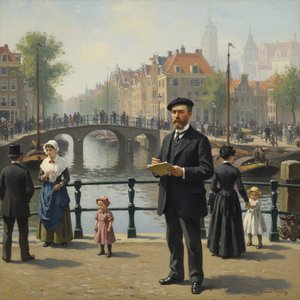
Isaac Lazarus Israëls' "Housemaid with Pram," painted in 1875, isn’t merely a snapshot of urban life; it’s a poignant meditation on the quiet dignity and understated beauty found within the everyday. This watercolor, now housed in the Rijksmuseum in Amsterdam, captures a fleeting moment along a bustling city street – a woman pushing a baby carriage, her face etched with a subtle blend of weariness and contentment. Israëls, a key figure in the Dutch Impressionist movement, masterfully utilizes loose brushstrokes and delicate washes to evoke not just a visual representation but an atmosphere, a feeling of the scene’s transient nature.
Israëls' artistic journey was deeply intertwined with his family history. The son of Jozef Israëls, a renowned Hague School painter known for his realistic depictions of working-class life, Isaac initially followed in his father’s footsteps, exploring similar themes of labor and social realism. However, he quickly developed his own distinct style, moving away from the stark formality of his father's work towards a more impressionistic approach – prioritizing capturing light, color, and mood over precise detail. This shift is powerfully evident in “Housemaid with Pram,” where the focus isn’t on the woman’s physical appearance but rather on her presence within the urban landscape.
The Language of Light and Color
Israëls' technique is characterized by a remarkable sensitivity to light. He employs broken color, layering translucent washes of pigment to create an ethereal quality, as if the scene is bathed in a soft, diffused glow. The muted palette – predominantly blues, greens, and browns – reflects the overcast Amsterdam sky, lending the painting a melancholic yet peaceful atmosphere. Notice how he uses highlights to draw attention to the woman’s face and the details of the pram, while simultaneously blurring the background figures into an indistinct mass. This selective focus directs the viewer's eye and emphasizes the central subject.
The composition itself is carefully constructed. The woman occupies a slightly off-center position, creating a sense of dynamism and inviting the viewer to step into the scene. The placement of the clock tower in the background provides a subtle temporal reference, anchoring the image within a specific moment in time. Israëls’ use of atmospheric perspective – making distant objects appear paler and less distinct – further enhances the illusion of depth and contributes to the painting's overall sense of realism.
Symbolism and Social Commentary
Beyond its aesthetic qualities, “Housemaid with Pram” carries a subtle layer of social commentary. The woman’s posture suggests both responsibility and exhaustion—a common reality for working-class women in 19th-century Amsterdam. The pram itself symbolizes motherhood and the cycle of life, while the bustling street represents the relentless pace of urban existence. Israëls doesn't offer a judgment or moralizing statement; instead, he presents a simple, honest portrayal of a woman’s daily life, inviting viewers to contemplate her experiences and consider the social conditions that shaped them.
The inclusion of other figures in the background – a man standing on the left and another further back on the right – adds to the painting's narrative complexity. They represent the broader context of urban society, highlighting the woman’s place within it. Their presence suggests a community, albeit one largely unseen by the central figure.
A Timeless Portrait of Human Experience
“Housemaid with Pram” is more than just a painting; it's a window into the past—a poignant and evocative depiction of everyday life in 19th-century Amsterdam. Israëls’ masterful use of light, color, and composition creates an image that resonates deeply with viewers today, reminding us of the shared human experiences of labor, motherhood, and the quiet beauty found within the ordinary moments of our lives. Reproductions of this work offer a chance to bring this evocative scene into any space, fostering contemplation and appreciation for Israëls’ enduring legacy.
Om kunstneren
Isaac Israëls: A Pioneer of Amsterdam Impressionism
Isaac Lazarus Israëls (1865 – 1934) stands as a cornerstone of Dutch Impressionist painting, embodying the spirit of innovation and artistic exploration that defined the Hague School’s successor. Born into an influential artistic lineage—his father, Jozef Israëls, being one of the foremost figures in the Hague School—Israëls inherited not only talent but also a profound understanding of artistic tradition and its potential for reimagining visual representation. From his early years, he demonstrated exceptional aptitude for painting, securing recognition before he even completed his formal education at the Royal Academy of Art in The Hague, where he forged a lifelong friendship with George Hendrik Breitner.This connection proved pivotal, shaping Israëls’ artistic vision and fostering collaborative endeavors that cemented their place within the burgeoning Impressionist movement.- Early Life & Artistic Beginnings: Israëls' upbringing instilled in him a deep appreciation for art, nurtured by his father’s unwavering dedication to capturing the essence of Dutch life. His prodigious talent manifested itself remarkably early—selling “Bugle Practice” at just sixteen years old—a feat that underscored his innate ability and foreshadowed his future success.This accomplishment speaks volumes about his artistic maturity and confidence.
- The Amsterdam Impressionist Circle: Israëls swiftly embraced the avant-garde ideals championed by the Tachtigers, rejecting academic conventions in favor of capturing fleeting moments of beauty and emotion. He established a studio in Amsterdam and cultivated close relationships with fellow artists like Breitner, creating a vibrant artistic milieu characterized by experimentation and intellectual discourse.Their shared commitment to Impressionist principles profoundly influenced Israëls’ stylistic choices.
- Key Works & Artistic Style: Israëls' oeuvre is distinguished by its luminous color palettes, loose brushwork, and masterful depictions of urban landscapes and portraits. Notable masterpieces include “Transport of Colonial Soldiers,” a monumental canvas reflecting the anxieties of his time; “The Coffee Sorters,” an evocative portrayal of daily life in Amsterdam’s bustling docks; and the iconic portrait of Mata Hari, capturing her enigmatic gaze with remarkable precision.His technique—characterized by rapid layering of paint—allowed him to convey immediacy and dynamism.
- Travels & Artistic Evolution: Israëls embarked on extensive journeys throughout Europe and Asia during the early 20th century, broadening his artistic horizons and exposing him to diverse cultural influences. His expeditions to India and the Dutch East Indies yielded invaluable sketches and paintings that enriched his artistic repertoire.These experiences instilled in him a sensitivity to exotic landscapes and traditions.
- Legacy & Recognition: Isaac Israëls’ enduring legacy resides not merely in his artistic achievements but also in his contribution to establishing Amsterdam Impressionism as a dominant force within Dutch art history. His paintings are now housed in prestigious museums worldwide, including the Van Gogh Museum and Mauritshuis, ensuring that his vision continues to inspire generations of artists.He achieved international acclaim, notably winning a Gold Medal at the 1928 Olympic Games for “Red Rider,” solidifying his reputation as one of the most celebrated painters of his era.
Influences & Artistic Vision
Israëls’ artistic sensibilities were deeply rooted in the traditions of Dutch painting, particularly the Hague School's focus on realism and tonal harmony.However, he swiftly transcended these conventions, embracing Impressionist principles that prioritized capturing light and color as perceived by the eye. The influence of Émile Zola—a fellow writer and artist—was palpable in Israëls’ exploration of social themes and his commitment to portraying human experience with empathy and nuance.He sought to convey emotion through visual language, mirroring the broader artistic currents of his time.Notable Paintings
Israëls' artistic output spanned a remarkable range of subjects, from monumental landscapes to intimate portraits. Among his most celebrated works are “Transport of Colonial Soldiers,” which powerfully captures the psychological impact of military service; “The Coffee Sorters,” an exquisitely detailed depiction of Amsterdam’s docks; and “Portrait of Mata Hari,” a haunting portrayal of the infamous dancer.These paintings exemplify Israëls' mastery of technique and his ability to convey profound emotional resonance.Conclusion
Isaac Lazarus Israëls remains an artist whose work continues to captivate audiences worldwide. His pioneering embrace of Impressionism, coupled with his unwavering dedication to artistic excellence, secured his place as a pivotal figure in Dutch art history.He bequeathed to posterity a legacy of luminous color, expressive brushwork, and insightful observation—a testament to the transformative power of artistic vision.
Isaac Israels
1865 - 1934 , Holland
Hurtige fakta
- Artistic Movement Or Style: Hague School Impressionisme
- Artists Or Movements Influenced By This Artist: ['Émile Zola']
- Artists Who Influenced This Artist:
- Jozef Israëls
- George Hendrik Breitner
- Date Of Birth: 3. februar 1865
- Date Of Death: 7. oktober 1934
- Full Name: Isaac Lazarus Israëls
- Nationality: Nederlands
- Notable Artworks:
- Transport af kolonitransportører
- Kaffe sorter
- Portræt af Mata Hari
- Place Of Birth: Amsterdam, Nederland
Relaterede artikler
Isaac Lazarus Israëls: A Chronicle of Dutch Life & the Evolution of Impressionistic Realism
Explore the captivating world of Isaac Lazarus Israëls (1865-1934), a leading Dutch Amsterdam Impressionist. Discover his city scenes, portraits & travels through Asia – a chronicle of Dutch life and artistic evolution.

Ephemeral Visions: Exploring the Artistic Legacy & Nuances of Watercolor Painting
Explore the captivating world of watercolor painting! Discover its rich history, essential techniques, influential artists & collecting tips from art experts. A comprehensive guide for enthusiasts.

Top 10 Akvarelmesterværker: Kunst der Ændrede Historien | OriginalUniqueArt.dk
Oplev de 10 mest legendariske akvarelmesterværker, der har ændret kunsthistorien! Fra Turner til Monet – lær om teknikken og historierne bag ikoniske værker. Find museumskvalitets reproduktioner & inspiration til din indretning på OriginalUniqueArt.com.

Ephemeral Visions: Exploring the History & Emotional Resonance of Watercolor Painting
Explore the captivating history of watercolor painting, from ancient techniques to modern masters like Kandinsky & Blake. Discover essential artists, collecting tips & the emotional power of this luminous medium. Expert insights for art enthusiasts.

Ephemeral Visions: Exploring the Artistic Legacy & Contemporary Practice of Watercolor Painting
Explore the captivating world of watercolor painting! Discover its rich history, essential techniques, influential artists & collecting tips. A comprehensive guide for art enthusiasts from OriginalUniqueArt.