

 Se i rummet
 Send
Send Del
Del
 Detaljer
 Studieguide til kunstværker

 Download
 Lignende værker
 Røntgenundersøgelse
 Se diasshow
 Statistik
Lord Ronald Sutherland Gower


 Læs mere
Giclée / Kunsttryk
Giclée- eller lærredstryk i museumskvalitet med hurtig produktion og fleksible muligheder for finish. ( Bestil håndmalet reproduktion Skift til digitalt billede)




P118B Dkr10

P118H Dkr10

P118W Dkr10

P438Z Dkr10

P508JH Dkr12

P508YH Dkr12

P805H Dkr10

P805Z Dkr10

P919BZ Dkr10

P919G Dkr10

P919XJ Dkr10

P959ZH Dkr10

P968JZ Dkr12

W106C Dkr8

W218G Dkr10

W218JH Dkr8

W218Y Dkr10

W307PJ Dkr10

W316G Dkr10

W316PJ Dkr8

W316Y Dkr10

W398PJ Dkr8

W4111J Dkr10

W500HY Dkr15

W500JH Dkr15

W692G Dkr12

W849H Dkr8

W940BG Dkr15

W953PJ Dkr8




Vælg mellem vores forudindstillede størrelser, der matcher kunstværkets originale proportioner.

Indtast den bredde og højde, du har brug for, så det passer til din ramme eller din væg. Et print kan kun beskæres, aldrig gøres større end billedet, så en størrelse med en anden form vil miste en del af motivet. Vi sender dig en digital mockup til godkendelse, før vi printer noget. Billedet vist på denne side viser ikke den faktiske beskæring — det er kun mockuppen, der gør.
Verdensomspændende levering () på 2 uger i stedet for de sædvanlige 4/5 uger. (22 oktober)

Gratis ekspresforsendelse til hele verden

Lærred af linned i høj kvalitet

Komplet transportforsikring

Garanti for refusion af told og importafgifter

Garanti for autentisk farvegengivelse

100 dages returret ved fabrikationsfejl

100% fuld returret

Mængderabat ved flere køb
 Glasmulighed er kun tilgængelig i størrelser under 110 cm

Lord Ronald Sutherland Gower
Giclée / Kunsttryk
Reproduktionsstørrelse
-


Samlet pris
Dkr 531
The Subject and Its Time
Henry Scott Tuke’s 1897 painting, “Lord Ronald Sutherland Gower,” isn't merely a likeness; it’s a carefully constructed tableau of late Victorian society. The subject himself, Lord Ronald Charles Sutherland-Leveson-Gower, was a figure of considerable standing – a sculptor renowned for his statue of William Shakespeare in Stratford-upon-Avon, and a man deeply embedded within the intellectual and artistic circles of London. Born into a distinguished lineage tracing back to the Earls of Carlisle, Gower’s life intersected with some of the most prominent artists and writers of the era, including Oscar Wilde. The painting captures him not as a flamboyant celebrity, but as a man of quiet authority, radiating an understated sense of dignity and bearing – a reflection of his social position and the expectations placed upon gentlemen of his station.
A Masterclass in Realist Detail
Tuke’s artistic approach is firmly rooted in realism, yet transcends simple representation. He employs a meticulous attention to detail, rendering every facet of Gower's appearance with remarkable precision. The artist skillfully captures the texture of his tailored suit, the subtle lines etched by age and experience on his face, and the carefully arranged poppy pinned to his lapel – a small emblem that subtly hints at remembrance or perhaps even loyalty. The brushwork is deliberately controlled, creating a sense of solidity and depth, while simultaneously conveying a remarkable level of intimacy. Notice how Tuke uses light and shadow to sculpt Gower’s form, imbuing the portrait with a palpable three-dimensionality.
Impressionistic Techniques in a Formal Setting
Despite its adherence to realism, “Lord Ronald Sutherland Gower” reveals subtle influences of Impressionism. Tuke's use of broken color and short brushstrokes creates a shimmering surface that captures the play of light on the subject’s clothing and features. The dark background serves not as mere emptiness but as a carefully considered element, drawing attention to the figure and enhancing its presence. The painting is executed in oil on canvas, a traditional medium that allowed Tuke to build up layers of color and texture with remarkable control. This combination of formal portraiture techniques with Impressionistic touches creates a captivating visual experience – a harmonious blend of tradition and innovation.
Symbolism and Emotional Resonance
Beyond the surface details, “Lord Ronald Sutherland Gower” is rich in symbolic meaning. The poppy, as mentioned earlier, carries connotations of remembrance and loyalty, potentially alluding to Gower’s service within Parliament or his connections to various noble families. The subject's stern expression – a hallmark of Victorian portraiture – suggests a man of seriousness and responsibility. Yet, there is also an underlying sense of melancholy in his gaze, hinting at the complexities and burdens of a life lived within the constraints of social expectations. The painting evokes a feeling of quiet contemplation, inviting viewers to consider not only Gower’s individual character but also the broader context of Victorian society – its values, its anxieties, and its aspirations.
A Legacy in Reproduction
Today, “Lord Ronald Sutherland Gower” stands as a testament to Henry Scott Tuke's artistic skill and his ability to capture the essence of his subjects. High-quality reproductions offer an accessible way to appreciate this remarkable portrait, bringing its beauty and historical significance into any home or gallery space. Consider commissioning a hand-painted reproduction from OriginalUniqueArt.com – a faithful recreation that preserves the painting’s original charm and detail, allowing you to experience the artistry of Tuke's vision firsthand.
Spørgsmål & svar
Hvor lys er "Lord Ronald Sutherland Gower" overordnet set?
Overordnet set er "Lord Ronald Sutherland Gower" registreret som deep_shadow. Den oplevede lysstyrke beskriver, hvor lyst eller mørkt værket fremstår.
Hvilke pseudonymer eller andre navne bruger Henry Scott Tuke?
Andre navne registreret for Henry Scott Tuke, skaberen af "Lord Ronald Sutherland Gower", inkluderer H.S. Tuke.
Hvilken placering passer til formatet på "Lord Ronald Sutherland Gower" af Henry Scott Tuke?
Formatet Portrait til "Lord Ronald Sutherland Gower" af Henry Scott Tuke anbefales til en Living Room. Format og rumstørrelse er tilsammen vejledende for placeringen af en reproduktion.
Om kunstneren
Henry Scott Tuke (HS Tuke)
Henry Scott Tuke var en dansk kunstner født i York, England, den 12 juni 1858, og opvokset i Lawrence Street, hvor hans far, Daniel Hack Tuke, var en fremtrædende læge med speciale i psykiatri. Hans familie havde dybe rødder i Quaker traditionen, og hans bedstefar William Tuke grundlagde Retreat Hospital i York i 1796 – et af de første moderne psychiatriske hospitaler og en pioner inden for humane behandlingsmetoder. Denne tidlige erfaring med psykisk sygdom ville senere forme hans kunstneriske perspektiv og hans interesse for menneskelige forhold.Artistic Career
Tuke begyndte sin kunstneriske rejse ved at studere på Slade School of Art under Alphonse Legros og Sir Edward Poynter i 1875, hvilket gav ham en solid grundlag i akademisk kunstteknik. Han vandt et stipendium, der gjorde det muligt for ham at fortsætte sine studier i Italien og Paris i 1880, hvor han blev dybt påvirket af den franske impressionistiske stil og teknikken til plein air maleri – målingen direkte udendørs under naturligt lys. Denne metode ville blive hans signaturstil og definere hans kunstneriske univers. Han fandt inspiration i samtiden Jean-Paul Laurens og blev ven med amerikansk kunstner John Singer Sargent, hvilket bidrog til hans forståelse af både klassisk og moderne kunst.The Newlyn School and Maritime Art
I 1883 flyttede Tuke tilbage til Cornwall og slog sig ned i byen Newlyn, hvor han blev en aktiv del af den nye kunstnergruppe kendt som Newlyn School. Denne skole var præget af fokus på landskabet og menneskelige figurer – ofte unge mennesker – malet udendørs med en særlig interesse for lys og atmosfære. Han fandt inspiration i det lokale miljø og arbejdede intensivt sammen med andre kunstnere som Walter Langley og Albert Chevallier Tayler, hvilket førte til nogle af hans mest ikoniske værker. Hans maritime kunst var også betydningsfuld; han malede mange portrætter af søskibe og udførte detaljerede studier af havnen og bølgerne omkring Newlyn. Han beskrev ofte sine omgivelser med stor præcision og følelsesmæssig dybde, hvilket gjaldt både hans kunstværker og hans dagbogsskrivninger.Notable Works and Legacy
Tuke efterlod sig et omfattende œuvre på over 1.300 værker, hvoraf mange er blevet udstillet i hele Europa og Nordamerika. Hans mest kendte værker inkluderer "The Boy's Dream" (1886), hvor han skildrer en ung dreng i søvnlig atmosfære, samt "August" (1887) og "Sailing Ships at Newlyn" (1894). Disse malerier er eksempler på hans mest karakteristiske stil – lysets effekt på menneskelige figurer og omgivelser – og hans evne til at fange øjeblikke af naturlig skønhed. Han blev medlem af Royal Academy i 1914 og fik fuld akademisk titel, hvilket cementerede hans position som en af Englands førende kunstnere på sin tid. Hans arbejde har haft stor indflydelse på udviklingen af Newlyn School og bidragt til den internationale forståelse af impressionismen som kunststil. Han var også kendt for sin menneskelighed og generøsitet overfor sine modeller, mange af dem unge mennesker, hvilket vidner om hans karakter og hans værdier. Hans kunst fortsætter med at fascinere publikum og inspirere kunstnere verden over.
Henry Scott Tuke
1858 - 1929 , Storbritannien
Hurtige fakta
- Artistic Movement Or Style: Impressionisme
- Artists Who Influenced This Artist:
- Alphonse Legros
- Sir Edward Poynter
- Date Of Birth: 12 juni 1858
- Date Of Death: 13 marts 1929
- Full Name: Henry Scott Tuke
- Nationality: Britisk
- Notable Artworks:
- The Boy’s Dream
- August
- Sailing Ships at Newlyn
- Place Of Birth: York, Storbritannien
Relaterede artikler
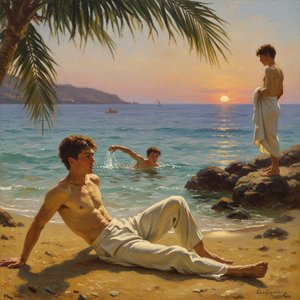
Henry Scott Tuke: Sunlit Masculinity & the Pastoral Ideal in Victorian Painting
Explore the captivating world of Henry Scott Tuke's paintings – a master of British Impressionism renowned for his intimate depictions of youth and sunlit maritime scenes. Discover his legacy & aesthetic influence.
The Refined Aesthetic of Victorian Illustration: A Study in Narrative & Technique
Explore the captivating world of Victorian illustration! Discover Pre-Raphaelite influences, key artists like Rossetti & Stephens, and the era's rich narrative detail. A deep dive for art enthusiasts.

Henry William Pickersgill: Narrative, Reform & the Victorian Domestic Interior
Explore the life & work of Henry William Pickersgill, a leading Victorian portrait artist. Discover his narrative style, realistic depictions of society, and lasting influence on British art history. Fine art reproductions available at OriginalUniqueArt.
Henry Thomas Dawson: Navigating Light, Sea & Sentiment in Victorian Marine Painting
Explore the captivating world of Henry Thomas Dawson (1811-1878), a master of Victorian marine painting. Discover his evocative coastal scenes, landscapes & lasting artistic legacy. Learn about collecting Dawson's work and find reproductions at OriginalUniqueArt.
Henri Matisse' Top 25 Kunstværker: Farvernes Mester & Indretningens Ikoner
Oplev Henri Matisse' 25 mest ikoniske kunstværker – fra Fauvisme til Paper Cutouts. Lær historien bag farvernes mester og find inspiration til din boligindretning med museumskvalitets reproduktioner på OriginalUniqueArt.com.