Contemporary Realism · 1957
Falling Warrior (Henry Moore, 1957)
Henry Moore (1898–1986) har skabt Falling Warrior. Det er fra 1957. Det tilhører Contemporary Realism-bevægelsen. Den er udført i Bronze. Det opbevares på National Museums Liverpool i Liverpool, Storbritannien. Målene er 48 × 147 cm.
- 1957
- Bronze
- 48 × 147 cm
- National Museums Liverpool

 Håndmalet oliemalerie
 Del som kort
 Del
 Faktablad


 Download
 Lignende værker
 Diasshow
 Spørgsmål og svar

 Statistikker
Falling Warrior kort fortalt
- Titel
- Falling Warrior
- Kunstner
- Henry Moore (1898–1986)
- Kunstner født i
- Castleford, Storbritannien
- Dato
- 1957
- Medium
- Bronze
- Dimensioner
- 48 × 147 cm
- Hvor det kan ses
- National Museums Liverpool, Liverpool, Storbritannien
- Bevægelse
- Contemporary Realism
- Periode
- Modern
- Motiv
- bronze sculpture, female figure, reclining pose, minimalism, organic form, tranquility
Hvad forestiller Falling Warrior?
A Symphony of Bronze and Bone: The Essence of Falling Warrior
In the quiet halls of Tate Britain, there exists a moment of profound stillness captured in bronze—a masterpiece that breathes with the weight of history and the lightness of spirit. Henry Moore’s “Falling Warrior,” created between 1956 and 1957, is far more than a mere sculpture; it is a meditation on the very nature of existence. As one approaches this monumental work, the eye is immediately drawn to the fluid, undulating lines that define the female form. The figure lies horizontally, her body a landscape of soft curves and deliberate voids, evoking a sense of both immense strength and heartbreaking vulnerability. It is a piece that does not merely occupy space but commands it, inviting the viewer into a silent dialogue about resilience in the face of inevitable decline.
The brilliance of Moore’s technique lies in his ability to marry the tactile reality of metal with the ethereal quality of movement. Through a masterful process of modeling clay and subsequent bronze casting, Moore achieved a surface texture that feels alive. One can trace the subtle depressions and ridges that mimic the contours of flesh and bone, creating a rhythmic vitality that suggests the figure is caught in a single, breathless moment of transition. His pioneering use of negative space—the intentional piercing of the form—allows light to pass through the sculpture, integrating the surrounding environment into the artwork itself. This interplay of solid mass and hollow void creates a dynamic tension, making the bronze appear deceptively supple, as if the warrior might stir at any moment.
Modernism Rooted in the Earth
To understand the soul of “Falling Warrior,” one must look to the rugged landscapes of Yorkshire, where Henry Moore first learned to see the world. The rolling hills and weathered stones of his youth are echoed in the organic abstractions of this piece. While the sculpture sits firmly within the mid-century movements of Abstract Expressionism and Surrealism, it avoids the coldness often associated with pure abstraction. Instead, Moore utilizes a semi-abstract language to explore deep psychological states. The pose—a female figure with an arm outstretched in what could be interpreted as either defiance or surrender—serves as a universal symbol for the human condition. It captures the duality of our existence: the struggle to remain upright and the eventual, graceful acceptance of our own mortality.
For the discerning collector or interior designer, “Falling Warrior” represents an unparalleled opportunity to introduce a sense of timelessness and intellectual depth into a space. A high-quality reproduction of this work brings with it the prestige of British Modernism and the calming influence of organic form. Whether placed in a sunlit gallery, a sophisticated study, or as a focal point in a contemporary living space, the sculpture’s presence is transformative. It offers more than decoration; it provides a window into a profound aesthetic experience, where the boundaries between the human body and the natural world dissolve into a single, hauntingly beautiful expression of life.
Hvilket museum udstiller Falling Warrior?
National Museums Liverpool
Liverpool, Storbritannien
National Museums Liverpool – En Rejse gennem Tid og Kreativitet Indhyl dig i hjertet af Liverpool, en by der pulserer med historie, industriel stål og en uimodståelig kunstnerisk ånd – her finder du National Museums Liverpool. Det er langt mere end blot et arkiv over artefakter; det er en levende fortælling om Merseyside’s udvikling, en dybdegående fejring af menneskelig kreativitet gennem tiderne. I modsætning til de store, centraliserede museer, der ofte dominerer kunstens landskab i London, blomstrer NML med sin unikke regionale identitet, forankret i det nordvestlige lands robuste ånd og dedikeret til at være tilgængelig for alle.


Højopløselige billeder af Falling Warrior

Protected by copyright: these files are for personal reference, not a licence to republish.
Henry Moore, Falling Warrior (1957), National Museums Liverpool.
Spørgsmål om Falling Warrior besvaret
Hvilket museum udstiller det originale "Falling Warrior"?
Originalen af "Falling Warrior" af Henry Moore opbevares på National Museums Liverpool, Liverpool, Storbritannien. En reproduktion gør det muligt at udstille værket i hjemmet.
Hvornår er "Falling Warrior" af Henry Moore skabt?
"Falling Warrior" af Henry Moore blev skabt i 1957.
Hvilken teknik er brugt til "Falling Warrior" af Henry Moore?
Henry Moore brugte Bronze-teknikken til "Falling Warrior". Teknikken definerer det originale værks materielle karakter.
Hvad er målene på det originale "Falling Warrior" af Henry Moore?
Det originale værk "Falling Warrior" af Henry Moore måler 147 x 48 cm.
Hvad forestiller "Falling Warrior" af Henry Moore?
Motiverne i "Falling Warrior" er bronze sculpture, female figure, reclining pose, minimalism, organic form, tranquility, monumental art.
Er billedet af "Falling Warrior" af Henry Moore frit tilgængeligt i det offentlige domæne?
Ophavsretsstatus for "Falling Warrior" af Henry Moore: værket er stadig beskyttet af ophavsret. Dette afgør, om der frit må foretages reproduktioner af billedet.
Hvem har skabt "Falling Warrior"?
"Falling Warrior" blev skabt af Henry Moore. Informationen på denne side beskriver Henry Moores originale værk.
Hvilken kunstretning tilhører "Falling Warrior" af Henry Moore?
Kunstretningen forbundet med "Falling Warrior" af Henry Moore er Contemporary Realism. Denne klassificering placerer værket blandt relaterede kunstnere og kunstværker.
Hvilken periode i Henry Moores karriere tilhører "Falling Warrior"?
Inden for Henry Moores karriere tilhører "Falling Warrior" perioden Mature Period, hvilket gør det muligt at sammenligne værket med kunstnerens øvrige værker.
Om kunstneren, Henry Moore

1898–1986, Storbritannien
Henry Moore
Henry Moore: En Skulptørs Liv Formet af Former Henry Spencer Moore, født i den Yorkshireanske mineby Castleford i 1898, blev en af det 20. århundredes mest betydningsfulde og internationalt anerkendte skulptører. Hans rejse fra ydmyge begyndelser til global berømmelse er et vidnesbyrd om hans urokkelige dedikation til kunstnerisk udforskning og hans dybe forbindelse til den menneskelige form og den naturlige verden. Henrys far, en autodidakt med en passion for læring, indlod ham i troen på magten af uddannelse, og ledte ham væk fra livet som minerarbejder mod formel skolegang.
Også af Henry Moore
 Reclining Figure
 Sculptural Objects (Cramer 47)
 Sheep 1
 A Miner at Work1942
Essays om Falling Warrior
 Romantic Realism's Finest: 10 Masterpieces for Your Home | OriginalUniqueArtExplore 10 defining masterpieces of Romantic Realism! Discover Courbet, Millet & Daumier's powerful paintings—capturing emotion and social …
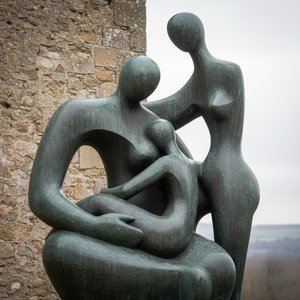 Henry Moore: Sculpting Modernity – Form, Emotion & the Human ConditionExplore the revolutionary sculptures of Henry Moore – abstract forms, reclining figures & powerful expressions of the human condition. Disc…
 Cubistisk Ekspressionisme: 10 Mesterværker der Ændrede Kunsten | OriginalUniqueArtOplev kubismens og ekspressionismens 10 mest ikoniske værker! Dyk ned i Picassos, Braques & Gris' revolutionerende kunst. Find inspiration …