

 Se i fuld skala
 Del
Del Del
Del
 Detaljer

 Download
 Lignende værker
 Røntgenundersøgelse
 Diasshow
 Statistik
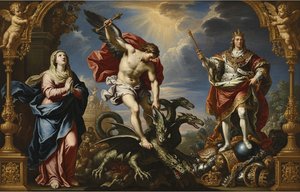
Polyptych Of St Barbara

 Se mere
Håndlavet oliereproduktion
Håndmalet olie på lærred i din valgte størrelse og ramme, udført efter bestilling af vores kunstnere. ( Skift til print Skift til digitalt billede)




































Vælg mellem vores forudindstillede størrelser, der matcher kunstværkets originale proportioner.

Du kan indtaste dine egne mål for at passe til en bestemt ramme eller plads. Hvis den valgte størrelse ikke stemmer overens med det originale billedes proportioner, vil vi enten beskære kunstværket eller udvide maleriet med yderligere håndmalede elementer. En digital skitse sendes til din godkendelse, før produktionen påbegyndes.
Bemærk venligst, at forhåndsvisningen på skærmen ikke afspejler den faktiske beskæring eller udvidelse. Kun skitsen vil nøjagtigt vise den endelige komposition.
Selvom specialmål er mulige, anbefaler vi at vælge en dimension fra den foruddefinerede liste for at bevare de originale proportioner.
Efter bestilling vil OriginalUniqueArt.com team sende en e-mail til kunden for at få instruktioner og levere et udkast til en skitse.
Levering i hele verden () på 3/4 uger i stedet for de standard 5 uger. (18 september). Ingen kompromiser med kvaliteten.

Gratis ekspresforsendelse til hele verden

Lærred af linned i høj kvalitet

Fuld transportforsikring

Garanti for refusion af told og importafgifter

Garanti for præcis farvegengivelse

100 dages returret (kun ved fejl og mangler)

100% Tilfredshedsgaranti

Mængderabat tilgængelig
 Glasmulighed er kun tilgængelig i størrelser under 110 cm

Polyptych Of St Barbara
Reproduktionsmetode
Størrelse på reproduktion
-


Samlet pris
$ 325
Kunstnerens biografi
The Stonecutter’s Legacy: The Life and Art of Giuseppe Torretti
In the heart of the Venetian Baroque, where drama meets devotion, the name Giuseppe Torretti resonates as a master of form and spirit. Born in the quiet surroundings of Asolo around 1664, Torretti did not begin his journey amidst the grand marble halls of academies, but rather through the tactile, gritty reality of a stonemason. This early apprenticeship as a stonecutter provided him with an intimate, almost visceral understanding of his medium. Before he ever sought to capture the divine, he had mastered the weight, texture, and resistance of stone, a foundation that would later allow him to breathe life into cold marble and transform it into vessels of profound religious emotion.
As his talent blossomed, Torretti’s work began to reflect the shifting tides of 18th-century Italian art. While his early endeavors, such as the altar of the Pietà in Udine, whispered of the influence of Arrigo Merengo, he soon transcended these initial stylistic constraints. His evolution was marked by a sophisticated movement toward the classical ideals championed by Pietro Baratta. By traveling to Rome alongside luminaries like Domenico Rossi, Torretti absorbed the essence of the Roman Baroque—a style that masterfully married theatrical grandeur with a disciplined, classical restraint. This synthesis became his hallmark, allowing him to navigate the opulent Venetian landscape with an ability to evoke both awe and quiet contemplation.
A Sculptural Presence in the Venetian Landscape
The true sanctuary of Torretti’s genius lies within the sacred architecture of Venice itself. To walk through the city's historic churches is to encounter his silent, stone witnesses. His sculptures do not merely occupy space; they command it, acting as focal points for spiritual transcendence. In the Basilica di San Giorgio Maggiore and San Giacomo Maggiore, his monumental statues stand as testaments to a mastery of anatomical precision and expressive gesture. He possessed a rare ability to capture the fleeting moment of a miracle—the tension in a saint's muscle, the sorrow in a draped fold of cloth, and the dramatic interplay of light and shadow that defines the Venetian Baroque aesthetic.
His repertoire was as diverse as his influences, ranging from intricate intaglios to massive, commanding figures. Some of his most evocative contributions can be found adorning the facades and interiors of several iconic Venetian sites:
- The Church of San Stae: Where his statues of Saint Sebastian and Saint Oswald serve as sentinel figures, showcasing his ability to integrate sculpture with architectural grandeur.
- Santa Maria Formosa and I Gesuiti: Locations where his religious narratives continue to inspire awe through their realistic portrayal of biblical themes.
- The Manin Chapel in Udine: A display of his skill in high-relief, depicting the poignant scenes from the Life of the Virgin Mary with a delicate, narrative grace.
Enduring Influence and Artistic Heritage
Beyond his individual masterpieces, Torretti’s significance is cemented by the lineage of artistry he helped foster. He established a notable studio that functioned as a crucible for future talent, ensuring that his technical precision and classical sensibilities were passed down through generations. His nephew, Giuseppe Bernardi (often known as il Torretto), continued this legacy, eventually serving as the first teacher to the legendary Neoclassical master, Antonio Canova. This connection links Torretti directly to the dawn of Neoclassicism, illustrating how his Baroque foundations provided the essential groundwork for the next great era of European sculpture.
Giuseppe Torretti passed away in Venice in 1743, leaving behind a city forever transformed by his chisel. His work remains a vital bridge between the exuberant theatricality of the late Baroque and the disciplined elegance of the classical revival. Through his hands, stone was stripped of its inertia and imbued with the eternal, capturing the very essence of faith through the enduring medium of sculpture.

giuseppe torretti
1664 - 1743 , Italy
Kort om kunstneren
- Artistic Movement Or Style: Baroque Sculpture
- Artists Who Influenced This Artist: ['Giovanni Battista Falconetti']
- Date Of Birth: 1664
- Full Name: Giuseppe Torretti
- Nationality: Italian
- Notable Artworks:
- San Eustachio Ed I Suoi Familiari Risparmiati Dal Leone Di Giuseppe Torretti
- Dettaglio Del Crocifisso Di Giuseppe Torretti Nella Chiesa Di San Moise A Venezia
- San Giacomo Giuseppe Torretti Basilica Di San Giorgio Maggiore A Venezia
- Place Of Birth: Treviso, Italy
Relaterede artikler

Barokkens Mestre: Top 10 Kunstværker der Definerede en Æra | OriginalUniqueArt.dk
Oplev barokkens storhed! Dyk ned i 10 ikoniske kunstværker af Caravaggio, Rembrandt & Vermeer. Lær historierne bag mesterværkerne og find inspiration til din indretning med museumskvalitets reproduktioner på OriginalUniqueArt.com

El Grecos 25 Mesterværker: Kunst, Historie og Inspiration til Dit Hjem
Oplev El Grecos 25 mest ikoniske malerier! Fordyb dig i spansk renæssancekunst, spirituelle værker og dramatiske kompositioner. Find inspiration til dit hjem & køb museumskvalitets reproduktioner på OriginalUniqueArt.com.

Theatricality & Triumph: Baroque Drama in Painting & Sculpture
Explore the dramatic world of Baroque art! Discover its history, defining characteristics, & lasting influence on painting & sculpture. Expert insights into Caravaggio, Zurbarán, and Bernini – plus high-quality reproductions at OriginalUniqueArt.

The Dramatic Flourish: Exploring the Baroque Movement's Enduring Legacy in Art History
Explore the dramatic world of Baroque art! Discover iconic artists like Caravaggio & Rubens, defining techniques, and its lasting impact on art history. Expert insights for collectors & enthusiasts at OriginalUniqueArt.
The Dramatic Flourish: Exploring Themes of Power, Faith & Emotion in Baroque Artworks
Explore the dramatic world of Baroque art! Discover masters like Zurbarán & the powerful influence of religious zeal on painting techniques. Expert insights for collectors and enthusiasts.