

 Se i rummet
 Del som kort
 Del
Del
 Detaljer
 Guide
Guide

 Download
 Lignende værker
 Røntgenundersøgelse
 Diasshow
 Q&A
Q&A Statistikker
Untitled (AQQJ9Q)


 Vis mere
Giclée / Kunsttryk
Giclée- eller lærredstryk i museumskvalitet med hurtig produktion og fleksible muligheder for finish. ( Køb håndmalet maleri Skift til digitalt billede)




P118B Dkr10

P118H Dkr10

P118W Dkr10

P438Z Dkr10

P508JH Dkr12

P508YH Dkr12

P805H Dkr10

P805Z Dkr10

P919BZ Dkr10

P919G Dkr10

P919XJ Dkr10

P959ZH Dkr10

P968JZ Dkr12

W106C Dkr8

W218G Dkr10

W218JH Dkr8

W218Y Dkr10

W307PJ Dkr10

W316G Dkr10

W316PJ Dkr8

W316Y Dkr10

W398PJ Dkr8

W4111J Dkr10

W500HY Dkr15

W500JH Dkr15

W692G Dkr12

W849H Dkr8

W940BG Dkr15

W953PJ Dkr8




Vælg mellem vores forudindstillede størrelser, der matcher kunstværkets originale proportioner.

Indtast den bredde og højde, du har brug for, så det passer til din ramme eller din væg. Et print kan kun beskæres, aldrig gøres større end selve billedet, så en størrelse med et andet format vil medføre, at dele af motivet går tabt. Vi sender dig en digital mockup til godkendelse, før vi printer noget. Billedet vist på denne side viser ikke den faktiske beskæring — det er kun mockuppen, der gør.
Verdensomspændende levering () på 2 uger i stedet for de sædvanlige 4/5 uger. (31 oktober)

Gratis ekspresforsendelse til hele verden

Lærred af linned i høj kvalitet

Fuld transportforsikring

Garanti for refusion af told og importafgifter

Garanti for præcis farvegengivelse

100 dages returret ved fabrikationsfejl

100% fuld returret

Mængderabat ved flere køb
 Glasmulighed er kun tilgængelig i størrelser under 110 cm

Untitled (AQQJ9Q)
Giclée / Kunsttryk
Størrelse på reproduktion
-


Samlet pris
Dkr 537
A Quiet Moment in Delft: Gerrit Dou’s “Untitled (AQQJ9Q)”
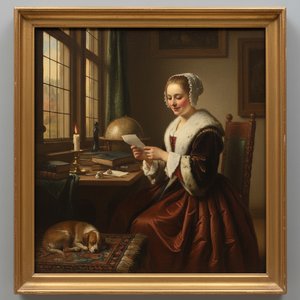
Gerrit Dou's "Untitled (AQQJ9Q)," a captivating work emerging from the heart of the Dutch Golden Age, isn’t merely a depiction of a domestic scene; it’s an invitation into a world of quiet contemplation and subtle grace. Painted around 1650, this small-scale masterpiece exemplifies Dou's signature “fijnschilder” style – a meticulous approach that elevates everyday life to the realm of profound observation. The painting centers on an elderly woman seated at a humble table, bathed in the warm glow of candlelight, seemingly preparing for or reflecting upon a simple meal. It’s a scene brimming with understated dignity and a poignant sense of timelessness, instantly transporting the viewer to a bygone era.
Dou's genius lies not just in his technical skill – though it is undeniably remarkable – but in his ability to imbue ordinary subjects with extraordinary depth. The composition is remarkably tight, drawing our attention immediately to the woman’s face and hands, rendered with an almost photographic realism. A window on the left acts as a portal, offering glimpses of a distant landscape—a subtle reminder of the world beyond this intimate space. Around her, carefully arranged objects – a spinning wheel, a simple pottery bowl holding food, a watchful dog – contribute to a narrative that speaks volumes about rural life and domesticity. The inclusion of these details isn’t haphazard; each element is deliberately placed to enrich the scene's symbolic weight.
The Language of Light and Shadow
Central to understanding Dou’s work is his masterful manipulation of light and shadow, a technique known as *chiaroscuro*. The painting is dominated by a dramatic interplay between illumination and darkness. A single candle, positioned strategically on the table, casts a warm, golden glow upon the woman's face and hands, highlighting their wrinkles and suggesting a lifetime of experience. The surrounding areas remain shrouded in shadow, creating a sense of mystery and intimacy. This contrast isn’t simply aesthetic; it serves to emphasize the woman’s presence and draw our attention to her inner world. The light itself feels almost tangible—a warm embrace that invites us into her quiet moment.
Dou's technique is characterized by layers of translucent glazes, meticulously applied to build up color and texture. He employed a unique method – using a concave lens and convex mirror – to achieve an unparalleled level of detail and accuracy in his rendering of surfaces. The fabric of the woman’s clothing appears soft and slightly wrinkled, while the wooden table and spinning wheel possess a tactile quality that invites us to reach out and touch them. The artist's brushstrokes are visible yet skillfully blended, creating a smooth surface that reflects light with remarkable brilliance. This painstaking attention to detail is what distinguishes Dou’s work from more generalized depictions of genre scenes.
Symbolism and the Essence of Dutch Piety
Beyond its technical brilliance, “Untitled (AQQJ9Q)” resonates with profound symbolic meaning. The woman's posture – seated at a table, hands clasped in prayer or gratitude – speaks to a deep sense of piety and humility. The simple meal she is preparing suggests contentment and an appreciation for the bounty of life. The presence of the dog, often associated with loyalty and companionship, further reinforces this theme of domestic harmony. These elements combine to create a scene that embodies the core values of Dutch society during the Golden Age – faith, family, and hard work.
Furthermore, the painting reflects the broader cultural context of the time, particularly the “paragone” debate—the ongoing discussion about which art form best represented nature: painting, sculpture, or poetry. Dou’s meticulous realism and his ability to capture fleeting moments of human emotion aligned with the pursuit of truth through observation, a central tenet of this artistic discourse. The scene evokes a sense of peace, tranquility, and perhaps even a touch of melancholy—a quiet reflection on the passage of time and the enduring beauty of simple things.
A Timeless Masterpiece
“Untitled (AQQJ9Q)” is more than just a painting; it’s a window into the soul of 17th-century Holland. Gerrit Dou's masterful technique, combined with his profound understanding of human nature and symbolism, has created a work that continues to captivate viewers centuries later. Reproductions of this piece offer an exceptional opportunity to bring this moment of quiet contemplation into your own home, allowing you to experience the enduring beauty and wisdom of one of the Dutch Golden Age’s greatest artists.
Spørgsmål og svar
Hvilken følelse formidler "Untitled (AQQJ9Q)" af Gerrit Dou?
"Untitled (AQQJ9Q)" af Gerrit Dou formidler en Tranquil stemning.
Hvilken teknik er brugt til "Untitled (AQQJ9Q)" af Gerrit Dou?
"Untitled (AQQJ9Q)" er udført i Oil On Canvas.
Hvilken atmosfære formidler "Untitled (AQQJ9Q)"?
"Untitled (AQQJ9Q)" har en Calm atmosfære.
Kunstnerbiografi
Gerrit Dou (1613 – 1675)
Gerrit Dou was one of the most celebrated painters of the Dutch Golden Age until the beginning of the nineteenth century. He trained under Rembrandt van Rijn, whose impact is evident in his early oeuvre. His fame rested on meticulously rendered scenes of everyday life—often depicted within arched stone openings known as ‘niche’ paintings—characterized by an unparalleled mastery of chiaroscuro. This distinctive artistic approach cemented his place among the foremost figures of Leiden’s artistic heritage.Early Life and Training
Gerrit Dou was born in Leiden on April 7, 1613, the youngest son of Marytje Jansdr van Rosenburg and the glazier Douwe Jansz de Vries van Arentsvelt of Harlingen (ca. 1584–ca. 1656). According to Jan Jansz. Orlers, burgomaster of Leiden and author of a city chronicle in 1641, Dou demonstrated “a pleasure and desire toward painting” from a young age. At the tender age of nine, he commenced his artistic education with Bartholomeus Dolendo (ca. 1570–1629), a copper engraver who instilled in him foundational skills in printmaking alongside painting. Subsequently, Dou pursued further training under Pieter Couwenhorn (ca. 1599–1654), a master glass painter, honing his craft and broadening his artistic horizons.Rembrandt’s Influence
Gerrit Dou's formative years coincided with Rembrandt’s residency in Leiden, where he served as Douwe Jansz.’s apprentice until the latter moved to Amsterdam in 1631. During this period, Dou benefited immensely from Rembrandt’s guidance—a relationship that profoundly shaped his artistic style and technique. As Arnold Houbraken recounts, Rembrandt's influence was palpable: “Whoever was surprised ‘that such noble painterly ability had sprouted from the school of Rembrandt’ had forgotten that Rembrandt, too, in his early years ‘had painted meticulously.’” This meticulous attention to detail—a hallmark of Rembrandt’s oeuvre—became a defining characteristic of Dou’s own artistic endeavors.The Leiden Fijnschilders and Artistic Innovation
Gerrit Dou emerged as a pivotal figure within the Leiden *fijnschilderij* school, alongside artists like Frans van Mieris the Elder and Gabriel Metsu. This movement championed an exacting style—characterized by minute detail and polished realism—primarily focused on genre scenes and nocturnal interiors illuminated with dramatic chiaroscuro effects. Dou’s groundbreaking technique of capturing subtle nuances of light—particularly in his iconic candlelit compositions—established him as a pioneer of artistic innovation, influencing generations of painters to come. His work stands apart from its contemporaries due to its profound psychological depth and masterful rendering of atmosphere.Notable Works and Legacy
Gerrit Dou's enduring legacy resides in his captivating paintings—among which “The Astronomer by Candlelight” exemplifies his unparalleled skill in portraying the interplay of light and shadow. These works are housed in prestigious institutions such as The Leiden Collection, New York, where visitors can immerse themselves in the splendor of European art from the sixteenth to eighteenth centuries. Furthermore, Dou’s influence extends beyond Leiden's artistic circles, permeating museums across Europe—including the Mauritshuis in Delft—where his masterpieces continue to inspire awe and admiration. Gerrit Dou remains a cornerstone of Dutch artistic history, celebrated for his unwavering dedication to craftmanship and his contribution to shaping the visual culture of his time.
Gerrit Dou
1613 - 1675 , Nederland
Kort om kunstneren
- Artistic Movement Or Style: Fijnschilder
- Artists Or Movements Influenced By This Artist: ['Frans van Mieris den Ældre']
- Artists Who Influenced This Artist: ['Rembrandt van Rijn']
- Date Of Birth: April 7, 1613
- Full Name: Gerrit Dou
- Nationality: Nederlandsk
- Notable Artworks:
- The Astronomer by Candlelight
- Portrait of an Old Woman
- Place Of Birth: Leiden, Netherlands
Relaterede artikler

Golden Age Reflections: Dutch Baroque Painting & Cultural Innovation
Explore the Dutch Golden Age of painting! Discover key artists like Vermeer & ter Borch, their innovative techniques, and the rich cultural context behind these Baroque masterpieces. Learn about collecting & appreciating this iconic art period.
Gerrit Dou: Intimacy & Light in the Dutch Golden Age
Explore the exquisite world of Gerrit Dou, a master of Dutch Golden Age painting. Discover his intimate genre scenes, signature use of light, and lasting legacy. Learn about collecting Dou's works & their value.

Golden Light & Dutch Skies: The Timeless Magic of Dutch Golden Age Landscapes
Discover the breathtaking beauty of Dutch Golden Age landscapes. Explore the mastery of light, chiaroscuro, and 17th-century realism through an expert art history lens, celebrating the enduring legacy of the Dutch Masters for discerning collectors and art lovers.
Illuminating Realism: Exploring the Dutch Golden Age of Painting (1600-1700)
Explore the Dutch Golden Age of painting (1600-1700) with OriginalUniqueArt. Discover Rembrandt, Vermeer & other masters. Learn about techniques, history & find museum-quality reproductions.

Hollandske Mestre: Top 10 Værker fra Guldalderen – Kunst til Dit Hjem
Oplev de 10 mest ikoniske værker fra den hollandske guldalder! Rembrandt, Vermeer og andre mestre afsløres. Find inspiration til dit hjem & køb museumskvalitets kunsttryk på OriginalUniqueArt.com.


